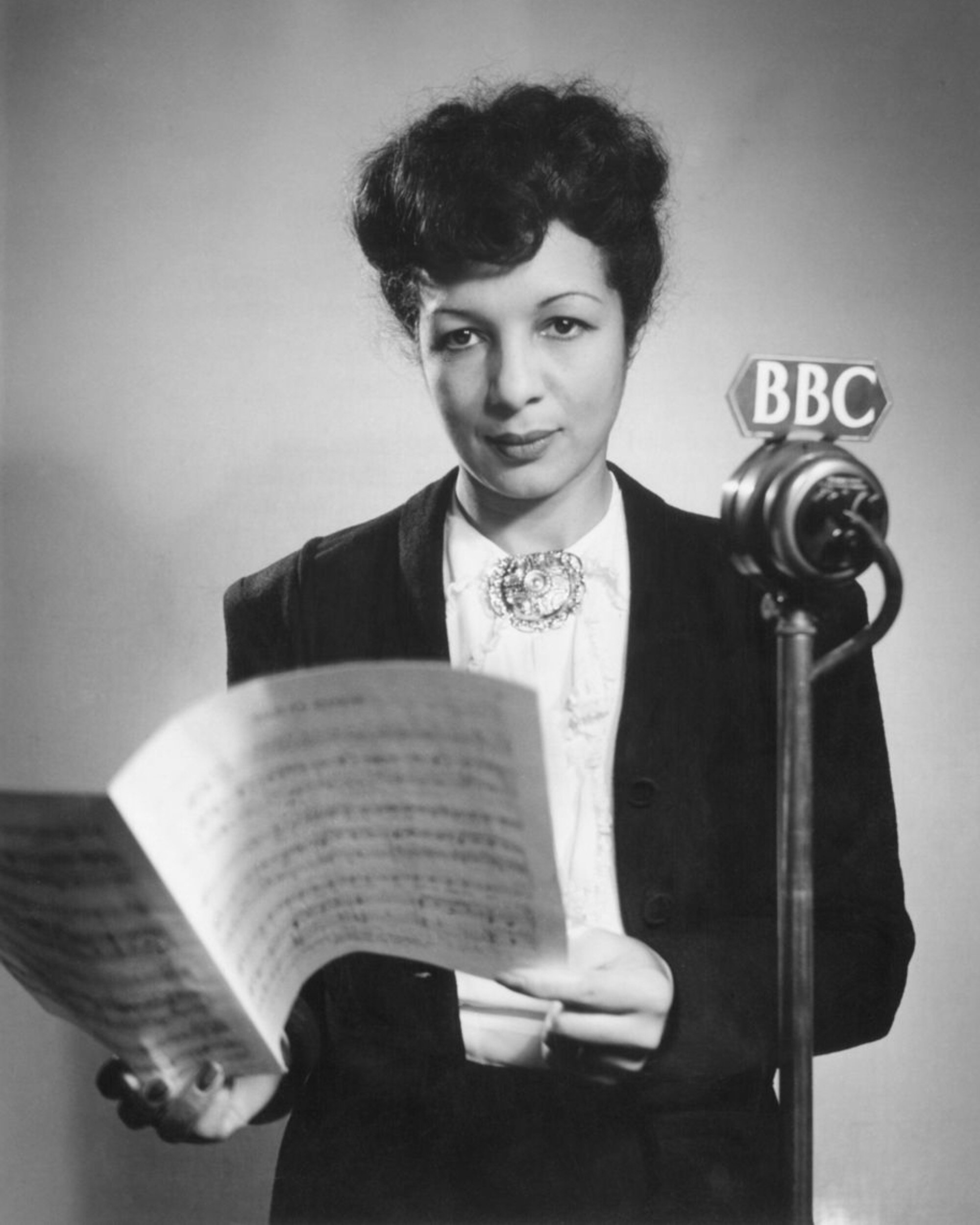
AI-created historical illustration of a fictional singer in a British radio studio around 1940.
Evelyn Dove belongs to the early history of British broadcasting. The National Archives identifies her as the first woman of African heritage to appear on BBC Radio, in 1925. That early date places her within a history of Black British entertainment already developing long before the postwar arrival of the Empire Windrush.1
A London childhood and a musical education
Born in London on 11 January 1902, Dove was the daughter of Francis Dove, a barrister from Sierra Leone, and Augusta, her white British mother. The 1911 census places Evelyn and her mother at Barnard Road in Battersea, in a household that also included a servant. Her middle-class childhood belongs to the history of Black London as well as Britain’s connections with West Africa. The census offers a glimpse of her life before the public career that would take her overseas.1
She trained as a contralto at the Royal Academy of Music and hoped to enter classical music. Yet training did not give her straightforward access to a career. The National Portrait Gallery describes the discrimination she faced as a performer of mixed heritage and her subsequent success in cabaret and touring jazz revues. These experiences shaped the opportunities available to her. They also make it misleading to imagine her musical identity as belonging naturally to one genre: her professional path crossed the boundaries that the industry placed around her.2
Touring, recording and finding a public
Dove’s early working life included the Southern Syncopated Orchestra. Music historian Howard Rye identifies her in its Glasgow engagements in September and October 1921, performing under the name Norma Winchester. She survived the sinking of the SS Rowan and appeared in the subsequent Survivors Sacred Concert. By the following summer she was with the orchestra in Vienna. These details show how quickly her working geography expanded, while the different names in contemporary records help explain why tracing a performer’s career can require more than searching a familiar name.3
Rye’s research also connects her with the Southern Trio, formed in 1925 with singers John Payne and Clinton Rosemond. The group made several broadcasts, documented in BBC files. During the same year, Dove appeared with Chocolate Kiddies in Berlin, Hamburg, Stockholm and Copenhagen. The microphone became another setting in which she worked, alongside the touring engagements that brought her before audiences across Europe.3
Her repertoire reached beyond the dance numbers associated with cabaret. The record label Frémeaux & Associés includes Dove’s performance of the spiritual “Couldn’t Hear Nobody Pray” in its collection The Concert Tradition 1909–1948, dating her recording to 1926. The compilation places her alongside performers including Marian Anderson and Paul Robeson. Its emphasis on the concert interpretation of spirituals offers another way into her career: Black sacred music could be presented through trained voices and arranged for the concert platform. A surviving recording therefore gives listeners an opportunity to encounter a musical performance alongside the photographs through which earlier entertainers are often remembered. The date belongs to the recording, rather than the later compilation that made it available again.4
The international cabaret circuit provided further employment. Dove performed in Europe and succeeded Josephine Baker as the attraction in a revue at the Casino de Paris. In 1937 she appeared at the Harbour Bar in Bombay, now Mumbai. Stephen Bourne’s research draws on an Evening News of India review that presented her as an established international artist and compared her with Baker. Such comparisons show how publicity presented one performer through another already famous name. They should also prompt us to look for Dove’s own career, training and working relationships within that publicity.5
A portrait by Carl Van Vechten preserves another aspect of that professional presence. The Library of Congress dates its photograph of Dove to 27 December 1935 and describes her holding a fan against a patterned background. The catalogue preserves the connection between the image, its subject and its maker. Those details allow the portrait to be placed within a working life. Dove’s visual presentation belongs to the history of entertainment alongside the titles of her broadcasts and stage productions.6
A voice for radio, then television
The Second World War brought a stronger focus on British work. Her radio series Sweet and Lovely began in 1939, followed by Rhapsody in Black with Elisabeth Welch in 1940. These named programmes show an established professional presence: Dove was contributing to the shape of musical broadcasting, alongside other Black performers.1
A particularly important partnership was with the Trinidadian folk singer Edric Connor. They appeared together in Serenade in Sepia during the mid-1940s, and the programme’s success led to a television version at Alexandra Palace. For Dove, this meant carrying a musical partnership from sound broadcasting into a medium in which the performers could also be seen. The collaboration joins her story to Connor’s, demonstrating how careers were sustained through shared work. It also places Black performers within the development of early British television, making music for audiences during the years when the medium was establishing its place in domestic entertainment.7
The stage remained part of the story
Radio and television did not replace theatre. In 1948 Dove appeared in Calypso, a production devised, directed and designed by Hedley Briggs. The University of Birmingham’s theatre collection records its performances at Wimbledon and the Playhouse Theatre in London, with a cast that included Connor and the dancer Mabel Lee. Ronnie Hill supplied music and lyrics, with additional contributions from other writers. A Chris Ware photograph also records Dove in the Playhouse production that May; its Hulton Archive caption identifies a predominantly West Indian cast. Song, dance and theatrical design came together in the production. The familiar broadcasting partnership of Dove and Connor thus also belonged to a larger company of performers and creative workers making entertainment for the stage.8, 9
Her career was also uneven. After further cabaret work abroad, she encountered difficulty finding employment in London. In 1951 she understudied Muriel Smith as Bloody Mary in South Pacific at the Theatre Royal, Drury Lane. This was work requiring preparation for a substantial role, although it carried different visibility from being the principal performer. Television later offered another opportunity: in 1956 Dove played the mother of Eartha Kitt’s character in Mrs Patterson. Her experience encompassed acting as well as singing, even when professional recognition did not produce steady employment.7
In 1958 she appeared in the West End production of Langston Hughes’s musical Simply Heavenly at the Adelphi Theatre. Theatre historian Sarah K. Whitfield places this appearance within a much broader British and Irish stage career. The production’s casting record identifies Dove as Mrs Caddy, landlady to Joyce Lane, played by Marpessa Dawn. Melvin Stewart played Jesse B. Simple, and the company also included Earl Cameron and Bertice Reading. Dove’s credit gives a specific role to the familiar face. Alongside the touring revues and musical broadcasts, she was working within a company to bring a dramatic character to the stage.10, 15
Working within Black theatre
Dove also joined the Negro Theatre Workshop, the organisation associated with Edric and Pearl Connor. Bourne records her appearance in its production of The Dark Disciples, a blues interpretation of the St Luke Passion, during the 1960s. This work brought music and drama together through a biblical story. It also connected an experienced performer from the interwar entertainment world with a developing Black theatre organisation, extending relationships formed during her broadcasting career into another setting.5
The Workshop’s archive, held by the George Padmore Institute, explains the purpose of that organisation. Established in 1961, it sought opportunities for Black writers, performers and technicians to develop and present work. Professional and amateur artists participated, with performances in community centres, churches, town halls and theatres. Pearl Connor’s administrative work and connections were central. Rehearsals took place at the Africa Centre with free use of its facilities, and churches also offered space without charge. The company struggled with inadequate funding and the absence of a permanent home. This was a practical effort to create opportunities: experienced performers and newer colleagues needed rehearsal space, organisational support and places in which their work could reach an audience.11
Recovering a career
Evelyn Dove died at Horton Hospital in Epsom on 7 March 1987, aged 85.3
Later acts of remembrance have approached her career through both music and images. In 2007 she was included in Sonia Boyce’s Devotional exhibition at the National Portrait Gallery. The project grew from conversations in which members of the public named Black British women singers, creating an expanding record of musical memory. The exhibition brought photographs of eighteen singers into an installation made with drawing materials. Placing Dove among those performers connected generations without suggesting that every career followed the same path. It also made remembrance participatory: the question of which artists people could name became part of the artwork, and a way of considering whose contributions remained visible.12
Google marked her birthday on 11 January 2019 with a Doodle. That brief intervention introduced her name through a familiar digital setting, presenting singing, musicianship and acting as parts of the same life. Such tributes can create a starting point for curiosity. Their value grows when the encounter leads further: towards recordings, named productions and historical research that allow the person behind the commemorative image to emerge in greater detail.13
A more permanent marker followed in September 2023, when a blue plaque was unveiled at her former home in Barnard Road, Battersea. Sony Music UK’s Social Justice Fund supported the plaque in partnership with the Nubian Jak Community Trust. It placed recognition within the London streets connected to her life. A career associated with international travel could therefore also be remembered locally, through a building that people pass in the course of an ordinary day. The connection between a home address and a public career helps return an entertainer to the social history of the place from which she came.14
Dove’s story asks us to hold that range of work together. Cabaret, radio, television and theatre were settings in which she made a living and practised her craft. Remembering the work gives substance to the honour: a performer’s contribution becomes clearer when we can name what she did.14
Sources and further reading
1. The National Archives: The story of Evelyn Dove.
2. National Portrait Gallery: Evelyn Mary Dove, by Macari, 1931: collection record and display label.
3. Black Music Research Journal / University of Illinois Press: Howard Rye, Southern Syncopated Orchestra: The Roster (2010), especially Evelyn Dove and John Payne entries.
4. Frémeaux & Associés: Negro Spirituals: The Concert Tradition 1909–1948, FA168, track listing.
5. Women’s History Network: Stephen Bourne, Spirit of a Dove: The Life of Evelyn Dove.
6. Library of Congress: Portrait of Evelyn Dove, Carl Van Vechten, 27 December 1935.
7. National Portrait Gallery: Evelyn Dove (1902–1987), Devotional exhibition biography.
8. University of Birmingham, Cadbury Research Library: Calypso by Hedley Briggs, 1948: Theatre Collection, MS38/2142.
9. Hulton Archive / Getty Images: Calypso, Playhouse Theatre, London: Evelyn Dove photographed by Chris Ware, May 1948.
10. Black History of British Musical Theatre: Sarah K. Whitfield, Evelyn Dove.
11. George Padmore Institute: Negro Theatre Workshop, 1962–1967: archive collection description.
12. National Portrait Gallery: Sonia Boyce: Devotional, 16 June–25 November 2007.
13. Google Doodles: Evelyn Dove’s 117th Birthday, 11 January 2019.
14. Sony Music UK: London Blue Plaque Honours Groundbreaking Star Evelyn Dove, 4 October 2023.
15. Ovrtur: Database of Musical Theatre History: Simply Heavenly: London production, 1958, original cast credits.