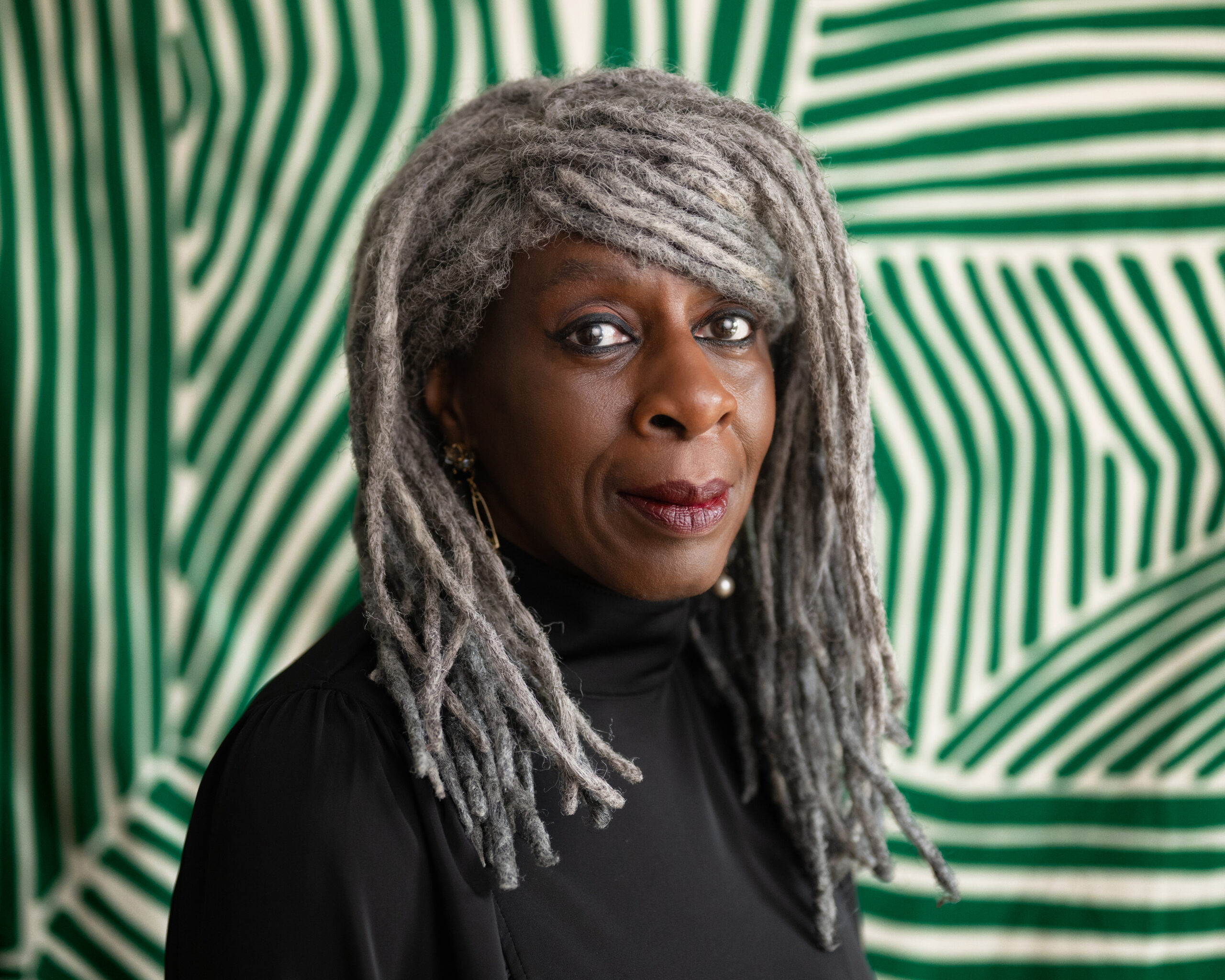
In a 2021 essay for the arts organisation Autograph, Lola Young described preparing to read the records of her childhood in care. Responding to photographs and films by Sonal Kantaria, she wrote about walking, the city and the countryside as places in which difficult memories could be approached. The commission brought art into contact with a personal archive. It also offered a way into Young’s wider work: an interest in the distance between a person’s experience and the account an institution keeps of their life.1
Childhood, performance and a return to study
Born in Kensington, London, in 1951, Young entered foster care at eight weeks old. Her parents had come from Nigeria. She grew up with a white foster mother in north London; after her foster mother’s death when she was about fourteen, she lived in children’s homes. That upbringing informed her discussion of care and belonging.2, 3, 4
She trained at the New College of Speech and Drama, receiving a diploma in dramatic art in 1975. Work for young audiences included Play School and the television comedy Metal Mickey, in which she played the neighbour Janey. She also worked at Haringey Arts Council. Performance and the organisation of cultural activity both became part of her working life.2
Before acting, she worked for the North Thames Gas Board and in residential social work, supporting children when her own experience of care was still recent. In her conversation with the Lord Speaker in 2024, Young described returning to education as a mature student with a child. A part-time degree at Middlesex led to doctoral research and teaching. She also traced her advocacy to Equity, the actors’ union, where she joined other Black and South Asian performers in discussions about representation. Those encounters led towards Arts Council committee work. Her account connects professional experience with collective action: asking who received opportunities became part of understanding the industry in which she worked.3
Looking closely at British cinema
Her book Fear of the Dark: ‘Race’, Gender and Sexuality in the Cinema examined the portrayal of Black people, with particular attention to Black female sexuality. Films including Sapphire, Black Joy, Playing Away and Mona Lisa became material for an argument about how racial ideas operate within stories. The questions went beyond counting appearances on screen. A character can be visible while still being confined by familiar assumptions about desire, family, danger or belonging. Young placed films in their historical and social settings and asked how gender and race worked together in their representation. The book also questioned how far Black filmmakers had challenged inherited stereotypes, bringing the same critical attention to different kinds of filmmaking. Her attention to imperial culture and interracial relationships connected screen images with inherited ideas about national identity, authority and the boundaries of social acceptance.5
That scholarly work developed alongside efforts to preserve the materials from which cultural histories can be written. Future Histories records Young’s support for establishing space for Black theatre archives at Middlesex University’s Bounds Green campus in 2001. Its collection also preserves evidence of a Black History Month event she organised the previous year. An archive gives programmes, records and other traces of performance a life beyond the original occasion. Supporting such work helped make Black British theatre available as a subject for later research, teaching and public memory.6
Working within cultural institutions
Young became Professor of Cultural Studies at Middlesex and later served as Head of Culture at the Greater London Authority. Her public appointments included the National Theatre and the National Archives. An OBE in 2001 recognised her services to Black British history. These roles placed cultural work within institutions responsible for policy, resources and the preservation of records, extending questions raised through performance and scholarship into administration.2, 7
She entered the House of Lords in 2004 as Baroness Young of Hornsey, sitting on the independent Crossbenches. Her parliamentary service has included the European Union Committee, the committee examining the draft House of Lords Reform Bill, and the Sexual Violence in Conflict Committee. She also served on the COVID-19 Committee between 2020 and 2022. This committee work placed her alongside colleagues examining evidence across subjects wider than the arts. It involved the less visible part of parliamentary life: sustained investigation, questions to witnesses and the preparation of recommendations, as well as contributions in the chamber.8
The Young Review and the meaning of rehabilitation
The Young Review, published in 2014, examined the experiences of young Black and Muslim men in the criminal justice system, particularly those aged eighteen to twenty-four. Young chaired the review and edited its final report; Jess Mullen of Clinks was its author, with contributions from colleagues at Clinks and the Black Training and Enterprise Group. The project combined existing research with discussions involving prisoners, former prisoners, service providers and others. That method gave people subject to the system a role in explaining how it operated.9
Its findings connected negative stereotypes with decisions and relationships inside prisons, and with the difficulty of rebuilding a life after release. Recommendations emphasised understanding individuals, involving community and faith organisations, and including service users in the design of support. For Young, fairness and rehabilitation belonged within the same discussion. Her foreword argued that a system which ignored racism and cultural context could obstruct the changes it said it wanted people to make. The review asked institutions to examine their practices alongside the behaviour of those they supervised.9
Fashion, labour and the responsibilities behind a product
Fashion provided another setting in which cultural interests met questions of power. Young helped establish parliamentary groups concerned with ethics and sustainability in fashion, and with sport, modern slavery and human rights. Fashion Roundtable’s account of an inaugural fashion-group meeting in February 2020 describes work with Young, Hubbub and the Centre for Sustainable Fashion. The subjects brought into that parliamentary conversation included education, the environment, business and international trade. Clothing could be considered through the systems that produce and sell it, alongside its creative and personal meanings.10, 11
Giving evidence to the House of Lords committee reviewing the Modern Slavery Act in March 2024, Young described how cancelled contracts and disrupted production during the pandemic had affected garment manufacturers. She connected economic insecurity, movement in search of work and exposure to exploitation. Her emphasis was on relationships along a supply chain: decisions taken by powerful purchasers could change the circumstances of workers far away. She also stressed that the issue extended across commercial sectors and public bodies, making it a question about everyday procurement.12
In the same evidence session, she argued that reporting requirements needed to lead to stronger action. A company’s statement about modern slavery, in her view, was an inadequate endpoint if business practices remained unchanged. She supported mandatory human rights due diligence: requiring organisations to investigate risks and take responsibility for addressing them. This approach brought her campaigning to a practical question about accountability. Information mattered, but so did the obligations placed on those who possessed the power to act on it.12
On 17 June 2026, she introduced a bill proposing a duty on commercial organisations and public authorities to prevent human rights and environmental harms. Its scope included their own operations, subsidiaries and wider value chains, with provisions for enforcement and access to justice. The parliamentary record identifies this as a private member’s bill, a proposal requiring further legislative consideration. It illustrates the form her campaign took: moving from concern about exploitation towards a defined responsibility to identify, prevent and respond to harm within the organisation of economic activity.13, 14
Universities, books and public access to culture
Young became Chancellor of the University of Nottingham with effect from 6 February 2020. She had already accepted an honorary professorship linked to its Rights Lab and School of Politics and International Relations in 2018, followed by an honorary doctorate in 2019. The university described her work advising research with possible policy applications and leading public engagement activity. That connection brought academic investigation and parliamentary experience into contact. It also continued a relationship with education that had begun through her own return to study and developed through teaching, cultural research and institutional leadership.15
Literary work remained part of that public life. In 2017 she chaired the Man Booker Prize judging panel, which selected George Saunders’s Lincoln in the Bardo as its winner. Her fellow judges included writers, a critic and an artist, bringing different reading experiences to the discussion. Chairing a literary jury requires attention to individual works and to the reasons readers give for their judgements. Here, the cultural critic’s work took another form, helping organise a conversation about the possibilities of fiction.16
In July 2018, her appointment as co-chair of the Foundation for Future London, alongside Sir David Bell, was announced. The charity sought to connect the developing East Bank cultural and education district at Queen Elizabeth Olympic Park with nearby communities and organisations. Its work involved relationships between major institutions, local arts activity and philanthropic support. For Young, this offered another setting in which questions about access could be addressed through the organisation of cultural life: how resources, programmes and partnerships might reach people living around a major development.17
Care, memory and who gets to shape the record
Her memoir Eight Weeks, first published in 2024, returned directly to childhood. It brought together care records, remembered experience and imaginative reconstruction where parts of the story were missing. That combination makes the book an inquiry into memory as well as a life narrative. An official document can preserve a date or decision while leaving the person concerned with unanswered questions. In revisiting those papers, Young explored what it meant to recover an account of herself from records originally created by adults responsible for her care.4
In June 2025, she led the launch at Toynbee Hall of the Foundation for Future London’s Co-Creating Meaningful Change with Care Leavers programme. The foundation described an approach in which care-experienced young people would identify priorities, develop peer networks and help shape responses. Its plans included leadership development and support for peer advocates. The programme connected personal experience with a specific model of public work: involving people in decisions about the services and opportunities intended for them, while recognising the knowledge they bring from living through the system.18
Young’s Autograph essay ends with the writer finding a setting in which she can open her files and attend to them. The action is quiet, but it gives a different scale to a career often described through titles and appointments. Alongside public roles is the work of deciding how to understand a life. Her writing allows uncertainty and feeling into that process. It asks readers to recognise that an institutional record is one account of a person, and that the person may still have much more to say.1
Sources and further reading
1. Autograph (original essay by Lola Young, 27 May 2021): City, Country, City.
2. Black History Month UK (Ava Harrison, 12 October 2023): Lola Young, Baroness Young of Hornsey: A Multifaceted Leader.
3. UK Parliament (interview transcript, 17 April 2024): Baroness Young of Hornsey: Lord Speaker’s Corner.
4. Penguin Random House UK: Eight Weeks: Looking Back, Moving Forwards, Defying the Odds.
5. Routledge: Fear of the Dark: ‘Race’, Gender and Sexuality in the Cinema.
6. Future Histories (Middlesex University archive material): Archive centre at Middlesex University.
7. UK Parliament: Experience for Baroness Young of Hornsey.
8. UK Parliament: Parliamentary career for Baroness Young of Hornsey.
9. Clinks and the Black Training and Enterprise Group, 2014: The Young Review: Improving outcomes for young black and/or Muslim men in the Criminal Justice System — final report.
10. Onassis Foundation: Lola Young, Baroness Young of Hornsey.
11. Fashion Roundtable (Tamara Cincik, 25 February 2020): Today’s inaugural meeting of the All Party Parliamentary Group for Ethics and Sustainability in Fashion.
12. House of Lords, UK Parliament: Modern Slavery Act 2015 Committee: corrected oral evidence, 18 March 2024.
13. Hansard, UK Parliament: Commercial Organisations and Public Authorities Duty (Human Rights and Environment) Bill [HL]: first reading, 17 June 2026.
14. UK Parliament: Commercial Organisations and Public Authorities Duty (Human Rights and Environment) Bill [HL], 2026–27.
15. University of Nottingham: Chancellor: Baroness Young of Hornsey OBE.
16. The Booker Prize Foundation: The Man Booker Prize 2017.
17. Queen Elizabeth Olympic Park / London Legacy Development Corporation, 23 July 2018: Co-Chairs of Foundation for FutureLondon appointed.
18. Foundation for Future London: Co-Creating Meaningful Change with Care Leavers.