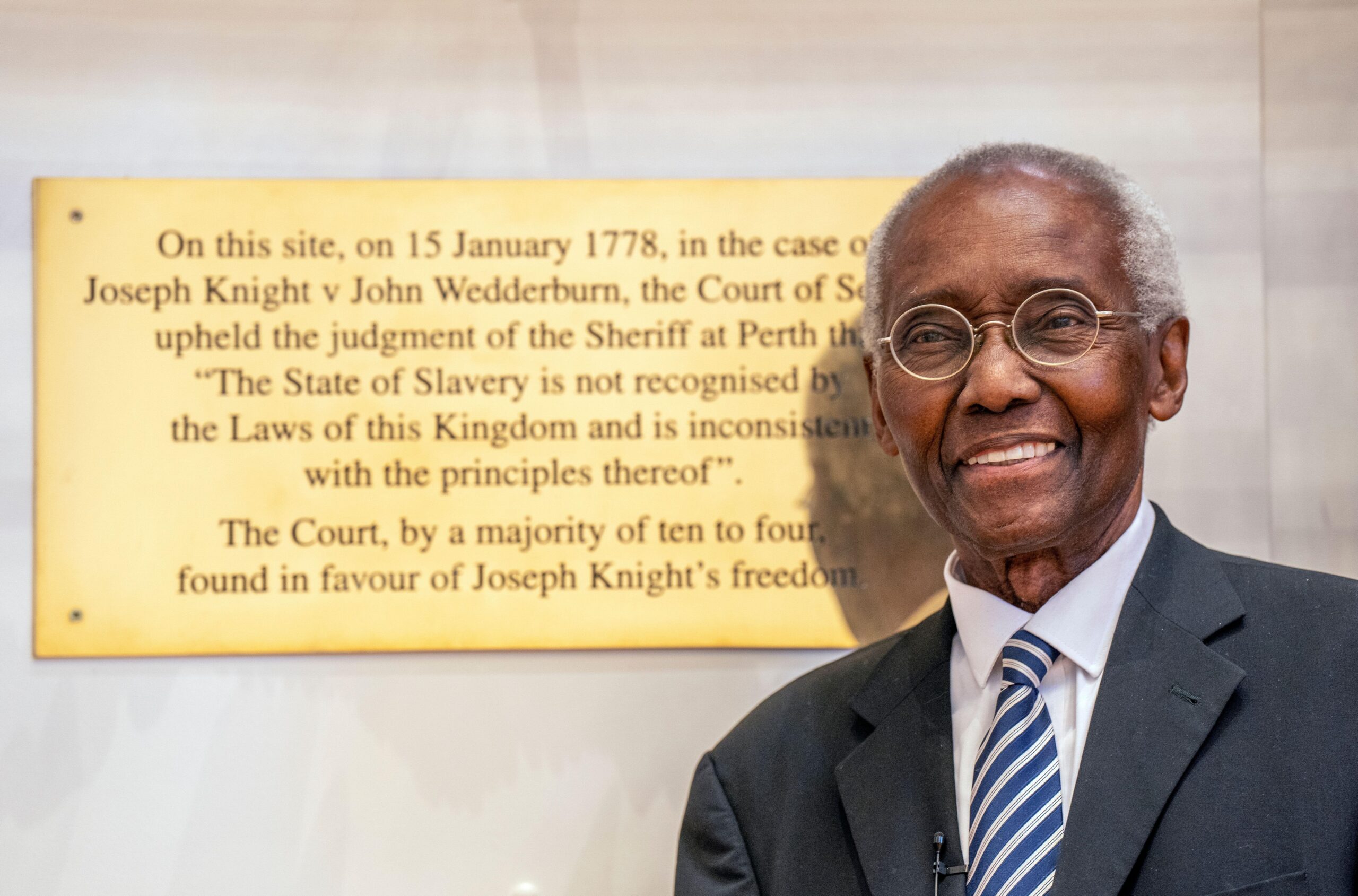
Sir Geoff Palmer became Scotland’s first Black professor in 1989, after building a career in grain science. He became equally identified with questions about race and public memory, particularly Scotland’s connections with Atlantic slavery. His career brought the laboratory, the lecture theatre and the debate over a capital city’s monuments unusually close together.1
A childhood divided by migration
Born in St Elizabeth, Jamaica, on 9 April 1940, Palmer moved to Britain in 1955, aged fourteen. His mother had travelled ahead of him. Like many children within the Windrush generation, he experienced migration through separation and reunion within a family.2, 3
In his account for Black History Month, Palmer remembered his mother struggling to earn a living as a dressmaker. After his father left for America, she took her children to relatives in Allman Town, Kingston. In London she worked in factories and saved for his passage. These details place her labour at the centre of his education: the journey required money, years of waiting and continuing sacrifices after they were reunited.3
Palmer recalled being classified as ‘educationally subnormal’ and sent to Shelburne Road Secondary Modern School. Cricket helped secure his transfer to Highbury Grammar School. He shared his paper-round earnings with his mother and used Islington Library to study and keep warm. His recollections expose how a school’s judgement could misread a newcomer’s ability, while housing, income and access to a quiet place to work shaped his opportunities.3
Finding a route into science
Speaking to Benjamin Zephaniah for the Open University, Palmer described studying at a polytechnic while holding a full-time job and sharing one room with his mother. By 1961 he had accumulated four A-levels and eight O-levels. He rejected the idea that he had always known he would become a scientist. His explanation made room for chance, assistance and practical decisions, alongside the work needed to gain qualifications.4
He studied botany at the University of Leicester, graduating in 1964. There he also met Margaret, his future wife. Leicester remained part of his life long afterwards: the university awarded him an honorary doctorate in 2016 and named student accommodation after him in 2022. Those later acknowledgements returned his story to a place where he had first studied plants as a university student.5
Palmer’s next opportunity was doctoral research with Anna Macleod. He later recalled applying after seeing an advertisement, without an established ambition to specialise in cereals. His doctorate, completed in 1967, was undertaken jointly through Heriot-Watt College and the University of Edinburgh. The project gave him a sustained problem to investigate: the processes within a germinating grain.2, 6
From 1968 to 1977 he worked at the Brewing Research Foundation in Surrey. There he developed the practical application of his doctoral research and used scanning electron microscopy to examine cereal grains. It was industrial science, concerned with improving a manufacturing process through careful investigation of biological structures.2
What barley abrasion changed
His 1969 paper described barley lightly abraded at the end away from the embryo. After treatment with gibberellic acid, a plant hormone, these grains produced more of the starch-degrading enzyme alpha-amylase than controls. The malt looked similar but yielded more material in hot-water extraction. A small physical intervention had produced measurable changes inside the grain.7
The patent explains the underlying problem. In malting, water starts germination and enzymes modify the grain’s food store, the endosperm. A surrounding layer of cells, the aleurone, produces important enzymes when stimulated by growth hormones. The intact outer coverings restricted the access of externally applied gibberellic acid. Selective abrasion opened a route at the far end, allowing more of those cells to respond and modification to proceed faster.8
Control was essential: excessive damage could harm the embryo or strip away useful husk. Palmer’s treatment preserved their functions while changing access to tissue underneath. The patent records British priority in June 1969 and a United States grant in August 1973. It improved the production of malt, which supplies later brewing operations.8
Research that travelled beyond one crop
Palmer also investigated sorghum. A 1989 review written with O. U. Etokakpan and M. A. Igyor considered which varieties could serve as brewing materials and how their processing should be assessed. The authors recognised that sorghum was a food crop: brewing required sufficient supplies and efficient use of processing by-products. Their discussion connected laboratory performance with agriculture and the wider use of the harvest.9
They also insisted that economics could not be separated from the quality of the drink. A cheaper ingredient would be of limited value if the finished product was unacceptable. This was a practical research agenda, requiring attention to different varieties and the enzymes needed to process them. It shows Palmer working with colleagues on the specific properties of another cereal, rather than assuming that methods developed for barley could simply be transferred unchanged.9
He returned to Heriot-Watt as a lecturer in 1977 and became a professor in 1989. His work also helped secure the future of brewing education there. Recalling concern that the subject might be closed, he described approaching Ronnie Martin of the Distillers Company and preparing a case for support. Martin took it to the Scotch Whisky Association, which, Palmer said, supplied £1 million towards developing the International Centre for Brewing and Distilling. He retired from his teaching post in 2005.6, 10
Recognition from his professional peers included the American Society of Brewing Chemists’ Award of Distinction in 1998. The society defines this as recognition of exceptional lifetime achievement in brewing science. It acknowledged sustained work within a technical profession, offering another way to understand his standing alongside the later public honours.11, 16
Education and everyday equality
Professional success did not remove Palmer’s memory of exclusion. In the Open University interview he recalled being told, while seeking postgraduate opportunities, that he should return to where he came from and plant bananas. His response to Zephaniah’s question about encouraging young people centred on reasoning: education could help a person defend themselves. Learning was therefore connected to independence and the ability to answer those who presumed to define someone else’s limits.4
That concern also took a local, organisational form. Palmer became a trustee of Penicuik Citizens Advice Bureau in 2004. In December 2021 the bureau named its building Palmer House, recognising the time and expertise he had contributed. Advice work provides a different measure of public service from a university title. His relationship with the bureau involved supporting a community organisation over years, alongside the more visible speeches, honours and debates associated with his name.12
Reading the history around Scotland’s monuments
In an essay published by Edinburgh and Lothians Regional Equality Council, Palmer explained why historical plaques mattered to him. They could place the labour and suffering of enslaved people beside monuments that had previously celebrated powerful individuals. He treated public space as a place of education, where a familiar building or statue could prompt questions about how wealth was acquired and whose experiences had been omitted from its story.13
Henry Dundas’s monument in Edinburgh’s St Andrew Square became a focus of this work. Palmer argued that Dundas had helped delay abolition of the Atlantic slave trade and should be remembered in that context. His essay presented the new wording as an intervention in historical interpretation. The statue remained, but the account offered beneath it changed. For Palmer, confronting the consequences of the past meant making those connections visible to people in the present.13
The work extended beyond one monument. Palmer chaired the independent Edinburgh Slavery and Colonialism Legacy Review Group from December 2020 to July 2022. Its ten recommendations addressed civic acknowledgement, education, interpretation and future oversight. The council’s Policy and Sustainability Committee endorsed the report on 30 August 2022. This gave the discussion an institutional form, with proposals that could be considered, resourced and monitored rather than left as statements of concern.14
A concrete outcome followed on 27 October 2022, when the Lord Provost issued an apology on behalf of Edinburgh for the city’s role in sustaining slavery and colonialism. The recommendations also provided for an independent group to oversee implementation and report on progress. These measures reveal the scale of Palmer’s aim: historical acknowledgement was to enter the continuing responsibilities of local government, education and cultural institutions.14
A life recorded in institutions and relationships
Palmer was formally installed as Heriot-Watt’s chancellor on 15 October 2021. The role included presiding over graduations, overseeing academic and honorary awards, and representing the university at ceremonial occasions. At his installation he emphasised its international community and the quality of students’ education. He was returning to an institution he had served for decades, now helping represent it publicly across its different campuses and communities.10
His place within the Windrush generation received another form of recognition in 2023. Derek Fordjour painted him for the ten portraits commissioned by King Charles III, shown in Edinburgh and London. The project included people who had arrived from the Caribbean in different years. Palmer’s inclusion connected scientific and civic achievement in Scotland with the wider history of migration and the lives built after arrival.15
A different portrait preserved his speaking voice. Graham Fagen’s 2023 video, commissioned by the Scottish National Portrait Gallery, presented Palmer recounting his life, with sections accompanied by Nyabinghi drumming and vocals from Ghetto Priest, produced by Adrian Sherwood. The work allowed his account to unfold through speech and music, giving visitors time with a person whose public identity could otherwise be compressed into a list of achievements.16
Knighted in 2014 for services to human rights, science and charity, he joined the Order of the Thistle in 2024. Palmer died on 11 June 2025, aged eighty-five, while still serving as Heriot-Watt’s chancellor.2
Reach Society, which he had supported as a patron for approximately ten years, created an award bearing his name in 2025. Its first recipient was Professor Kevin Fenton. The society described the award as recognising a substantial contribution to society, continuing its association with Palmer’s commitment to young people’s potential and social justice. His name would therefore remain attached to work being done by others.17
Asked about his legacy in 2020, Palmer spoke of his children, grandchildren, students, friends and the people who had helped him. His answer acknowledged relationships and mutual dependence. It offers a fitting way to read a career in which passing knowledge on mattered alongside discovering it.6
Sources and further reading
1. Nature: My pivot from grain scientist to slave-trade historian.
2. Heriot-Watt University: Death of University Chancellor Professor Emeritus Sir Geoff Palmer KT OBE.
3. Black History Month: My Mother, Jamaica, Windrush and Me — by Professor Sir Geoff Palmer.
4. The Open University, OpenLearn: The Z Files: Professor Geoff Palmer — interview transcript.
5. University of Leicester: Professor Sir Geoff Palmer — obituary.
6. Whisky Magazine: A spirited life: Sir Geoff Palmer — interview by Mark Jennings, 17 July 2020.
7. Journal of the Institute of Brewing / Wiley: G. H. Palmer, Increased endosperm modification of abraded barley grain after gibberellic acid treatment (1969).
8. United States Patent Office, reproduced by Google Patents: Godfrey Henry Oliver Palmer, Malting process — US patent 3754929A.
9. MIRCEN Journal of Applied Microbiology and Biotechnology; abstract in Heriot-Watt Research Portal: G. H. Palmer, O. U. Etokakpan and M. A. Igyor, Sorghum as brewing material (1989).
10. Heriot-Watt University: ‘Proud memory’ for Heriot-Watt’s new Chancellor.
11. American Society of Brewing Chemists: Award of Distinction — award criteria and past recipients.
12. Penicuik Citizens Advice Bureau: Naming of Palmer House, 10 December 2021.
13. Edinburgh and Lothians Regional Equality Council: An original piece by Professor Sir Geoff Palmer OBE on ‘Plaques’, 30 May 2023.
14. City of Edinburgh Council: Slavery and colonialism in Edinburgh — recommendations from the review.
15. The Royal Family: Windrush: Portraits of a Pioneering Generation.
16. Matt’s Gallery: Graham Fagen: A Portrait of Sir Geoff Palmer (2023).
17. Reach Society: Sir Geoff Palmer Award 2025.