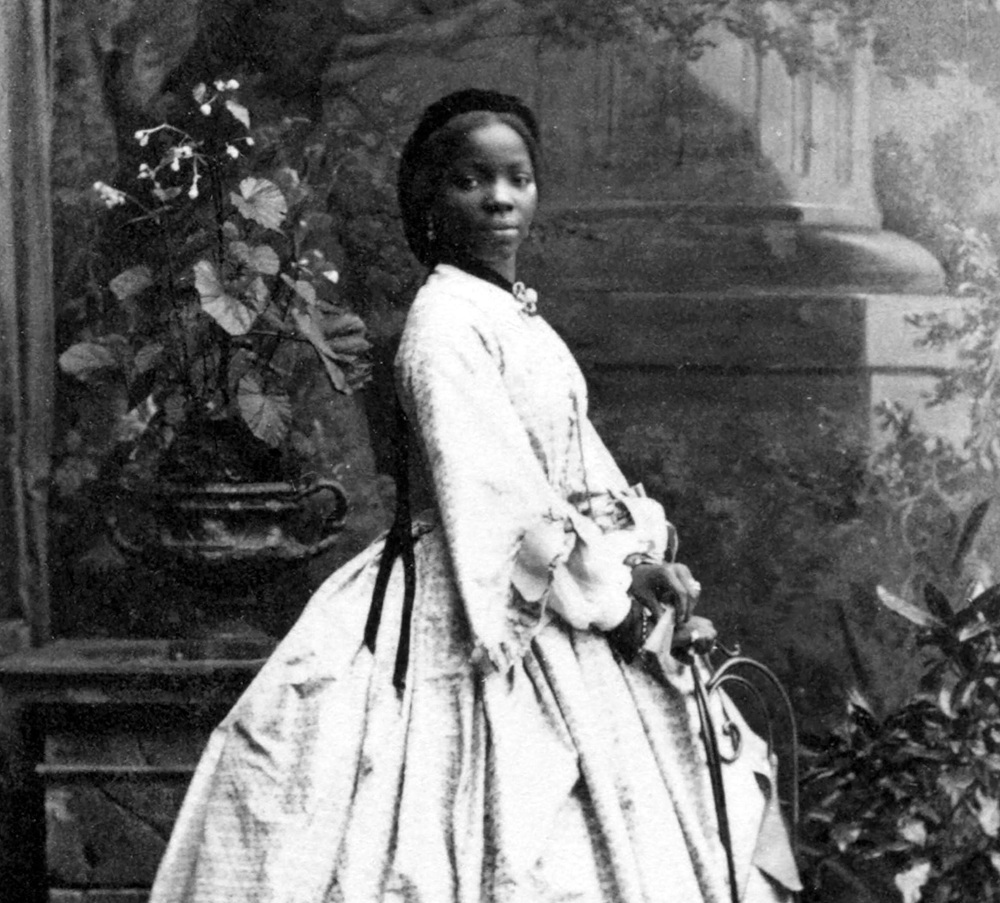
Sarah Forbes Bonetta’s life began in Òkè-Òdàn in West Africa. Photographs, letters, a travel diary and royal records trace her later journeys between Africa and Britain. They follow a child displaced by violence who grew into a woman with family responsibilities, religious commitments and opinions of her own.1
A childhood interrupted
Born around 1843 in what is now south-west Nigeria, she was Yoruba and is remembered by the name Aina, also rendered Àìná. She was about five when soldiers of King Ghezo of Dahomey captured her. Her parents were killed, and the girl’s subsequent childhood unfolded far from the family and community into which she had been born.2
In 1850, the British naval officer Frederick Forbes visited Dahomey, in present-day Benin, on a mission concerning the suppression of the slave trade. He asked Ghezo to let him take the child. The Royal Collection’s account acknowledges uncertainty over whether he initially requested her for himself or for Queen Victoria. The language of a diplomatic gift describes the adults’ transaction; it cannot describe a child’s consent.3
Forbes’s published account helped shape later versions of her childhood. In a passage reproduced by Brighton Museums, he inferred that she came from a prominent family because she had been retained at court rather than sold. He also associated her captivity with the possibility of ritual killing. These are the officer’s claims and deductions. They do not establish a royal genealogy or justify retelling an imagined last-minute rescue as a witnessed scene.6
British intervention belonged to a larger, complicated history. Parliament prohibited the British slave trade in 1807 after centuries in which it had supported the system. The Royal Navy subsequently intercepted slave-trading vessels. Royal Museums Greenwich’s research overview stresses that the journeys and lives of people taken from those ships could still involve displacement and restricted freedom. Sarah’s particular journey began at Ghezo’s court, but it raises the same question: who decided what freedom would mean for an African child?4, 5
Names, patronage and education
Forbes renamed her Sarah Forbes Bonetta, joining his surname to the name of his ship. Records also use Sally; the Royal Collection notes that a later marriage document recorded Ina, possibly a form of Aina. On 9 November 1850 she met Queen Victoria and Prince Albert at Windsor. Victoria paid for her education and continued to see her. Royal patronage brought resources and powerful connections, but it did not make Sarah the Queen’s adopted daughter.3
Historian Henry B. Lovejoy’s 2026 biography examines this relationship as an apprenticeship under royal guardianship. Its publisher describes the image of an African princess as something fashioned by the press and woven into imperial stories. That interpretation makes the distinction between protection and independence especially important. Sarah could receive personal attention from the monarch while other people retained considerable authority over her upbringing and future.1
In 1851 she was sent to the Church Missionary Society’s school in Freetown, Sierra Leone. Concern about her cough and the English climate accompanied plans for a Christian education that could prepare her for missionary work. Sierra Leone was another setting with its own institutions and relationships, not a return to her childhood home. After four years she returned to England, where she lived with the Schön family at Palm Cottage in Gillingham.7
The Schön household became an important place of learning and attachment. Medway’s account records that Annie Schön taught her French and English and remembered her enthusiasm for study. Contemporaries also remarked on her ability in music. Books, lessons and visits to the royal household helped her move within British society. They were skills she acquired through sustained learning, even when observers preferred to present her accomplishments as evidence of an exceptional African child.7
Marriage and the question of choice
The proposed husband was James Pinson Labulo Davies, a merchant born in Sierra Leone in 1828 to Yoruba parents who had been freed from a slave-trading vessel. His career included teaching and service with the British navy before he settled in Lagos. His life, like Sarah’s, connected African communities, Christian education and the institutions of British power. By the time they married, he was an established businessman considerably older than his prospective wife.8
Sarah’s own words complicate any account of an uncomplicated society romance. A surviving letter, displayed from the Myers Family Collection, challenges the suggestion that marrying a wealthy man would make her independent. She asks whether financial security should require the surrender of her peace of mind. That argument gives us something more substantial than speculation about her expression in a portrait: her stated priorities. It shows a young woman weighing the life being proposed for her and resisting the assumption that wealth settled the matter.9
The marriage nevertheless took place at St Nicholas Church in Brighton in August 1862. Brighton Museums describes a procession of ten carriages and a gathering that included African and white members of fashionable society. Such attention made the wedding a public event. Yet the splendour of the occasion cannot settle questions about the bride’s wishes. Sarah’s objections belong beside the reports of the ceremony, because both form part of the historical record.6
Looking carefully at the photographs
An earlier portrait by William Bambridge, dated 1856, shows Sarah seated beside a table. Preserved in the Royal Collection, it records her as a girl several years before Silvy photographed the young married woman.3
Camille Silvy made the well-known photographs on 15 September 1862, after Sarah’s August wedding. He photographed her individually and with Davies in his London studio in Porchester Terrace. These albumen prints record a carefully arranged sitting by the newly married couple, rather than their church ceremony in Brighton.10, 12
In one portrait, Sarah stands in an elaborate dress with a fitted waist and full skirt, jewellery and a head covering. A chair, plants and a backdrop create the appearance of a grand garden. The National Portrait Gallery identifies these details as the work of a staged studio setting and considers the dress likely to be her wedding dress. The arrangement communicated social position through clothing, posture and surroundings, giving viewers a highly composed public image.11
A photograph preserves appearance without giving unrestricted access to a sitter’s thoughts. It cannot tell us whether Sarah felt happy, resigned or impatient. Clothes and pose are evidence; an account of her emotions requires something more. Reading the portraits alongside her writing allows both sources to contribute without making either explain an entire life.11
Family life and an African woman’s writing
After their marriage, the couple went to Sierra Leone before moving to Lagos. Sarah’s story continued within a prosperous West African family whose connections crossed the Atlantic. Lagos belongs near the centre of her biography: it was a place where her adult relationships developed, rather than simply the destination to which she departed after her wedding.12
The couple named their first child Victoria with the Queen’s blessing, and the younger Victoria became the monarch’s goddaughter. This is a documented relationship that is often confused with Sarah’s own position. Motherhood extended the family’s royal connections into another generation. It also reminds us that the woman in the celebrated photographs had a life of family ties that cannot be reduced to her association with a British sovereign.2
Sarah’s letters and travel diary offer a way to follow that wider life. In Moving Home, literary scholar Sandra Gunning examines her journeys between Lagos, Freetown and England, treating her as a writer whose movements helped maintain family and social relationships. Travel could bring prestige to the West African social class into which she married. It also connected different places of belonging, including Lagos and the Kentish household that had helped raise her.13
Gunning’s approach makes room for forms of writing that are easily overlooked. Sarah did not need to publish a conventional autobiography for her account of the world to matter. Letters and a private diary recorded relationships, journeys and the expectations surrounding her. Reading these materials brings an African woman’s perspective into histories often organised around naval officers, missionaries and monarchs. It also shows how social advantages could exist alongside limits imposed by gender and imperial authority.13
Death in Madeira and the work of remembrance
Suffering from tuberculosis, Sarah travelled to Madeira in the hope that the climate might help her health. She died there on 15 August 1880, aged about 37. Researcher Bill Hern, who inspected the burial register at the British Cemetery in Funchal, records that she was buried the following day. The entry identified her through her marriage to Davies of Lagos, placing her West African family connection within the record of her final journey.15
The cemetery also became a place where remembrance required practical work. Hern described finding her grave without a headstone and later recorded the installation of one, 139 years after her death. Fundraising by Taiwo Olaiya and support from people in Madeira helped make that possible. A marked grave provides a place to remember an individual whose name had travelled widely, but whose burial place had received much less attention.15
Artists have brought other parts of her history into public view. In October 2020, English Heritage unveiled Hannah Uzor’s portrait of Sarah at Osborne on the Isle of Wight. Based on a nineteenth-century photograph, the painting places her cream dress against a deep turquoise background. Displaying it at a former royal residence created an opportunity to ask whose lives visitors encounter there and how a familiar historical setting changes when an African woman receives sustained attention.16
In 2021, Christopher Myers’s exhibition I Dare Not Appear brought seven of Sarah’s letters from his family’s collection together with new textile works. His father, the writer Walter Dean Myers, had helped preserve those documents and used them in his own book. The exhibition connected the survival of historical evidence with contemporary artistic interpretation. Sarah could be encountered through words she had written as well as images made of her.14
Remembering Sarah well means keeping that individual voice audible. Her life asks us to consider the difference between being protected and being able to choose, and to recognise African family history as a subject in its own right. The surviving letters offer a particularly valuable starting point: a woman making judgements about her future, rather than simply occupying the role that someone else had prepared for her.9, 14
Sources and further reading
1. University of Toronto Press: Becoming Sarah Forbes Bonetta: A Yorubá Woman in Queen Victoria’s Court — publisher description and contents.
2. National Portrait Gallery: Aina (Sarah Forbes Bonetta (later Davies)).
3. Royal Collection Trust: William Bambridge: Sarah Forbes Bonetta, 1856, RCIN 2906613.
4. UK Parliament: Parliament and the British Slave Trade.
5. Royal Museums Greenwich: African experience on slaving vessels captured by the West Africa Squadron, 1808–1867 — research overview by Jane Webster.
6. Brighton & Hove Museums: Sarah Forbes Bonetta (1843–1880) — local history and reproduced Forbes account.
7. Medway Council: Circle of Six: biographies — Sarah Forbes Bonetta.
8. National Portrait Gallery: James Pinson Labulo Davies.
9. Myers Family Collection / James Cohan Gallery: Handwritten letter by Sarah Forbes Bonetta, 1861, Myers Family Collection.
10. National Portrait Gallery: Camille Silvy: Aina (Sarah Forbes Bonetta), 15 September 1862, NPG Ax61380.
11. National Portrait Gallery: Aina (Sarah Forbes Bonetta) by Camille Silvy — analysing the portrait.
12. National Portrait Gallery: James Pinson Labulo Davies and Aina (Sarah Forbes Bonetta), NPG Ax61382 — 2023 display label.
13. Duke University Press: Sandra Gunning: Moving Home — introduction, especially pages 5 and 21–22.
14. James Cohan Gallery: Christopher Myers: I Dare Not Appear, 7–23 October 2021.
15. Historycal Roots: Bill Hern: The final resting place of Sarah Bonetta Forbes-Davies.
16. English Heritage: New portrait of Sarah Forbes Bonetta unveiled at Osborne, 7 October 2020.