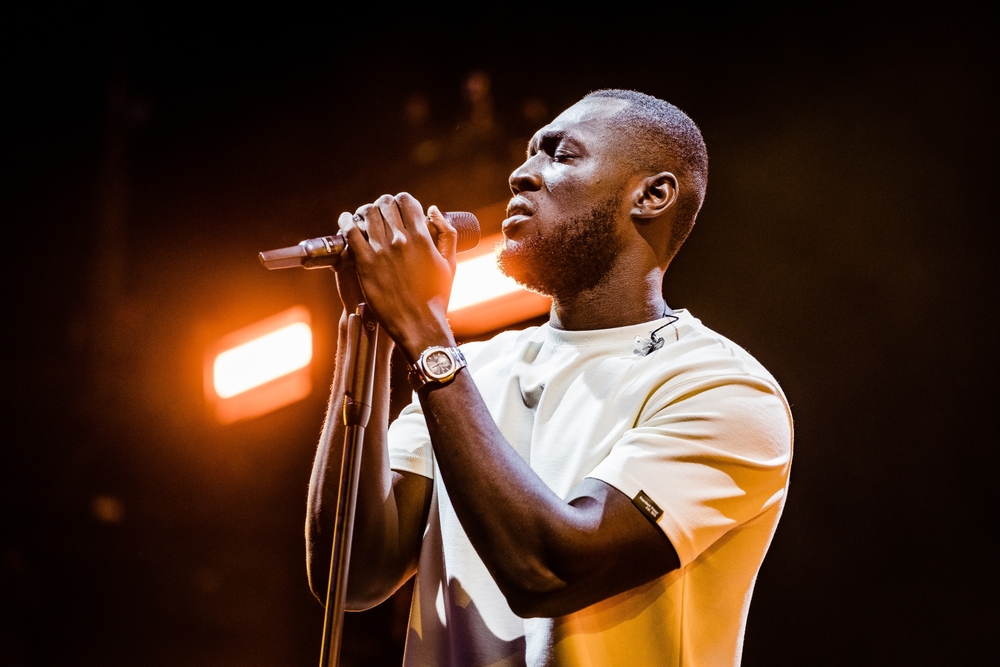
On 28 June 2019, Stormzy became the first Black British solo artist to headline Glastonbury. His Pyramid Stage performance brought together rap, ballet and an arresting visual image: a stab vest designed by Banksy. The occasion placed a musician from south London at the centre of a national cultural event. It also made visible a recurring feature of his career: bringing other people’s talents into the space he occupied.1, 2
Learning his craft in south London
Born Michael Omari in 1993, Stormzy grew up in Thornton Heath, in the London borough of Croydon. His mother came from Ghana, and Christianity was part of his upbringing. In an early interview, he recalled trying out verses with his sister and listening to her response to the way he delivered them. The picture is of someone learning through performance and feedback, developing a feel for language long before the attention of a recording industry audience.3, 19
London’s MCs offered examples close enough to feel attainable. Speaking to the FADER in 2015, he identified artists including Wiley, Dizzee Rascal, Wretch 32 and the Boy Better Know collective as formative influences. Their language, appearance and surroundings were recognisable to him. He had begun MCing and battling at a youth club by the age of eleven. Those encounters made rap something to practise with other people, where timing, confidence and the ability to hold attention mattered.4
Before committing to music full time, he worked for an engineering firm, travelling around Britain. His early videos depended on a small circle of collaborators, including filmmaker Jaiden Ramgeet, rather than a large production operation. In that same interview, Stormzy described a wish to help unfamiliar listeners understand his music while keeping its identity. Reaching more people was already part of the ambition; the challenge was how to carry a particular voice into those encounters.4
The Wicked Skengman freestyle videos and his independently released 2014 EP Dreamers Disease established two related strands of his work: the directness of an MC performing to camera and the possibilities of a recorded project. The National Portrait Gallery’s account of this period places those releases at the beginning of his wider recognition. They provided a route by which listeners could encounter his delivery repeatedly, beyond the immediate circle of a live performance.5
Shut Up carried that recognition into the singles chart in 2015, eventually reaching number eight. Official Charts also records a number eighteen peak for Wicked Skengman 4 that year. These were measurable signs of an audience forming around material associated with his freestyle identity. The chart positions mark a stage in his career when the performance style that had attracted attention online was becoming part of Britain’s commercial music landscape.6
An album with room for different selves
Released on 24 February 2017, Gang Signs & Prayer gave Stormzy space to present a broader musical and emotional range. Explaining the record to the FADER, he described wanting his Christian faith and experiences outside church to coexist within it. Big for Your Boots drew on grime production, including the pitched-up vocal textures associated with earlier records. Elsewhere, singing and gospel changed the atmosphere. Across those choices, the album made room for confidence, family attachment and vulnerability within one artist’s account of himself.7
His account of recording Blinded by Your Grace, Part 1 makes that expansion concrete. Anxious about singing, he recorded with producer Fraser T Smith while sitting on a studio couch, reducing the self-consciousness he associated with singing in the booth. For Part 2, he invited MNEK because of the places another singer’s voice could reach. Such decisions involved recognising what a collaborator could contribute. Strings, brass and woodwind arranged with Rosie Danvers also helped create an album whose scale extended beyond a beat and a solitary vocal.7
At the 2018 BRIT Awards, Gang Signs & Prayer won British Album of the Year, while Stormzy received the British Male Solo Artist award. The combination recognised both the recording and its performer. It was a significant point in the movement from independently circulated videos to the institutions through which the British music industry publicly acknowledges success.8
Building a Glastonbury performance
The Glastonbury headline appearance followed earlier performances at the festival’s Sonic Tent in 2016 and Other Stage in 2017. When organisers announced his return for 2019, they were describing his third appearance at the festival. That progression matters because it shows the headline event as part of a developing relationship with live audiences. A performer accustomed to smaller spaces now had to shape an evening for the Pyramid Stage and the people watching beyond the festival site.9
The production brought different kinds of performance into contact. Ballet Black’s contribution featured dancers Cira Robinson and Mthuthuzeli November, whose appearance the company preserves in its own film archive. Dance introduced movement and expression beyond the rapper’s delivery. Including those performers within the programme gave the audience an encounter with another Black British cultural institution. It also allowed the show to change pace and texture, making collaboration part of its structure.10
Responsibility and musical change
Heavy Is the Head followed in 2019. Discussing its creation with Australia’s triple j, Stormzy contrasted the concentrated making of his debut with a second album developed across two years, different locations and a wider range of producers. Touring, family commitments and expanding public projects competed for his time. He described feeling like a new artist again as he worked out what the record should become. Its title connected public confidence with the pressure of responsibility, while its musical range included R&B, soul and gospel alongside rap. Making a second album required him to reconsider his working methods as well as his sound, under expectations that had changed since the first.11
For This Is What I Mean, released on 25 November 2022, collaboration became central to the recording environment itself. After the pandemic interrupted work begun in Los Angeles, Stormzy gathered musicians, writers and producers on Osea Island in Essex. In his Apple Music account of the sessions, he described guiding the project while remaining receptive to other people’s ideas. Contributors included producer P2J, Jacob Collier and Tems. The approach allowed songs to emerge through shared decisions about sound, mood and the performer best suited to a particular moment.12
The process could involve letting an idea move beyond his own performance. Sampha’s Plea developed when he invited Sampha to reinterpret material connected to Please. Firebabe grew from work with singer Debbie and musician George Moore. Stormzy’s explanations describe melodies, chords and conversations becoming songs through revision. They offer a useful way into his development: an MC known for commanding a track was also learning to direct a room, listen closely and let the finished recording carry the contribution of several imaginations.12
Paying for the time to study
His education work began on a much smaller numerical scale than the crowds he could draw. In 2018, the Stormzy Scholarship funded two Black students at the University of Cambridge, covering tuition and a maintenance grant throughout their courses. The initial commitment addressed both the cost of a place and the expense of living while studying. It attached his public name to a practical arrangement intended to make sustained university study financially possible for its recipients.13
The Cambridge Trust describes the scholarship as supporting Black UK undergraduates from low-income or disadvantaged backgrounds, with fees and a substantial contribution towards maintenance for up to four years. Those details explain the programme’s purpose more clearly than celebrity association alone. A student needs resources during the years between admission and graduation. Support for living costs recognises that university participation involves accommodation, food and everyday expenses alongside the formal price of teaching.14
By October 2025, Jesus College reported that the scheme had funded 68 students. Its account identified £2 million commitments from HSBC UK in 2021 and again in 2023 as part of the expansion. This is a dated measure of the programme’s reach: the students supported through the scholarship, including those whose studies were still under way.1
Books and access to publishing
In 2018, Stormzy also launched #Merky Books with Penguin Random House UK. The imprint was conceived as a home for fiction, non-fiction and poetry, beginning with Rise Up, a book about his own development. Its launch announcement also proposed a competition for new writing and a paid internship. These plans connected the published book with the work behind it: finding manuscripts, developing writers and creating routes into an industry whose decisions shape what reaches readers.15
The New Writers’ Prize made part of that ambition into a recurring programme. For its 2026 competition, Penguin offered the winner a publishing contract and shortlisted writers access to workshops, editorial conversations and a writers’ camp. The opportunity involved contact with people who commission and develop books. Alongside the prospect of publication, that structure gave participants a way to receive informed responses to work still being shaped and to learn more about the process of becoming an author.16
The imprint’s catalogue has included Malorie Blackman’s memoir Just Sayin’, Taking Up Space by Chelsea Kwakye and Ore Ogunbiyi, and Caster Semenya’s The Race to Be Myself. These books bring different experiences into the same publishing list: a writer reflecting on her life, accounts of education, and an athlete’s story. Stormzy’s involvement therefore extends into the circulation of other people’s narratives, each with its own subject and authorial voice.17
Community work and a continuing connection to Croydon
The #Merky Foundation set out a pledge of £10 million over ten years for organisations working on racial equality, justice reform and Black empowerment in Britain. One recorded contribution was £500,000 to the Black Heart Foundation’s Each Day. Every Day campaign. The recipient’s May 2022 report confirmed that funding within its wider fundraising total. This places Stormzy’s support within an existing scholarship organisation, whose work reaches young people across different institutions and forms of education.13, 18
A partnership with Adidas brought a further connection to his home borough. Following the #Merky FC careers programme, established in 2022 to develop opportunities for Black young people in football’s off-pitch workforce, #Merky FC HQ opened in Croydon in May 2024. Adidas described facilities including football pitches, a recording studio, gaming space and multipurpose rooms at the existing Selhurst Sports Arena site. The centre linked sport with music and other creative activities. Its practical significance lay in providing places and equipment through which young people could explore interests together, supported by the organisation managing the site, Communities First Foundation.20
When the University of Exeter awarded Stormzy an honorary doctorate in 2022, he spoke about leaving his own A-level studies and about the importance his mother attached to education. He acknowledged the work of the graduates receiving their earned degrees alongside him. That distinction gives the occasion its human detail: public recognition had brought him into a university ceremony by a different route. His music and public projects continue to invite a connected question about opportunity: who has the time, resources and encouragement to develop the abilities they already possess?19
Sources and further reading
1. Jesus College, University of Cambridge: Stormzy and Julia Longbottom elected as Honorary Fellows.
2. Victoria and Albert Museum, Performing Glastonbury: Stormzy: Glastonbury performance, 28 June 2019.
3. Pitchfork (Jazz Monroe’s interview with Stormzy): Stormzy: Grime Heavyweight.
4. The FADER (Aimee Cliff’s interview with Stormzy): Meet Stormzy, The Next Gen Grime MC That Everyone’s Co-Signing.
5. National Portrait Gallery: Stormzy: display, 2019.
6. Official Charts: Stormzy: Official Chart history.
7. The FADER (Aimee Cliff’s interview with Stormzy): Stormzy Tells The Story Behind Every Song On His Debut Album.
8. The BRIT Awards: The BRITs 2018.
9. Glastonbury Festival: Stormzy to headline Friday night at Glastonbury 2019.
10. Ballet Black, BB on Film: BB at Glastonbury.
11. ABC triple j (Al Newstead’s report of Lucy Smith’s interview): Stormzy ‘felt like a new artist’ making Heavy Is The Head.
12. Apple Music: This Is What I Mean: album and Stormzy’s track-by-track commentary.
13. #Merky Foundation: #Merky Foundation: pledge and projects.
14. Cambridge Trust: Stormzy Scholarship.
15. Penguin Random House UK: Stormzy launches imprint #Merky Books for new voices with Penguin.
16. Penguin Random House UK: #Merky Books New Writers’ Prize: 2026 competition.
17. Penguin Random House UK: #Merky Books: imprint and catalogue.
18. The Black Heart Foundation: Black Heart Foundation charity awards 500th scholarship.
19. University of Exeter: Acclaimed musician and social justice campaigner Stormzy receives honorary degree from University of Exeter.
20. Adidas: Adidas and Stormzy announce #Merky FC HQ: a new multi-purpose centre.