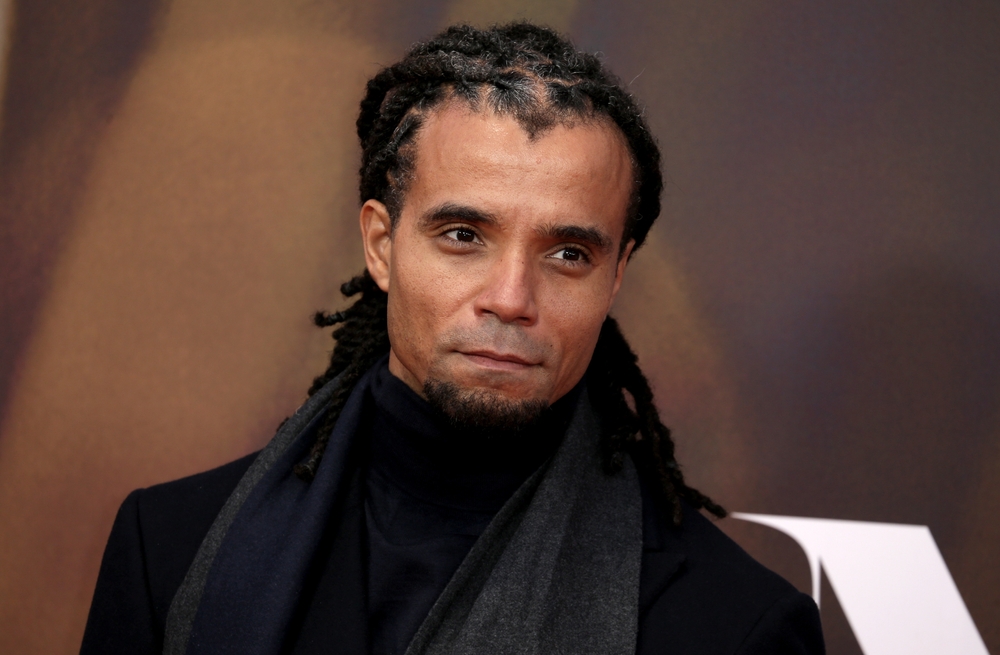
An audience hears a line of verse and must decide whether it comes from Shakespeare or a rapper. The exercise is one of Akala’s ways into a larger conversation about language and prejudice. Familiar expectations become less reliable when the names are removed. In a 2017 interview with the Folger Shakespeare Library, he explained that the point was to unsettle assumptions about both traditions. What listeners hear, and what they expect to hear, can be very different things.1
Growing up among books, music and performance
Born Kingslee Daley in Crawley, West Sussex, in 1983, Akala grew up in Kentish Town in north London. His mother was Scottish and his father Jamaican. His older sister became the musician Ms Dynamite. Theatre was also part of his early surroundings: his stepfather worked as a stage manager at the Hackney Empire. These connections placed him within several creative traditions before he had a recording career of his own. Family life, neighbourhood and performance all contributed to the cultural world in which he grew up.2
A pan-African Saturday school added another dimension to that education. Learning about Black history took place through community effort as well as formal schooling. The experience helps explain why community learning occupies such a central place in his later work. Knowledge could be passed between generations, through institutions people built themselves. His interest in books and historical arguments developed alongside his interest in rhythm, language and the possibilities of the stage.2
Establishing a musical voice
In 2006, Akala won Best Hip Hop at the MOBO Awards, aged twenty-two. The award established an early public marker in his career, recognising him in a category devoted to the music he was making. It also meant that the younger brother of an already successful artist was being recognised under his own name, for his own work. Music provided the first substantial public platform from which his later activities developed.3
His musical practice has drawn on rap, rock and electronic sounds. The Hip-hop Shakespeare Company’s account of his career identifies Saul Williams and Gil Scott-Heron among his influences, and describes his collaboration with drummer and producer Cassell ‘TheBeatmaker’. That attention to live musicianship matters. Ideas have to become audible through timing, arrangement and delivery; a serious subject alone cannot create an effective performance. Akala’s work has involved the practical craft of making language carry across a room as well as the arguments carried by the words.4
Speaking to The Music ahead of Australian performances in 2016, he described assembling a tenth-anniversary show from material across his career. Shortened songs and closely joined sections kept the pace high, while spoken-word passages changed the intensity. The description offers a useful glimpse of preparation behind a public performance. A set had an overall shape, and the movement between different kinds of material was deliberate. For an artist associated with long arguments and historical references, the physical experience of listening remained part of the work.5
Books have also supplied ideas for his music. The title track of his 2013 album The Thieves Banquet drew inspiration from Kenyan novelist Ngũgĩ wa Thiong’o’s Devil on the Cross. As music scholar Justin A. Williams explains, Akala used a fictional gathering of powerful wrongdoers to examine exploitation and corruption. The connection brings African literature into the making of a British rap record. It also shows his use of storytelling: an argument about power can be carried through invented characters, dramatic voices and a scenario that invites listeners to recognise behaviour beyond the story itself.6
Making space for young performers
In 2009, Akala founded The Hip-hop Shakespeare Company. Launched with support from actor Ian McKellen, it developed educational programmes, live events and theatre productions exploring connections between Shakespeare and contemporary hip-hop. Its stated purpose extended to how young people understood their own capabilities. Workshops could lead towards making something: a performance, a piece of writing or a contribution to a shared production. The company brought learning and artistic practice into the same setting.7
Its structure included established artist associates and a programme for emerging peer leaders. Participants could develop as actors, singers, rappers, poets, producers or members of a production team. This made room for several kinds of creative work. Public attention usually falls on the person holding the microphone, but a production needs people who organise, design, support and collaborate. The company’s model offered routes into those activities as well as opportunities to perform alongside experienced artists.7
Actor and spoken-word artist Lorianne Tika-Lemba’s experience gives that process a particular shape. The company records that Akala invited her to perform with him at the Southbank Centre in 2010 after seeing work she had written at the National Theatre Studio. She then joined a two-week workshop tour in Denmark, gained experience in facilitating sessions and went on to help lead workshops in Britain. Her route illustrates how an invitation to participate could develop into responsibility for helping other people learn.8
Akala’s Shakespeare work also involves close attention to technique. In his Folger interview, he demonstrated how lines written in iambic pentameter could be performed over beats at different tempos. Hearing verse against music made rhythm tangible. The emphasis was on speaking, listening and experimenting with a text. A learner could approach a difficult passage through the skills used in performance, then ask more detailed questions about its words and meanings. Familiarity with rap became a resource within the exercise.1
Working across countries
The educational work has also involved international collaboration. A British Council account prepared for European Development Days in 2016 describes workshops with young people in the Horn of Africa through the EU-funded HOLLA programme. Akala and The Hip-hop Shakespeare Company led the first of two workshop series. Participants used dance, hip-hop and Shakespeare to explore concerns including poverty, gender discrimination and democracy. The programme involved local partners and several British creative practitioners.9
The same account announced performances in Brussels by six young people from the region. Their work gave them a platform to express concerns from their own countries. That distinction matters when considering international arts projects: the young participants brought subjects, experiences and creative decisions of their own. Akala’s role belonged within a wider exchange, alongside the work of poet Deanna Rodger, Dan Boyden and Dan Tsu in the second workshop series. The resulting programme depended on that collective effort.9
Natives and the relationship between personal experience and history
In 2018, Akala published Natives: Race and Class in the Ruins of Empire. The book combines episodes from his own life with a wider examination of British society. Experiences of schooling, racial identity and being stopped and searched provide starting points for questions about institutions and power. The movement from an individual memory to a larger historical argument is central to its form. Readers are invited to consider how circumstances that appear personal can also be shaped by decisions made far beyond a family or neighbourhood.10
The book’s scope includes education, policing, politics and the continuing influence of empire. It presents Akala’s interpretation of the relationships between race and class, using his experiences as part of that investigation. The extended form allows questions to be developed across chapters. It gives a different pace to concerns that also appear in his performances: how people understand their place in society, which histories become familiar, and how opportunities are distributed.10
In a 2018 interview with Tes, Akala described a curriculum as something made by people, with choices about whose experiences and knowledge it includes. He acknowledged that a curriculum he designed would also reflect the subjects he knew best. His argument was for a wider range of voices. That acknowledgement gives the discussion practical weight: widening education involves asking who contributes to it, and bringing in knowledge that any one writer, teacher or institution may lack.11
He also argued for dialogue with young people about the relevance of what they were learning. The point grew from his experience of working with students whose daily concerns included poverty and violence. In that account, listening was part of teaching. Explaining a subject’s value required taking pupils’ questions seriously and understanding the conditions in which they lived. His emphasis rested on teachers understanding the people in front of them, as well as the subject they hoped to explain.11
Writing for younger readers
Akala’s writing also reaches much younger children. Oxford University Press published You Can Do Anything, the first Hip and Hop picture book, in July 2017, with illustrations by Sav Akyuz. The book uses rhyme and a friendship between a hippo and a bird around the challenge of a bicycle race. Its scale and audience differ from those of Natives, while the connection between language, encouragement and learning remains visible. Illustration and the sound of words share the storytelling.12
His novel The Dark Lady took that work into fiction for teenagers. Set in Elizabethan London, it follows Henry, a fifteen-year-old outsider with magical abilities. The story combines danger, survival and an imagined gift within a historical setting. Its publisher presents it as a novel for young readers from around twelve upwards. The premise gives a young character at the edges of society a central role in the action. History becomes a setting that readers can enter through a person’s predicament, while the supernatural elements make clear that this is an invented adventure.13
Taken together, the two books show an interest in how a reader’s age changes the way a story is told. The shared reading and visual detail of a picture book offer one kind of encounter with language. The Dark Lady asks readers to follow an unfolding narrative and an unfamiliar world. Akala’s move into teenage fiction gave his interests in storytelling and the past another form, with a young protagonist carrying the reader through it.12, 13
Learning as a continuing practice
When the University of Brighton awarded Akala an honorary Doctor of Arts in July 2018, it recognised his contribution to empowering young people through learning. He had not attended university himself. In his address to graduates, he described keeping a reading diary and setting himself regular periods of study. The detail is revealing because it makes education a repeated activity: choosing a book, making time for it and returning to that commitment over months and years.14
He also asked graduates to consider what they owed to the society that had supported their education. Personal discipline and public responsibility appeared together in the speech. That pairing runs through his work as a musician, writer and educator. Learning has value in what it allows a person to understand and make, and in how that understanding can be shared. The practical tasks remain familiar: reading, listening, practising, questioning and helping another person find a way into a subject.14
Sources and further reading
1. Folger Shakespeare Library: Akala and Hip-Hop Shakespeare: Shakespeare Unlimited, episode 78.
2. Postcolonial Writers Make Worlds: Akala, profile by Dominic Davies.
3. MOBO Organisation: MOBO Awards 2006.
4. The Hip-hop Shakespeare Company: Akala: Artistic Director.
5. The Music: Interview: Celebrating Ten Years of Akala.
6. Popular Music and Society / University of Bristol: Justin A. Williams: Rapping Postcoloniality: Akala’s The Thieves Banquet and Neocolonial Critique.
7. The Hip-hop Shakespeare Company: About The Hip-hop Shakespeare Company.
8. The Hip-hop Shakespeare Company: Lorianne Tika-Lemba.
9. British Council: Hip Hop Shakespeare at European Development Days, 2016.
10. John Murray Press / Two Roads: Natives: Race and Class in the Ruins of Empire.
11. Tes: Tes talks to… Akala, interview by Simon Creasey.
12. Oxford University Press: You Can Do Anything (Hip and Hop).
13. Hachette Children’s Group: The Dark Lady.
14. University of Brighton: Akala urges graduates: develop good habits.