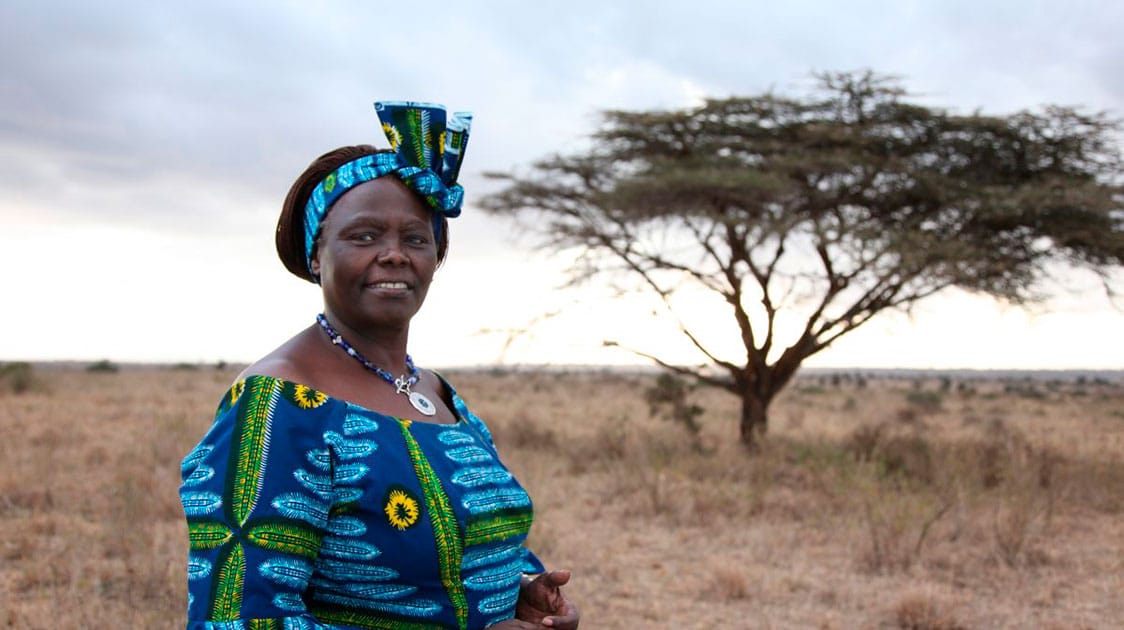
When Wangari Maathai received the Nobel Peace Prize in 2004, she became the first African woman to win it. The award recognised a career that had connected environmental protection with democratic participation and women’s rights. Planting trees had become a way of asking who controlled land, whose work sustained a community and who could speak when public resources were threatened.1
A scientist shaped by several worlds
Wangari Muta Maathai was born on 1 April 1940 and grew up in Nyeri, in Kenya’s central highlands. Her foundation’s account describes a rural childhood and an education at St Cecilia’s mission school. The countryside remained an important reference point throughout her life, even as study and public work took her abroad.2
In her Nobel lecture, she recalled fetching water for her mother from a stream beside their home. She remembered frogspawn and tadpoles, and water she could drink directly. Returning to that memory, she described a stream that had since dried up. Environmental loss meant that children would inherit a different landscape, while women faced longer journeys to obtain water. Her account made a changing ecosystem understandable through everyday experience.3
In 1960, Maathai travelled to the United States through the educational programme commonly known as the Kennedy Airlift. She studied at Mount St Scholastica College in Atchison, Kansas, now part of Benedictine College, and graduated in biology in 1964. Her education belonged to a wider movement of African students gaining opportunities overseas. Those journeys would help shape the professional lives of a generation returning to work in their home countries.4, 5
At the University of Pittsburgh, she continued in biological sciences and received her master’s degree in 1966. Biology was her principal subject, but her undergraduate studies had also included chemistry and German. These were years of sustained scientific training, preceding the environmental organising through which she later became internationally known.5
Doctoral study took her to Germany and the University of Nairobi, which awarded her a PhD in 1971. The Nobel biography identifies her as the first woman in East and Central Africa to earn a doctorate. She taught veterinary anatomy at Nairobi, becoming chair of the department in 1976 and an associate professor in 1977. Scientific research, teaching and departmental responsibility formed a substantial career before the Nobel Prize.6
Listening to women, growing a movement
Maathai founded the Green Belt Movement in 1977 under the National Council of Women of Kenya. Its starting point was what rural women were reporting: streams were disappearing, food supplies were becoming less dependable and finding firewood required longer walks. These were practical difficulties with consequences for household labour and security. Taking the women’s observations seriously brought environmental change into the centre of a discussion about how families lived.7
The response involved women working together to raise seedlings and plant trees. The aims included protecting soil and water, providing food and fuel, and offering a small payment for the work. Local participation was essential to the method. Women whose knowledge came from cultivating land and maintaining households became participants in environmental restoration, with a direct connection between the trees they grew and the resources their families needed.7
The organisation’s published ten-step procedure shows how much coordination tree planting requires. It begins with community awareness of trees and responsibilities towards natural resources. Groups identify suitable land, work with foresters, prepare holes, agree planting dates and keep records. Seedlings must be packed, transported and planted, followed by continuing visits. That sequence gives substance to the familiar photograph of somebody holding a young tree: a planting ceremony is one stage in organised, continuing work.8
Defending land and public space
The protection of trees increasingly brought Maathai into conflict with political power. In the late 1980s, she opposed plans for a skyscraper complex in Nairobi’s Uhuru Park. The Goldman Environmental Prize’s account records how President Daniel arap Moi’s government attacked her publicly and the movement lost its office at short notice. The campaign continued, foreign investors withdrew their support and the development was cancelled. The dispute made the future of a public park a question of public accountability.9
In 1992, Uhuru Park also became a site of protest over political imprisonment. Maathai supported a hunger strike seeking prisoners’ release and was beaten unconscious by police. The Green Belt Movement’s later history places that attack within a decade of efforts to suppress its work. Environmental organising and the demand for political freedoms had become closely connected through the treatment of those who challenged the government.10
A contemporary Amnesty International alert records another confrontation on 8 January 1999. Security guards violently broke up a peaceful demonstration at Karura Forest, in northern Nairobi, against the transfer of public land to developers. The protest had been organised by the movement led by Maathai. Amnesty expressed concern for the campaigners’ safety. Such records preserve the risks behind later commemorations: defending a forest involved confronting decisions about land, and exposure to violence for doing so.11
Maathai explained the relationship in political terms. In her Nobel lecture, she argued that a peaceful society needed fair development, responsible environmental management and room for citizens to participate. She called on governments to recognise community movements as part of the checks on power. In this view, people needed the freedom to question decisions affecting the places that supplied their water, food and livelihoods.3
Parliament, the Nobel Prize and international work
In 2002, Maathai entered Kenya’s Parliament. The United Nations’ record of her public service states that she won with 98 per cent of the vote and served as Assistant Minister for Environment, Natural Resources and Wildlife from 2003 to 2005. After years of challenging government decisions, she now worked within national institutions. Her parliamentary and ministerial roles became another part of a career spanning community action, science and public office.12
The 2004 Nobel Peace Prize gave international recognition to the connections she had been making. The Nobel account places women’s rights and international solidarity alongside ecological thinking and democracy. Her selection expanded the public understanding of peace work to include the protection of the resources on which daily life depends. The award honoured both an individual and an approach developed through collective action.1
That influence extended into new international campaigns. The United Nations Environment Programme credits Maathai as the inspiration for its Billion Tree Campaign, launched in 2006. Her experience in Kenya helped inform an appeal that reached well beyond one country. The campaign carried the practice of community planting into a global effort, while the Green Belt Movement retained its own organisation and responsibilities.13
In December 2009, the UN Secretary-General appointed her a Messenger of Peace, with a particular focus on the environment and climate change. The role recognised the relationships she drew between environmental protection, poverty, human rights and security. It gave her a further platform for bringing those subjects into international public discussion.14
Writing, teaching and sharing experience
Maathai also explained her work through books. Unbowed: A Memoir, first published in 2006, followed her journey from rural Kenya through education, family life, environmental activism and conflict with the state. Writing her own account allowed her to place public achievements within the longer experience that produced them. Readers could encounter a life unfolding through difficult choices, alongside the familiar milestones of awards and public office.15, 16
The Challenge for Africa, published in 2009, widened the discussion to the continent’s development. Maathai challenged accounts that reduced African countries to helplessness and dependence. She emphasised the responsibilities of Africans themselves, including the need for accountable leadership. The book developed her position as a political thinker: her environmental work raised questions about how societies governed themselves and whose knowledge shaped their future.17
Replenishing the Earth followed in 2010. It considered the spiritual values that could support environmental responsibility, including gratitude, respect and service. Although educated within Christianity, Maathai drew on several traditions. She explored ideas of repairing the world and avoiding waste, connecting personal conduct with the condition of the planet. Scientific understanding and ethical responsibility were both part of the way she addressed an audience beyond the environmental movement.18
Universities remained part of that exchange. Yale hosted her as the Dorothy S. McCluskey Visiting Fellow in Conservation in 2002 and awarded her an honorary doctorate in 2004. Its connection to her work continued: in 2024, Dorceta Taylor received an endowed chair named for Maathai in environmental justice. The name linked a new generation of scholarship on inequality and the environment with the Kenyan organiser’s work.19
At Nairobi, Maathai became the founding distinguished chair of the Wangari Maathai Institute for Peace and Environmental Studies in 2010. Its mission links academic knowledge with practical experience and community work. Returning her ideas to a university setting helped establish a place where the relationships between environmental management, public responsibility and peace could be studied together.20, 21
Work that continued beyond her lifetime
Maathai died on 25 September 2011, aged 71. The organisations and relationships built during her lifetime continued. In a report published in March 2018, the Green Belt Movement stated that more than 51 million trees had been planted and over 5,000 nurseries established. Those figures describe the movement’s collective work by that date, including the years after its founder’s death. The trees stood on farms, at schools and churches, beside rivers and across rural landscapes.10, 14
Its later programmes show how the original concern with livelihoods developed. By 2025, the movement reported pilot activities in bamboo farming, beekeeping and eco-tourism, together with training on agriculture, finance and access to markets. These programmes seek to connect environmental care with ways of earning a living. They continue the practical question that runs through Maathai’s story: how can people support their households while protecting the land around them?22
The institute bearing her name describes a programme of learning through experience, involving students in environmental issues at community, county and national levels. Activities have included visits to John Michuki Memorial Park and the institute’s campus. This is a fitting continuation of a career that moved between universities and local organising. Maathai treated people’s observations as knowledge worth investigating and sharing. The work continues when another group learns how to understand a place, care for it and take responsibility for what happens there.23
Sources and further reading
1. The Norwegian Nobel Institute: Wangari Maathai: Nobel Peace Prize 2004.
2. Wangari Maathai Foundation: Wangari’s story.
3. Wangari Maathai / NobelPrize.org: Nobel Lecture, Oslo, 10 December 2004.
4. Benedictine College: Wangari Maathai.
5. University of Pittsburgh, Dietrich School of Arts and Sciences: Women’s History Month celebrates Wangari Maathai.
6. NobelPrize.org: Wangari Maathai: Biographical.
7. The Green Belt Movement, Google Arts & Culture: The Green Belt Movement: institutional history.
8. The Green Belt Movement: GBM ten-step procedure.
9. Goldman Environmental Prize: Wangari Maathai, 1991 Goldman Prize winner.
10. The Green Belt Movement, guest contribution to Goldman Environmental Prize: The Green Belt Movement: 40 Years of Impact, 21 March 2018.
11. Amnesty International: Kenya: Ill-treatment/Fear for safety: Wangari Maathai, 11 January 1999.
12. United Nations: Millennium Development Goals Advocacy Group: Wangari Maathai.
13. United Nations Environment Programme: Africa Celebrates Africa Environment Day and Life of Wangari Maathai, 3 March 2015.
14. United Nations: Wangari Maathai: Messenger of Peace.
15. Penguin Random House: Unbowed: A Memoir.
16. Indiana University Libraries: Unbowed: A Memoir, first edition, 2006 — catalogue record.
17. Penguin Random House: The Challenge for Africa.
18. Penguin Random House: Replenishing the Earth.
19. Yale School of the Environment: YSE Awards First Endowed Chairs for Professors of Environmental Justice, 17 October 2024.
20. University of Nairobi, Wangari Maathai Institute: About Prof. Wangari Maathai.
21. University of Nairobi: The Wangari Maathai Institute for Peace and Environmental Studies: vision and mission.
22. The Green Belt Movement: Sustainable Livelihoods and Nature-Based Enterprises.
23. University of Nairobi, Wangari Maathai Institute: Mentorship Programmes.