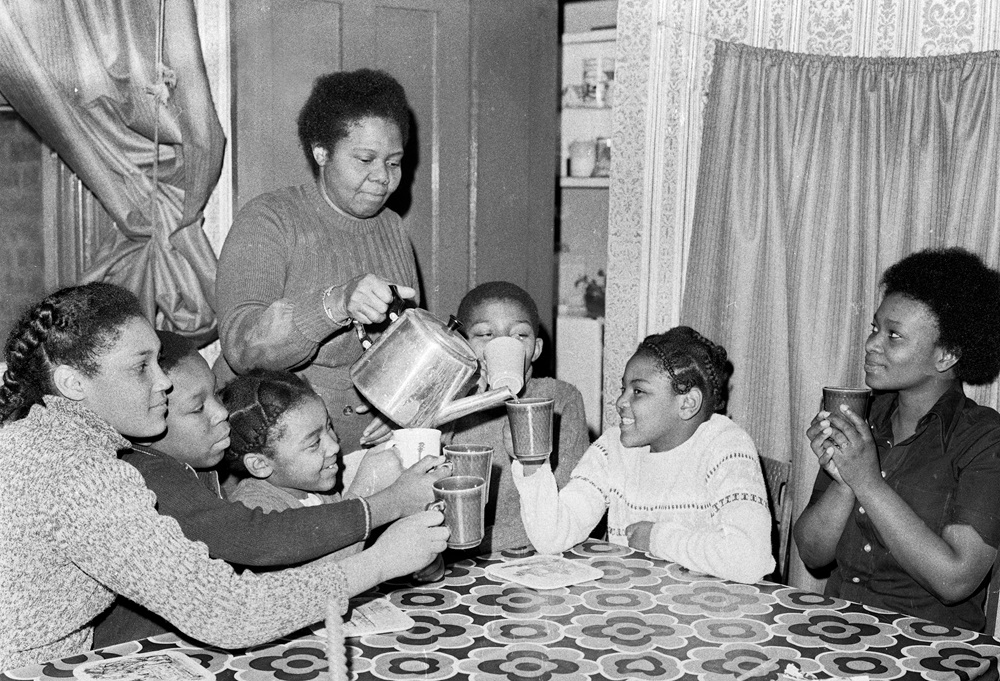
In the 1973 New Year Honours, Sybil Phoenix received an MBE. The official entry identified her as vice-chair of the Lewisham Council for Community Relations. Fostering and youth work had already made care a public responsibility in her life. Over the following decades, she connected the needs of individual young people with wider efforts to change the institutions around them.1, 4
A childhood in British Guiana
Phoenix was born on 21 June 1927 in Georgetown, British Guiana, now Guyana. Her mother died when she was nine, and she lived with her grandfather until his death three years later. An aunt and uncle then brought her up. Lewisham’s local history account connects these early experiences of loss and insecure care with her later determination that young people should have dependable adults in their lives.2
Before migrating, she had acquired skills that would sustain both her livelihood and her voluntary work. Trained as a seamstress, she ran Sunset Sports Wear and Leather Goods, making and selling clothing and handbags. Church work also gave her experience of organising help. As a young secretary to a minister, she assisted with welfare provision; singing and youth activities brought further responsibilities. Her community work in Britain grew from abilities developed in the Caribbean over many years.3
Making a home in London
In 1956, Phoenix and her fiancé, Joe, moved to London. They married at Shepherd’s Bush Methodist Church. She was already a trained singer, businesswoman and youth worker, but those accomplishments did not protect the couple from racism. The Methodist Church’s account of her life places her arrival within the discrimination experienced by Black migrants trying to establish themselves in Britain.4
Her own recollections preserve the practical connections across that journey. She brought her sewing machine, while a minister in Georgetown wrote to a minister in Shepherd’s Bush recommending her youth work. Soon after arriving, she was invited to help restart activities for young people. Migration interrupted an established life, but it also carried relationships, skills and ideas into a new setting.5
Fostering in Lewisham
During the early 1960s, fostering became central to Phoenix’s life. Her Brockley home offered a place to young people who needed care, and over time the household became part of a much wider network of relationships. Exact totals vary in published accounts, but the scale was substantial. In an interview with Eastlondonlines, her son Woodrow described a childhood shaped by the frequent arrival of temporary brothers and sisters.6
His memories also show what that commitment required of the family. Sharing rooms, space and their parents’ attention could be enjoyable, but it could also be difficult. Looking back as an adult, he understood more clearly why his mother had responded as she did. That account gives substance to the often general language of community service: fostering involved daily adjustments within a household, as well as the willingness to welcome somebody new.6
Phoenix continued to use dressmaking to support her work. Yvonne Field’s profile records that early caring responsibilities were unpaid and that sewing helped finance them. In the early 1970s, she established Phoenix Afro-European Fashions, a dressmaking school at her Tressillian Road home. Fashion shows took the work into London venues, including the Savoy. Earning a living and providing care were closely connected activities.3
The Moonshot years
By the early 1970s, her youth work had developed into the Moonshot club, based in an old mission hall. Phoenix described a club open to the wider community, with a library of Black books and activities ranging from sport to photography and practical classes. Keeping it open at weekends and through the summer holidays mattered: young people needed somewhere to go beyond the school timetable.5
In December 1977, fire destroyed the old Moonshot premises in New Cross. Historian Aaron Andrews describes the incident as a suspected arson attack by members of the National Front. The destruction was part of the background against which Black residents understood threats to their safety and to the institutions they were building.7
Phoenix pursued a replacement. In her account, the rebuilding campaign culminated in the opening of the new Moonshot by the Prince of Wales in March 1981. A new, permanent centre made it possible to continue the work after the loss of the original hall. Rebuilding was itself a commitment to the neighbourhood’s future.5
Supporting a community after the New Cross fire
Before that formal opening, the new centre became a place of emergency support. On 18 January 1981, a fire at a birthday party in New Cross brought devastating loss to local families. Phoenix opened the still unfurnished Pagnell Street building so that people could gather and establish who had been caught in the blaze. She liaised with police, helped the bereaved and accompanied the mother whose home had burned to hospital. Andrews’s research shows her working where immediate personal care met a rapidly developing public crisis. The centre provided a place in which grief could be shared and a community response organised.7
The response involved many organisations and different political traditions. The New Cross Massacre Action Committee, chaired by John La Rose, challenged the handling of the investigation, government indifference and hostile reporting. Its campaign led to the Black People’s Day of Action in March 1981. The cause of the fire remained unresolved: both the original inquest and the second inquest in 2004 returned open verdicts. Phoenix’s contribution belongs within that larger history of bereaved families and campaigners seeking answers and recognition.15
She also worked to secure a permanent memorial. Speaking in the Commons in March 1999, Lewisham Deptford MP Joan Ruddock recalled that Phoenix had approached her three years earlier to ask for support. A memorial was erected in 1997. Ruddock emphasised how long the families had waited for that public acknowledgement. Phoenix’s intervention extended the work of care across time: supporting a family after a disaster could include insisting, years later, that its loss should have a recognised place in the borough’s history.8
Faith, racial justice and wider connections
Christian commitment remained central to Phoenix’s work, including her efforts to change the Church itself. In his history of Methodist racial justice work, Inderjit Bhogal records her influence on the report adopted by the Methodist Conference in 1978, which condemned racism as incompatible with Christianity. A statement of principle, however, still had to be translated into changes in behaviour and understanding. Bhogal observes that the statement called for constructive action without defining racism or setting out a comprehensive programme. The distance between passing a resolution and changing everyday practice gave training particular importance.9
From the early 1980s, Phoenix and the Revd Vic Watson developed racism awareness training through the Methodist and Ecumenical Leadership Racism Awareness Workshops, known as MELRAW. The training addressed racism within churches and worked across denominational boundaries. It asked Christian communities to examine their own practices. Phoenix’s religious work therefore included both offering support through church networks and challenging the prejudice that could operate inside those same networks.9
The influence travelled further through people she trained. Phoenix e.V., an organisation established in Germany in 1993, traces its teaching methods to her work. Austen Peter Brandt, who had trained with Phoenix, developed workshops whose participants helped form the organisation. Its account emphasises the relationship between everyday experiences and structural racism. This provides a concrete example of her influence beyond Lewisham: ideas developed through community work and church training became part of another country’s organised response to discrimination.10
She also founded Guyana Connection, which linked young people in Britain and Guyana through educational exchanges and computer learning. Lewisham’s archive records fundraising for computer equipment in five Guyanese schools. The exchange included Black and white children in Britain alongside participants in Guyana, giving them opportunities to learn by living and working in another culture.2
The Marsha Phoenix Memorial Trust
A lasting housing project carried a personal loss into public service. Phoenix’s daughter Marsha died in a car crash in 1974. The Marsha Phoenix Memorial Trust, founded in her memory, opened in 1979. Its purpose was to provide supported accommodation for young women facing homelessness. The project created an organisation through which the work could continue, with housing and individual support offered together.11
The Trust now describes its service as supporting single homeless women aged 16 to 25. Its two Lewisham hostels provide 29 bedspaces: 23 at Tressillian Road in Brockley and six at Erlanger Road in New Cross. Referrals come through the borough’s supported housing arrangements. Staff work individually with residents to help them gain the skills needed for independent living. The aim extends beyond a temporary roof to preparing a young person to manage a home and life of her own.11
Recognition and a continuing legacy
Recognition came from institutions close to the places where Phoenix worked. Goldsmiths awarded her an honorary fellowship in 1993, and Lewisham granted her the freedom of the borough in 1996. She also served as the borough’s mayoress in 1998–99. These honours and responsibilities reflected a relationship with the area built through years of youth work, voluntary organisations and practical support for residents.2, 4
In 2008, she received an OBE. The official Birthday Honours citation specified her service to the community in Lewisham, South London. The wording again placed the neighbourhood at the centre of national recognition.13
Her story has also entered Lewisham’s public art. Artist Boudicca Collins created a portrait for the Lewisham Legends project, working from photographs supplied by Woodrow Phoenix. The artwork was installed in Lewisham Shopping Centre. Collins described choosing an image of Phoenix standing in her garden as the starting point. The commission placed a local community worker within an everyday public space, where residents could encounter the person behind familiar organisations and places.14
That garden offers another way into the story. For the Garden Museum’s Sowing Roots oral history project, Woodrow described the outdoor space his mother created as a place to relax after demanding work. She combined planting, water, colour and objects she made herself. A rockery built with Joe’s help stood beside a fishpond, while a birdbath and a children’s sandpit made space for different kinds of activity. Her garden included palms, roses and fruit trees, with planting ideas gathered from shows and travels. At the Trust, gardening brought residents together with local volunteers, and the grounds included places to sit and rest. The attention to gardens connects with the wider purpose of the housing: somewhere secure should also offer room for ordinary pleasure. Phoenix’s legacy continues in such practical arrangements, through people sharing skills and creating the conditions in which others can feel at home.12
Sources and further reading
1. The London Gazette: New Year Honours 1973: Sybil Theodora Phoenix, p. 16.
2. Local History and Archives Centre, Lewisham: Phoenix, Sybil.
3. Marsha Phoenix Memorial Trust: History & Origins: Sybil Phoenix — a profile by Yvonne Field.
4. The Methodist Church: Sybil Phoenix: building the first black youth club.
5. Windrush Foundation: Sybil Phoenix: first-person account.
6. Eastlondonlines, Goldsmiths: “She did the things that needed to be done and that’s an inspiration”: the legacy of Sybil Phoenix.
7. History Workshop Journal / Oxford University Press: Truth, Justice, and Expertise in 1980s Britain: the Cultural Politics of the New Cross Massacre.
8. UK Parliament, Hansard: Joan Ruddock, House of Commons debate, 29 March 1999, columns 808–810.
9. The Methodist Church: Racial Justice: A Task for All, by Inderjit Bhogal.
10. Phoenix e.V.: Overview: Effective measures against racism.
11. Marsha Phoenix Memorial Trust: Who we are.
12. Garden Museum: Sowing Roots: Sybil Phoenix OBE.
13. The London Gazette: Birthday Honours List 2008: Sybil Theodora Phoenix, p. B12.
14. Lewisham Council: Sybil Phoenix by Boudicca Collins.
15. George Padmore Institute: New Cross Massacre Campaign, 1980–1985.