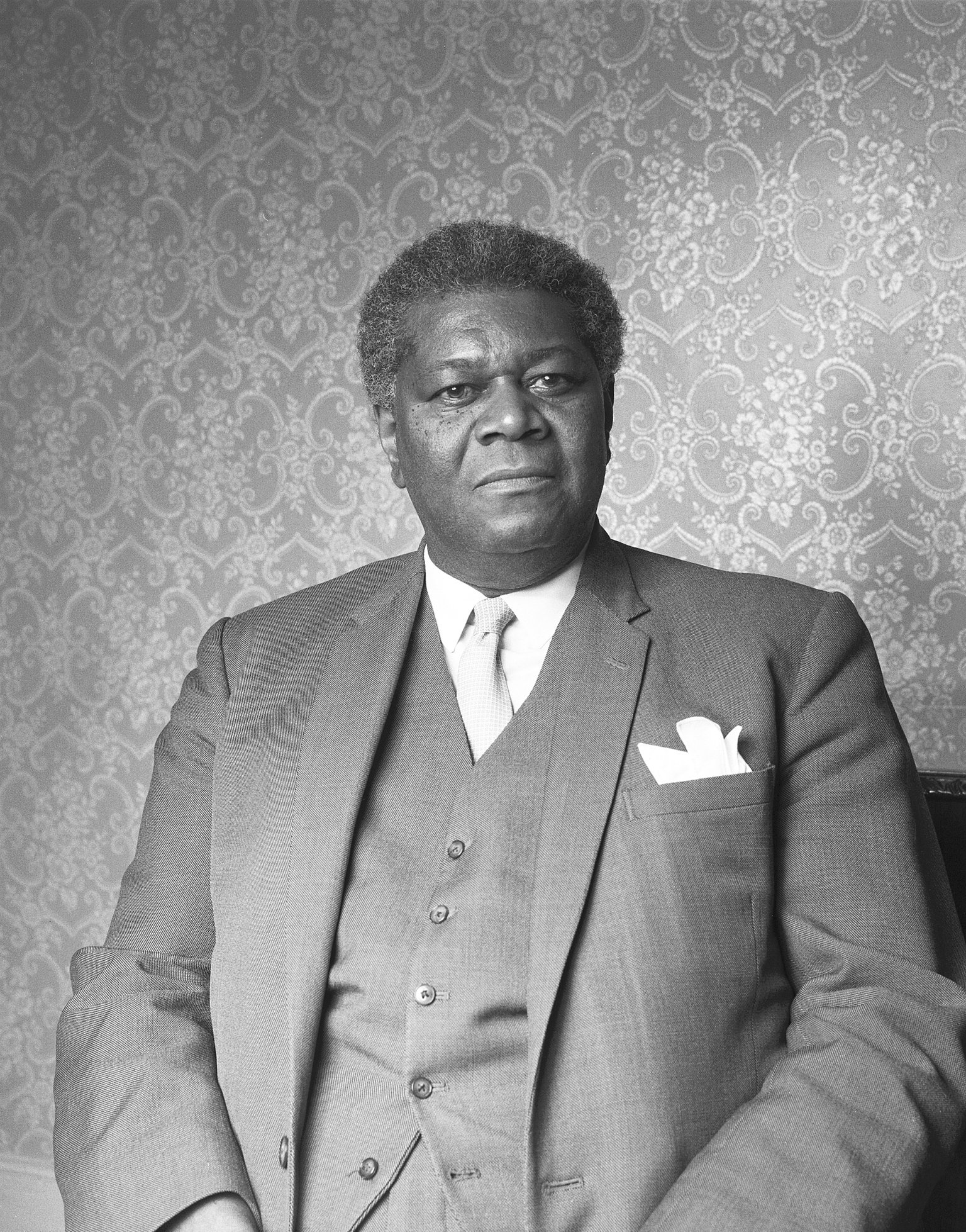
In 1959, Dr David Pitt stood for Labour in Hampstead, bringing a Caribbean political career and a London medical practice into one parliamentary campaign. He lost that election, and another attempt in Clapham eleven years later. Yet those defeats describe only part of his public life. His work continued in local government, in organised opposition to discrimination and, eventually, in the House of Lords. Across these settings, he pursued questions he also encountered in medicine: who could obtain help, who faced exclusion, and what public institutions owed them.1
From Grenada to Edinburgh
David Thomas Pitt was born in Grenada on 3 October 1913. He first visited Britain in 1929 as a teenage Scout, then returned in the early 1930s to study medicine at Edinburgh, supported by an island scholarship. He graduated in 1938. The city also became part of his political education. Encountering deprivation during the Depression, he recognised connections between the hardships of Scottish workers and rural Caribbean communities. His socialism linked people’s circumstances with their health. He joined the Labour Party in 1936 and participated in university socialist politics, beginning the combination of medical training and political organisation that would shape his working life.2, 3
Back in the Caribbean, Pitt worked at San Fernando General Hospital in Trinidad and entered municipal politics. He served on the San Fernando Borough Council in the early 1940s and also became deputy mayor.3
By 1941 he had established a general practice in San Fernando; in 1943 he helped found the West Indian National Party. Its ambitions extended beyond one island: Pitt supported a federation through which Caribbean territories could achieve political autonomy together. He understood the region’s shared colonial history as a reason for common political action, while questioning whether separate small territories could sustain self-government.2
In 1946 he contested the legislature as part of the United Front, alongside politicians including Patrick Solomon and Simboonath Capildeo. These were Trinidad and Tobago’s first elections under universal adult suffrage. Pitt did not win a seat, but he had already acquired experience of campaigning within a society debating how colonial rule should end.3
A surgery with wider connections
In 1947 Pitt travelled to Britain to press the government for a West Indian federation. He established a surgery in North Gower Street in 1950, and the premises developed a second purpose as a meeting place for African and Caribbean campaigners seeking self-government. South African exiles and supporters of the struggle against apartheid also gathered there. The address connected everyday medical work with movements challenging racial hierarchy across different countries.1
Pitt worked with his wife Dorothy to build the practice. Patients came from different backgrounds, and his support for members of London’s growing Caribbean population extended to difficulties with jobs and accommodation. People seeking medical attention could also need help negotiating a landlord’s refusal or finding work. This practical overlap helps explain the breadth of his public commitments. Problems did not arrive at a surgery neatly divided between health, housing and employment, and Pitt’s activities followed them beyond the consulting room.4
Hampstead and the risks of public campaigning
His Hampstead candidacy brought those commitments into a highly visible contest. At an early public meeting on the steps of the Old Town Hall, members of the racist White Defence League interrupted him. The gathering descended into fighting and damage to property, while Pitt continued speaking. Anonymous telephone calls and death threats reached him and his family during the campaign. The intimidation made the cost of seeking elected office personal: a decision to stand affected the safety and peace of the household as well as the candidate. Pitt remained in the contest.5
A separate attack struck the surgery building on 4 March 1961. The Anti-Apartheid Movement’s archive records that fire gutted the basement offices and caused extensive damage to the property, which contained Pitt’s surgery, the Committee of African Organisations and the London office of the United National Independence Party. The attack occurred while anti-apartheid demonstrators were protesting against South African prime minister Hendrik Verwoerd’s visit. Four people were tried and acquitted. The archive found no evidence of direct South African intelligence involvement. The episode nevertheless shows how closely a London doctor’s workplace had become connected to international political struggles.6
Representation and organised pressure
Pitt gained elected office in 1961, representing Hackney on the London County Council. He subsequently served on the Greater London Council, becoming its deputy chairman in 1969–70 and chairman in 1974–75. He remained a councillor until 1977. The sustained council career matters alongside the better-known parliamentary defeats: London voters repeatedly entrusted him with public responsibilities. He regarded the chairmanship as an office speaking for the whole capital. His political work therefore involved representing a city with many overlapping needs, while continuing to challenge the particular barriers faced by Black Londoners.7
National organisation provided another route. A meeting with Martin Luther King during his December 1964 visit to London helped inspire the Campaign Against Racial Discrimination, known as CARD. Marion Glean organised the meeting; Pitt became one of CARD’s founders and its chairman. Its founding gathering took place on 10 January 1965. The coalition included activists and organisations with Caribbean and South Asian connections, including the Indian Workers’ Association and the National Federation of Pakistani Associations. It sought legislation and procedures through which people could challenge discrimination, bringing communities with different histories into shared political work.8
That work required attention to what legislation actually covered. The 1965 Race Relations Act left discrimination in housing and employment outside its protections. A CARD letter preserved by Parliament from 1968 shows the organisation pressing for changes to the new Race Relations Bill and asking supporters to contact their MPs. The document captures an essential part of campaigning: examining clauses, proposing amendments and sustaining pressure after the announcement of reform. For people denied a job or a home, the difference between a declaration of principle and an enforceable protection was substantial.9
Pitt returned to a Commons contest in 1970 as Labour’s candidate for Clapham. This time he was defending a Labour-held seat, and his campaign addressed familiar constituency concerns, including transport and the health service. Labour lost nationally; in Clapham the movement against the party was particularly large. Reports also recorded racist hostility, and an anonymous leaflet urged voters to reject Labour through appeals to prejudice against Black neighbours. Its authorship and effect remain uncertain. Pitt resisted making race the complete explanation for his defeat and acknowledged that voters had had limited opportunity to know him. Both facts belong in the account: racism was present, and its precise contribution to an election result cannot be measured from the surviving campaign incidents alone. He never became a member of the House of Commons.10
What Pitt brought to the Lords
In 1975 Pitt entered Parliament as a Labour life peer, taking the title Baron Pitt of Hampstead. His parliamentary interests encompassed social services, health, welfare and education, as well as migration and race relations. Membership of the Lords gave him a continuing platform from which to examine legislation and question government policy, drawing on experience accumulated in medical practice, Caribbean politics and London government.11
An immigration debate on 24 June 1976 reveals how he used that platform. Pitt challenged the argument that reducing Black immigration would automatically improve relations between communities. He recalled discrimination against students in the 1930s, when Black people were relatively few: rejected requests for lodgings, exclusion from social venues and refusal of service. His reasoning was historical and personal. Prejudice had existed when immigration was not being presented as a problem of numbers, so a restriction on numbers could not by itself remove it.12
He also warned that arguments blaming immigrants for deprivation could misdirect public frustration. Poor living conditions would persist after tighter controls, he argued, creating demands for still harsher restrictions. His proposed response was to address those conditions and explain the value of a multiracial society. This was an argument about political responsibility: governments helped shape public attitudes through the explanations they offered for people’s difficulties.12
His contribution to the 1976 Race Relations Bill was equally practical. On 5 October he proposed that local authorities should work closely with the planned Commission for Racial Equality. He drew on eight years chairing the Community Relations Commission’s Field Work Committee, describing the uneven willingness of councils to support local race relations work. National legislation needed organisations capable of applying its purposes locally. Pitt wanted central bodies, councils and voluntary groups to act together, with clear responsibilities for tackling discrimination.13
The government did not accept his proposed wording, and he withdrew the amendment. Recording that outcome helps explain the nature of his parliamentary contribution. He was one participant in the detailed making of legislation, seeking to improve how institutions worked. His case for co-operation arose from experience of persuading councils to recognise a responsibility that some had been reluctant to accept.13
Medicine, housing and the public good
Pitt became president of the British Medical Association for 1985–86. In his presidential address he defended equal access to healthcare as a practical commitment to sick people, rejecting the idea that economic arguments should justify withholding treatment available to others. The office brought his political and medical convictions before his professional colleagues. He continued to treat medicine as work shaped by decisions about resources and access, rather than an activity insulated from public policy.4
During a public health debate in April 1988, he explained why general practitioners belonged at the centre of prevention. He described treating people in Britain and the Caribbean whose mothers he had cared for during pregnancy. Such continuity gave doctors opportunities to support immunisation, advise families and explain health risks. He also discussed the GP’s role in education about HIV and in helping people with drug dependence. These were specific responsibilities within an organised service, and he pressed for the GP’s contribution to be properly recognised and monitored.14
Housing remained integral to that view. Speaking in June 1994, Pitt identified himself as a former chairman of Shelter and a doctor with fifty years’ experience. He described the health consequences of damp homes, the pressures on families in temporary accommodation and the difficulty homeless people faced in obtaining timely medical help. He argued that inadequate housing investment transferred costs elsewhere, including to the NHS. Caring for older and vulnerable people in the community, he added, required homes in which they could live safely.15
Pitt died in 1994 and was buried in Grenada. His wife Dorothy, their son and two daughters survived him.4
The argument of that late housing speech brings the different parts of his career into focus. Public spending decisions reached into the consulting room; the condition of a home could alter a patient’s health; and the consequences of neglect fell across more than one government department. Pitt’s political work followed those connections, asking institutions to account for the lives affected by their decisions.15
Sources and further reading
1. Windrush Foundation, Windrush 70: David Pitt.
2. University of Edinburgh, UncoverED: David Pitt.
3. Parliament of Trinidad and Tobago: Condolence: Lord David Pitt, House of Representatives, 6 January 1995.
4. British Medical Association, The Doctor: A champion of equality.
5. Wac Arts: David Pitt: Black Parliamentarian and campaigner for racial equality.
6. Anti-Apartheid Movement Archives Committee: Submission to the Truth and Reconciliation Commission on South Africa’s Illegal and Covert Activities in the United Kingdom, 10 November 1997 (addendum on the 1961 arson attack).
7. Encyclopedia.com: Pitt, David Thomas 1913–1994.
8. South Asian Britain: Connecting Histories: Campaign Against Racial Discrimination (CARD).
9. UK Parliament, Living Heritage: CARD: Campaign Against Racial Discrimination.
10. The Critic, Anthony Broxton: Fifty years on: the battle to elect Britain’s first black MP.
11. UK Parliament, Living Heritage: David Pitt (1913–1994).
12. UK Parliament, Hansard: Immigration Policy, House of Lords, 24 June 1976.
13. UK Parliament, Hansard: Race Relations Bill, House of Lords, 5 October 1976.
14. UK Parliament, Hansard: Public Health in England, House of Lords, 27 April 1988.
15. UK Parliament, Hansard: Housing and Homelessness, House of Lords, 8 June 1994.