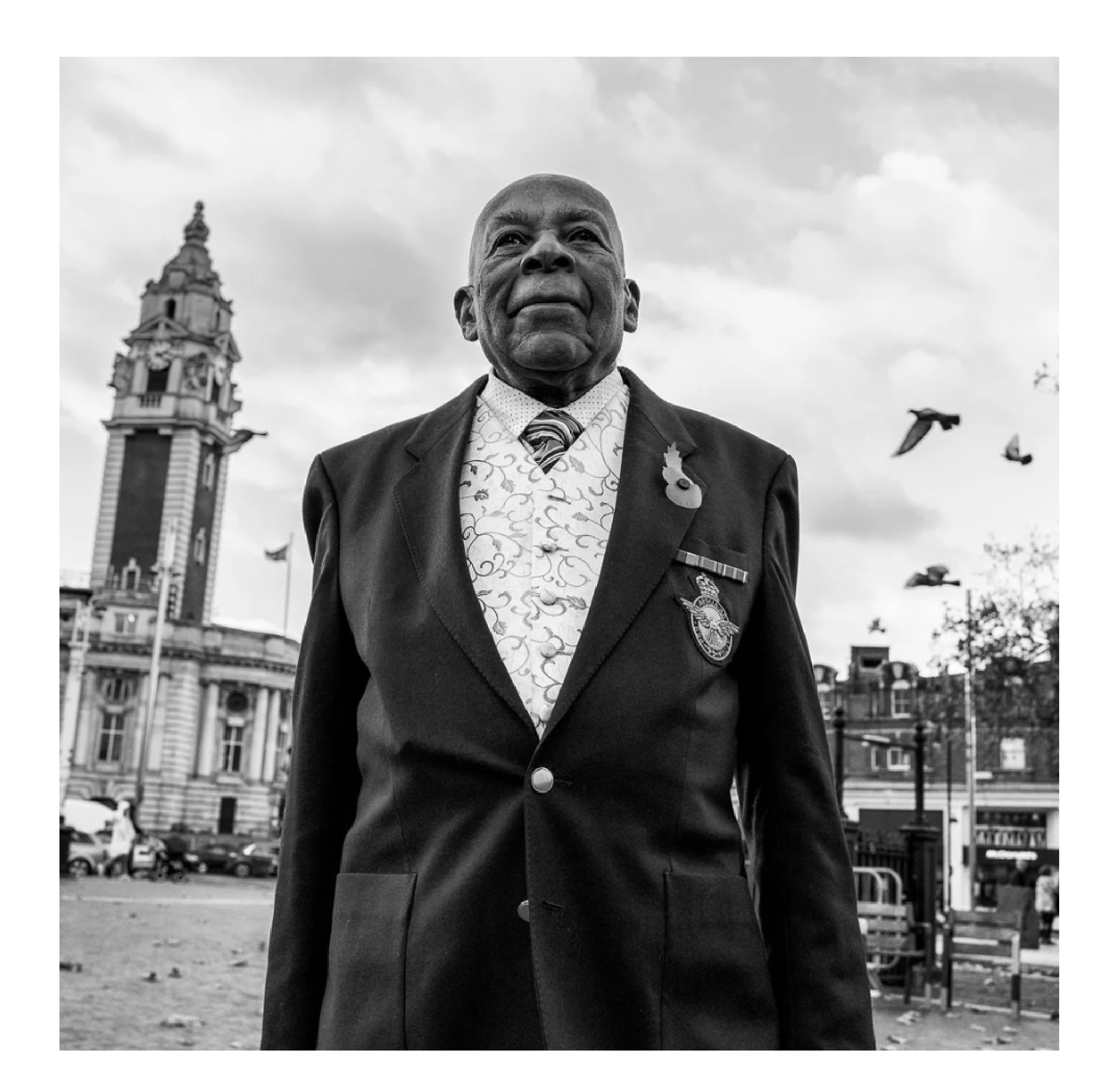
A New Orleans-style jazz band led Gilbert Constantine Clarke’s funeral procession through East Ham on 4 July 2026. RAF personnel carried his coffin into the town hall. Clarke had died on 23 May, aged 100, after becoming a familiar presence at veterans’ gatherings and commemorations. His farewell brought military service into the streets of the London community where he had made his home. The young Jamaican volunteer who once repaired electronic equipment for Hurricanes and Spitfires had lived long enough to help shape how Britain remembered the Caribbean people who served it.1
A practical mind in Montego Bay
Born in Montego Bay in 1925, Clarke lost his father when he was three. His family had little money. A capable pupil, he remained at school for an additional year, leaving at sixteen. Outside the classroom, he experimented with electrical equipment, recharging discarded batteries and bringing old items back into use. Brief employment in a bookshop, followed by work selling clothes, gave him experience of earning a living before military service.2
Newspaper and radio reports of German submarines in Caribbean waters helped persuade him to volunteer. This was a war that might reach Jamaica, rather than an entirely distant struggle. Recalling his decision to the Press Association in 2024, he described the fear that Hitler’s ambitions could extend to the Caribbean and South America. “It was important not to do nothing,” he said. Joining the RAF as a teenager was his answer to that danger: a decision to become involved while there was still something he could do.1
The opportunity existed because the war had forced a change in British recruitment policy. In October 1939, the RAF lifted its racial restrictions; recruitment of aircrew in Britain’s Black colonies followed in November 1940. Obstacles continued despite that formal change, and some volunteers paid for their own journeys to Britain or entered the Royal Canadian Air Force. The invitation to serve therefore came from an institution whose doors had previously been restricted by race. An Air Ministry order in June 1944 instructed officers and airmen to act against discrimination towards non-European personnel. That official policy forms part of the background to Clarke’s service, although it cannot describe every encounter that an individual recruit experienced.3
Jamaica supplied the largest Caribbean contingent. The RAF Museum records more than 3,700 Jamaicans in the service by February 1945, within a wartime Caribbean contribution of approximately 6,000 men and eighty women in the Women’s Auxiliary Air Force. Most of the men served on the ground. Clarke belonged to this substantial body of recruits whose work required practical skill, technical instruction and the willingness to undertake the daily tasks on which flying depended.3
Across the Atlantic to Yorkshire
After passing the RAF’s entry tests, Clarke went to the camp at Kingston Palisadoes. His training included military discipline and physical exercises alongside the knowledge required for technical service. Recruits also learned to recognise Allied and enemy aircraft and ships.4
Clarke travelled in the first large contingent of Caribbean recruits to reach Britain in 1944. Their route passed through the United States before the Atlantic crossing and arrival at Liverpool. He then trained at RAF Hunmanby Moor, near Filey. The station had an unusual history: Billy Butlin had begun developing the site as a holiday camp before the government took it over for wartime use. It had no runway or aircraft. Here, military drill, weapons instruction and physical training prepared recruits for later work at other stations. The familiar name of a seaside holiday destination concealed a demanding introduction to service life.5
D-Day remained one of Clarke’s strongest wartime memories. In his 2024 interview with the Associated Press, he recalled looking up as a mass of aircraft filled the sky on 6 June 1944. He was still training when the noise announced that the invasion of France had begun. The men cheered. Their reaction held both excitement and hope that the war might be moving towards its end. For Clarke, the event would remain inseparable from the sound of engines and the extraordinary number of aircraft overhead. Later, he maintained radio and radar systems in British and American aircraft.6
The work behind the aircraft
His account of workshop life was more detailed than the simple description “RAF mechanic” suggests. Interviewed by ITV in July 2023, Clarke explained that he repaired equipment, tested it and took it back to the aircraft. Damaged components required judgement as well as manual skill. Supplies were limited, and the workshop’s task included recovering whatever could still be made useful. “We tried to salvage what we could,” he remembered. This was maintenance conducted under the pressure of keeping military equipment available.7
Clarke’s recollection places the tools and instruments of that work beside the larger events of the war. He remembered mending equipment and testing instruments when the sound of aircraft drew attention outside. He also recalled anxiety about how the conflict would end and the relief brought by American supplies. The workshop was part of that wider dependence on material, repairs and replenishment. His contribution involved making equipment serviceable again, a practical responsibility repeated each time something damaged reached the bench.7
The scale of the air effort explains why such work mattered. Allied aircraft flew more than 14,000 sorties in support of the D-Day landings. Before the invasion, bombing had targeted transport routes to obstruct German reinforcement, while aerial reconnaissance gathered intelligence on coastal defences. Transport aircraft and gliders carried troops into Normandy. These were different operations with different immediate purposes, joined by a dependence on aircraft and equipment that could be relied upon. Clarke’s later accounts help bring the maintenance work behind that immense undertaking into the history of the campaign.8
Building a life beyond the RAF
Clarke’s service continued after the war. The Royal British Legion records his demobilisation on 9 July 1948 and his subsequent work as a radio and television engineer. Another part of his RAF education endured too: he had learned the piano during his service and continued playing into old age.9
Civilian life took him through several London neighbourhoods. A 2025 profile in Newham Voices traced his homes from Kensington to Putney and then Harold Hill, where he and his wife raised their family among other former service families. His electrical knowledge helped him find employment, including appliance repairs for Rumbelows. These details give substance to the years between demobilisation and public recognition: finding work, establishing a household and using a wartime trade to support everyday life.10
His experience of Britain also included racial prejudice. Clarke believed his lighter complexion had sometimes made life easier, but he recalled customers who looked through their curtains rather than opening their doors to him. He moved on to the next job. His account held different experiences together: employment and supportive neighbours, alongside occasions when he was treated with suspicion. After retirement he moved to Plaistow, the part of Newham closely associated with his later life.10
Music gave that life another dimension. For Immediate Theatre’s Hackney and Newham history project, Clarke shared memories of his enthusiasm for jazz and the bands he had played in over the years. He also discussed his television work and ambitions for part-time farming. The project preserves these recollections alongside the experiences of other local residents, with full interviews available through Hackney and Newham archives. The range matters: Clarke’s recorded life includes interests, work and possibilities beyond the uniform in which he was so often photographed.11
Making Caribbean service visible
In June 2021, Clarke took part in the opening of the British Normandy Memorial. Pandemic restrictions prevented the planned veterans’ journey to France, so volunteer drivers from the Taxi Charity for Military Veterans took the group to the National Memorial Arboretum in Staffordshire. There, in the rain, they watched the opening through a live link. Clarke and fellow veteran Ken Hay spoke during the service. His participation connected the new memorial with men whose experiences still gave its ceremonies a direct human voice.12
The memorial at Ver-sur-Mer carries the names of 22,442 people who died under British command during D-Day and the Battle of Normandy. Its opening was therefore a commemoration of many individual lives. Clarke’s presence among the speakers helped place Caribbean service within that shared act of remembrance. The occasion also showed how much depended on practical arrangements: drivers, transport and an alternative gathering made it possible for veterans to participate when travel abroad was closed to them.12
Another important return was to Filey. In April 2023, Clarke joined other Caribbean veterans at the unveiling of a plaque commemorating the recruits trained at Hunmanby Moor. Photographs from the event show him among men whose lives had passed through the same wartime station. After the unveiling, participants shared a Caribbean lunch and viewed displays of historical material. A place that had once introduced them to British military life had become somewhere their own experiences could be publicly remembered.5
The RAF’s report of the unveiling records more than a hundred people attending the ceremony on 1 April. The plaque recognised the approximately 4,000 Caribbean servicemen who had trained near Filey. That local focus was significant. It attached the history to a town, a former camp and the people who had lived and trained there. Visitors could connect the Caribbean contribution to a specific place in Yorkshire, rather than encounter it only as a distant national statistic.13
Clarke also helped connect wartime service with the history of migration. Patrick Vernon recalled sitting beside him on a panel at the Imperial War Museum marking the seventy-fifth anniversary of Windrush. Clarke could speak about both service and the subsequent making of a home in Britain. His life extended the discussion backwards into the war and forwards into the communities established afterwards. The association with the Windrush generation concerned that larger history of settlement and belonging; his wartime journey to Britain had preceded the famous 1948 arrival.14
A century of experience
The remembrance work continued as Clarke approached his hundredth birthday in late 2025. Vernon recorded his participation that October in a visit to the graves of Caribbean soldiers who had served in the First World War. Clarke was remembering an earlier generation as well as representing his own. His centenary brought together those overlapping histories: a childhood in Jamaica, wartime service and the long experience of building a life in Britain while helping others understand the people who had come before them.14
At his funeral the following July, those relationships were visible in the organisations gathered around his family. Councillor John Gray, who attended on behalf of Newham’s mayor, recorded a military tribute by Air Commodore Alun Roberts and the participation of the RAF Regiment bearer party. Family and friends had organised the service with veterans’ organisations and the Caribbean Social Forum. The town hall was full. The commemoration that Clarke had helped sustain for other Caribbean servicemen had become an act of remembrance for him.15
Sources and further reading
1. Press Association / The Standard: Jamaican WWII veteran who joined RAF at 16 remembered as ‘courageous and humble’.
2. African Stories in Hull & East Yorkshire: Gilbert Clarke: own recollections supported by Alan Clarke (son).
3. Royal Air Force Museum: The Second World War, 1939 to 1945: Recruitment.
4. RAF Stories / Royal Air Force Museum: Joining Up: Gilbert Clarke interviewed by Jess Boydon-Jukes.
5. Historycal Roots; Audrey Dewjee: The Forgotten 4,000: West Indian Airmen at RAF Hunmanby Moor, Filey.
6. Associated Press: Remembering D-Day, RAF veteran Gilbert Clarke recalls the thrill of planes overhead.
7. ITV News Meridian: D-Day 80 The Last Veterans: Gilbert Clarke.
8. Imperial War Museums; retrieved through UK Government Web Archive: How D-Day Was Fought From The Air.
9. Royal British Legion: Gilbert Clarke.
10. Newham Voices; Julia Omari: Veteran Gilbert speaks for a generation of pioneers and heroes, p. 11, October 2025.
11. Immediate Theatre: Voices of Change & History Social Club Contributors.
12. Taxi Charity for Military Veterans: WWII veterans delighted as British Normandy Memorial opens.
13. Royal Air Force: Blue plaque unveiled for Caribbean WWII volunteers.
14. Patrick Vernon: Celebrating 100 Remarkable Years: Honouring RAF Veteran Gilbert Clarke.
15. John Gray, John’s Labour Blog: Celebrating the Life of Gilbert Constantine Clarke: RAF World War 2 Veteran / Windrush Pioneer / Musician / Community Elder.