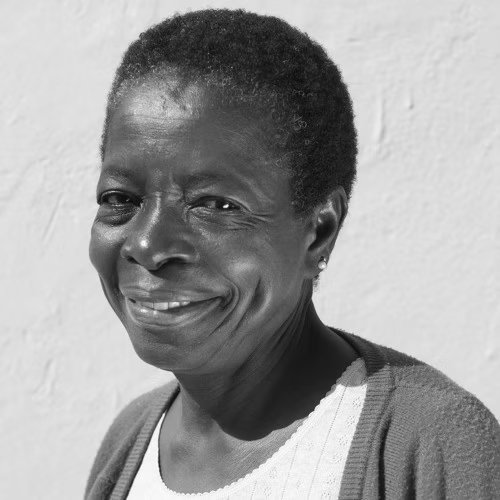
Altheia Jones-LeCointe’s place in Black British history connects scientific study with political organising. A Trinidadian researcher at University College London, she became a central figure in the British Black Panthers and one of the Mangrove Nine defendants. Her activities included political education, community organisation and the defence of people confronting racism in everyday life.1
Her importance also raises a question about how movements are remembered. A courtroom photograph can preserve a face, and a celebrated trial can preserve a name. The sustained work around those moments requires a fuller account: the meetings, reading, conversations and relationships through which a community learned to organise. Jones-LeCointe’s story brings that work, and the women involved in it, into view.7
From Trinidad to London
Her political education began in Trinidad, where her parents were involved in the People’s National Movement. She grew up around campaigning connected with independence and the future of the country. When she came to UCL in 1965 to study biochemistry, she therefore arrived with experience of political discussion as well as academic ambitions. She went on to earn a doctorate in the subject.1
London brought encounters with racism that unsettled her expectations of Britain. She later recalled accommodation lists divided according to whether landlords would accept Black students. Such experiences put discrimination into the routines of student life. Finding somewhere to live could expose the distance between gaining admission to a university and being treated as an equal in the city around it.1
Organising with the British Panthers
The British Black Panther Movement was founded in London in 1968 by the Nigerian writer Obi Egbuna. Inspired by the American Black Panther Party, it was organisationally separate. Jones-LeCointe became a central organiser after Egbuna’s departure. The movement developed a presence beyond its original Notting Hill setting, with activity in Brixton and other parts of London.2
Political education was part of belonging to the organisation. Members read and discussed ideas, organised meetings and brought Black history into youth clubs and cultural spaces. Linton Kwesi Johnson, who became involved as a young person, later recalled the close relationship between culture and politics. Workshops, public events and the youth league were ways of drawing people into discussion. The movement also had supporters who attended demonstrations without becoming members; the distinction matters when assessing its reach.2
Panther publications connected racial discrimination with the organisation of work, wealth and empire. Their arguments therefore reached beyond individual prejudice to ask how institutions and economic arrangements shaped people’s lives. These ideas informed their campaigns and the education they offered to members.2
The British movement’s use of the word Black included a political alliance across African, Caribbean and South Asian communities. People had different histories and experiences, but could organise together against racial discrimination, immigration restrictions and unequal treatment. This helps explain why a profile of Jones-LeCointe also involves activists whose backgrounds were different from her own.3
Among them were the writers Mala Sen and Farrukh Dhondy. The movement’s newspaper, Freedom News, gave members a means to record their experiences and communicate their arguments. Such work made organising an ongoing process: gathering information, deciding what to publish and taking those accounts back into the community. Solidarity was expressed through this practical activity as well as through speeches and demonstrations.3
Why the Mangrove mattered
The Mangrove restaurant opened in Notting Hill in 1968. Its owner, Frank Crichlow, had come from Trinidad, and the business became an important meeting place for London’s Caribbean community. People went there to eat, socialise, discuss politics and support one another. A restaurant could provide the setting for relationships that extended into housing, employment and the wider life of a neighbourhood.4
Repeated police raids disrupted that space. Crichlow complained to the Race Relations Board, and an action committee prepared a protest. The march took place on 9 August 1970 amid a large police presence and ended in clashes and arrests. Documents preserved by the National Archives include a police witness statement and a newspaper report carrying marchers’ accounts. They present sharply different descriptions of how the confrontation developed, showing why control of the public account became part of the struggle.4
The National Archives records twelve police raids between January 1969 and July 1970, with no evidence of illegal activity found. The following year, nine defendants stood trial at the Old Bailey following the march. Jones-LeCointe was among them. After a trial lasting 55 days, all nine were acquitted of the most serious charges. The case carried experiences of police treatment in a London neighbourhood into a national courtroom.5
Defending themselves and their community
Jones-LeCointe chose to represent herself, as did Darcus Howe. In later accounts, she and barrister Ian Macdonald described a defence that depended on work both inside and outside the court. Supporters filled the public gallery, circulated community bulletins and organised demonstrations, including a women’s march. These activities helped keep the case visible and connected the defendants with the people whose experiences lay behind the protest.6
The political education undertaken by the group also shaped how they understood their position. According to the organisers of the documentary How the Mangrove Nine Won, the defendants studied C. L. R. James’s account of the Haitian Revolution, The Black Jacobins. That reading placed their immediate circumstances within a longer history of Black people organising for freedom. The relationship between study and action, already present in Panther activities, continued through the defence campaign.6
The trial’s outcome needs to be stated accurately. All nine were cleared of the principal riot charge, while four, including Jones-LeCointe, received suspended sentences for lesser offences. The judge’s acknowledgement of racial hatred within the Metropolitan Police was significant. The defendants had made allegations of police racism part of the argument the court had to address, and the case became an important episode in British struggles over equal treatment and justice.8
A Black woman’s place in the record
Jones-LeCointe’s work shows why women need to appear throughout accounts of Black Power. She participated in the movement’s political thinking, education and public defence. Historian Jada Gannaway has argued that studying her life helps recover Black women’s contributions to the connections between Caribbean and British radical politics. That approach asks who organised, who explained ideas and who sustained relationships, alongside the more visible questions of who spoke at demonstrations or appeared in court.7
It also requires care over the word leader. Research reported by Michigan State University in 2026 records Jones-LeCointe’s wish to emphasise the collective nature of the movement. Recognising her central role can sit alongside recognising the others who worked with her. The history includes Black women and men, Afro-Caribbean and South Asian participants, and communities whose involvement gave the organisation its purpose.10
Remembering through film and research
The 1973 documentary The Mangrove Nine, made by Franco Rosso and John La Rose, preserves interviews recorded before the verdicts were announced. That timing allows viewers to encounter the defendants’ experiences while the outcome was still uncertain. The film remains a source through which their own voices can be heard.8
A later dramatisation introduced the case to new audiences. Steve McQueen’s Mangrove, part of the 2020 Small Axe anthology, featured Letitia Wright as Jones-LeCointe. The film places a Black woman’s political and legal work within a story of collective resistance. Its appearance on screen also provides a starting point for exploring the surviving documents and testimony behind the drama.9
Research continues beyond the best-known trial. Gannaway’s work has involved interviews with relatives and associates in Trinidad and London, alongside records in the Alma Jordan Library and elsewhere. These sources help connect family life, migration and political work across borders. They also make room for the quieter parts of a life whose public image has often been concentrated into a few photographs and one court case.10
Sources and further reading
1. Students’ Union UCL, Julia Chaffers: Saluting Our UCL Sisters: Elsa Goveia and Altheia Jones-Lecointe.
2. Special Branch Files Project, Rosie Wild and Eveline Lubbers: Black Power: Main groups, 17 September 2019.
3. South Asian Britain: Connecting Histories, Ellen Smith: British Black Panthers.
4. The National Archives: The Mangrove Nine: resource pack.
5. The National Archives: Mangrove Nine protest.
6. Global Women’s Strike and Women of Colour GWS: How the Mangrove Nine Won, 3 November 2020.
7. North American Conference on British Studies, Jada Gannaway: Althea Jones-Lecointe: Black Women Activists and Historical Scholarship, 9 June 2023.
8. George Padmore Institute: Mangrove Nine Documentary (1973).
9. British Film Institute, Sight and Sound, Alex Ramon: Mangrove relays Black British struggles of the past, 19 November 2020.
10. Michigan State University, Delaney Cram: Jada Gannaway builds relationships across oceans while conducting dissertation research, 10 March 2026.