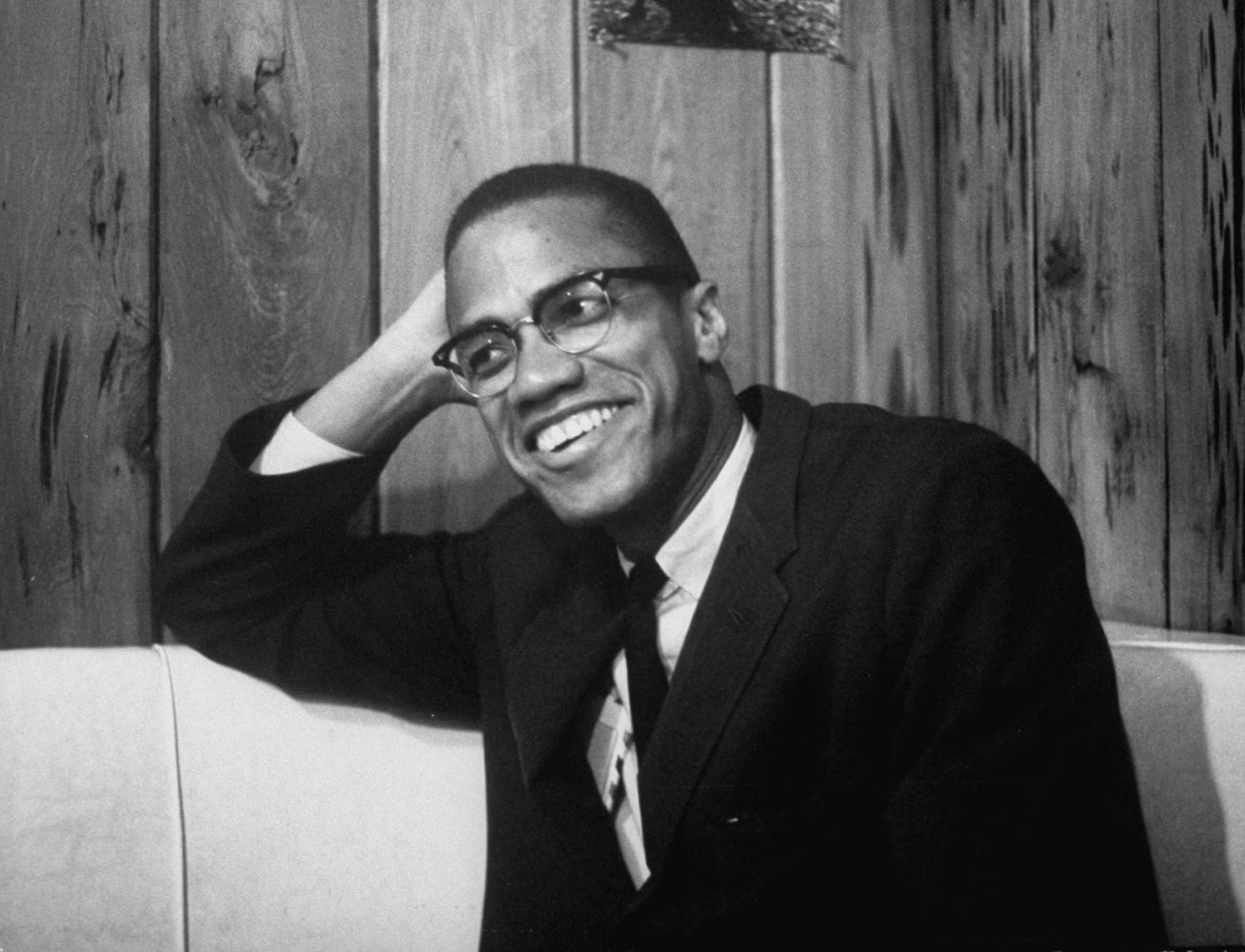
Malcolm X spoke about the right of Black people to define their own lives. His speeches connected dignity with practical questions: who controlled a neighbourhood’s businesses, whose voices counted in politics, and how people understood their African heritage. His ideas developed through faith, reading, organising and travel. Following that development reveals a life larger than its most familiar photographs: a public speaker who repeatedly reconsidered how freedom might be achieved.1
A childhood shaped by Black political life
Born Malcolm Little in Omaha, Nebraska, on 19 May 1925, he grew up in a family already involved in the struggle for Black advancement. His parents, Earl and Louise Little, supported Marcus Garvey’s movement. Political discussion was part of the household long before Malcolm became a public figure. The family also faced threats from white supremacists, and moved during his childhood. Experiences of racial hostility entered his life at an age when most children were only beginning to understand the world outside their homes.2
The family’s connections to Garveyism offered something beyond a response to discrimination. The Universal Negro Improvement Association encouraged pride in African history, economic independence and solidarity among people of African descent. Those concerns would reappear in Malcolm’s own arguments decades later. His parents’ involvement helps explain why Africa occupied such an important place in his thinking: it was part of a political inheritance within his family, as well as a continent he would eventually visit for himself.1
His childhood was also marked by loss. His father died in 1931, and his mother later entered a psychiatric hospital. The children were separated into different homes. At school, Malcolm did well academically, but a teacher discouraged his ambition to become a lawyer because he was Black. In 1941 he moved to Boston to live with his half-sister Ella Little-Collins. The city introduced him to a larger Black community and a different social world, alongside the difficulties of finding a direction as a young man.3
Education, faith and a new name
In 1946 Malcolm was imprisoned following a burglary conviction. During his sentence he began a sustained programme of reading and study. Contact with his siblings introduced him to the Nation of Islam, led by Elijah Muhammad. He studied its teachings while working on his education. These years brought changes in his religious beliefs and in his understanding of himself. The future minister’s development depended on patient learning, family encouragement and the effort to give his life a different direction.4
After his release in 1952, he adopted the name Malcolm X. The letter represented the African family name lost through enslavement, replacing a surname he associated with that history. A name became a way of making a historical argument in everyday life. He committed himself to the Nation of Islam and began the work that would take him into its ministry, carrying questions about ancestry, identity and independence into his public speaking.4
Building an audience
Malcolm became an important organiser and spokesman for the Nation of Islam, travelling to build its membership and leading its Harlem congregation. His speeches reached people beyond religious meetings, and a 1959 television documentary about the movement increased public attention. His challenges to police brutality also helped bring national attention to his work. By the end of the 1950s, his audience extended far beyond those who shared his faith. He addressed experiences of humiliation and exclusion in direct language that made the demand for Black dignity difficult to overlook.2
During his years in the Nation of Islam, Malcolm argued for Black self-reliance and a separate society in which Black people could exercise control. He also defended the right to protect oneself against violence. These positions grew from his assessment of the conditions African Americans faced. His emphasis on the value of African heritage challenged the idea that Black people should measure their worth against white approval. Dignity, economic strength and community independence belonged together in the political vision he was developing.5
A new direction in 1964
Malcolm left the Nation of Islam in March 1964. The break opened a period of rapid political and religious development. He established Muslim Mosque, Inc., and began working towards a wider public programme. Travel would soon give him new experiences through which to test his ideas. He continued to confront American racism, while exploring how religious fellowship and cooperation across communities might fit with the independence he wanted for Black people.5, 7
His April 1964 speech, The Ballot or the Bullet, showed the practical questions occupying him. He urged Black audiences to recognise shared interests across religious differences and to understand the power of their votes. Political support, he argued, should bring results for the people giving it. He connected voting with economic organisation, including control of local businesses and the creation of employment. The speech treated ordinary people as political actors who could study their circumstances, organise together and make demands. It also conveyed his urgency: equality should become a present reality, rather than remain a promise indefinitely postponed.6
Later that year his pilgrimage to Mecca brought him into contact with Muslims from different racial backgrounds. These encounters helped change his understanding of the possibilities for human fellowship. He embraced orthodox Islam and became known as El-Hajj Malik El-Shabazz. His commitment to Black empowerment continued, but his developing outlook made more room for brotherhood across racial lines. Religious experience and political thought were closely connected: meeting people whose lives challenged his assumptions became part of the process through which he revised them.7
Connecting America with the wider world
The Organization of Afro-American Unity gave his new direction an organisational form. Malcolm wanted to connect the situation of African Americans with an international struggle for human rights. His journeys through Africa and the Middle East served two connected purposes: strengthening relationships within the Muslim world and developing links between Black Americans and emerging African nations. The correspondence and travel diaries preserved by the Schomburg Center record this outward-looking work. His political map increasingly joined neighbourhood concerns in the United States with conversations taking place across national borders.8
He also explored cooperation within the American freedom struggle. In March 1964 he met Martin Luther King Jr. at the US Capitol, their only face-to-face meeting. He later made contact with organisers including John Lewis and Fannie Lou Hamer. Early in 1965 he travelled to Selma, Alabama, while King was in jail, and spoke privately with Coretta Scott King. Their approaches remained distinct, but these encounters show Malcolm engaging with the people and campaigns working for change in the South. He was seeking relationships as well as developing arguments.9
Malcolm X in Britain
Britain formed part of this international story. On 3 December 1964 Malcolm spoke at the Oxford Union, at a debate chaired by Eric Anthony Abrahams. Discussions about freedom there had a local significance: a survey that year had exposed racial discrimination in accommodation offered to students. In his address, Malcolm connected the defence of human life with the need to change unjust conditions. He also expressed a willingness to work with people of any colour who shared that purpose, giving a British audience a direct view of his evolving position.10
On 12 February 1965 he visited Smethwick, where racial hostility had become a national issue following the previous year’s general election. Contemporary television footage preserved by the Media Archive for Central England shows him walking along Marshall Street, looking at a house offered for sale and speaking with reporters. The visit placed an internationally recognised Black campaigner in a British street shaped by arguments about race and belonging. It connected his concern with American conditions to questions being faced in Britain.11
A life preserved in words
Malcolm X was assassinated in New York on 21 February 1965, aged thirty-nine. The Autobiography of Malcolm X, written with Alex Haley, appeared after his death. It carried the account of his childhood, education, faith and changing convictions to readers who had never heard him speak. His life ended while important parts of his political programme were still developing, leaving readers to consider the movement of his ideas across a very short public career.3
Recordings preserved in the US National Archives offer another way of encountering that career. Speeches, debates and broadcasts retain the voice behind the printed pages, alongside records of his public activity. Read and heard together, they invite attention to the questions he kept returning to: power, dignity and Black people’s ability to shape their future. His contribution remains available through the work itself, in arguments made to different audiences at different moments in his life.12
Sources and further reading
1. Smithsonian National Museum of African American History and Culture: Who Was Malcolm X?.
2. PBS American Experience: Malcolm X.
3. US National Park Service: Places of Malcolm X.
4. The Official Website of Malcolm X: Biography.
5. US National Park Service: Nebraska: Malcolm X House Site Omaha.
6. Teaching American History, Ashbrook Center: The Ballot or the Bullet, 3 April 1964.
7. US National Park Service, Selma to Montgomery National Historic Trail: Malcolm X.
8. New York Public Library, Schomburg Center for Research in Black Culture: The Malcolm X collection: papers.
9. Stanford University, Martin Luther King, Jr. Research and Education Institute: Malcolm X.
10. The Oxford Union Society: About Us: Malcolm X on Extremism.
11. Media Archive for Central England: Midlands News: 12.02.1965: Malcolm X.
12. US National Archives and Records Administration: Malcolm X (May 19, 1925 – February 21, 1965).