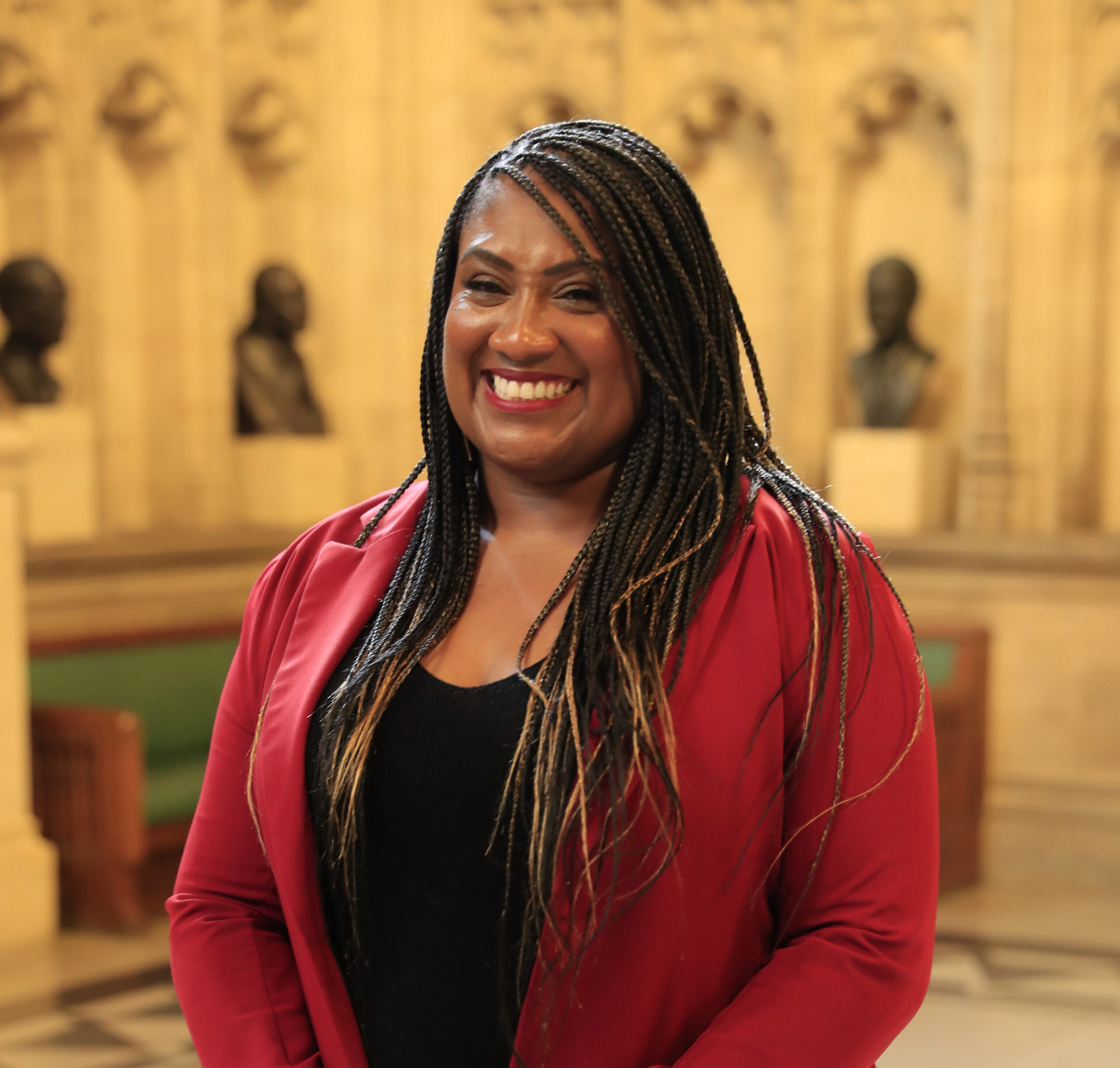
When Bell Ribeiro-Addy made her first Commons speech on 30 January 2020, she thanked Diane Abbott for her mentorship and challenged Britain to confront the injustices of empire. She had arrived in Westminster with causes already formed through campaigning. Her account of belonging was local and international at once: a childhood on Brixton Hill, solidarity with migrants and an insistence that Britain’s relationships with formerly colonised peoples involved obligations as well as opportunities.1
First elected for Streatham in December 2019, Ribeiro-Addy became the Labour MP for Clapham and Brixton Hill following the boundary changes at the July 2024 election. By October 2026, her parliamentary work included membership of the Home Affairs Committee. Earlier service on the Women and Equalities Committee and the Joint Committee on Human Rights had brought her into detailed investigations of discrimination and the use of state power.5
Brixton, education and political formation
Ribeiro-Addy grew up on Brixton Hill and has continued to describe the area’s traditions of activism, faith and mutual support as the foundations of her politics. Her constituency office is on the same hill, with surgeries and casework providing a regular point of contact for residents seeking help. That geographical continuity connects the experiences she brings to Parliament with the everyday concerns of people living in the neighbourhood where she was raised.2
Her education combined science with questions about responsibility and rights. She graduated from Bradford in 2006 in biomedical science with ethics and philosophy of science, then completed a master’s in medical law and ethics at Queen Mary University of London in 2007. A graduate diploma in law followed in 2015. Operation Black Vote’s profile records her Ghanaian heritage and her work as a political adviser and chief of staff to Abbott before she entered Parliament herself.3
A university friend’s deportation became an important part of the story she told about her political beginnings. In a 2020 interview, she recalled a Kenyan student at Bradford phoning her from detention after working more hours than his visa permitted. She said he was deported within weeks. The episode gave immigration rules a personal immediacy: a fellow student’s education and future could be interrupted by an administrative system whose consequences his friends had scarcely understood.4
She joined Labour after campaigning for Chuka Umunna in 2010. As she later explained to MPs, she had been sceptical of the party because of tuition fees and the Iraq war. A conversation with another campaigner convinced her that people who shared those objections also belonged within it. Working for Abbott subsequently gave her a political apprenticeship with Britain’s first Black woman MP. In her maiden speech, Ribeiro-Addy acknowledged the encouragement and example that relationship had provided.1
Immigration and the meaning of contribution
As shadow immigration minister in early 2020, she challenged the assumptions behind the Conservatives’ proposed points-based system. Responding to Priti Patel that February, she disputed the equation of low wages with low skill and warned about recruitment in social care. She also questioned what the rules would mean for families and access to support. Her argument centred on the work migrants already performed and the relationships they sustained, challenging a policy debate dominated by salary thresholds and eligibility categories.6
On the Home Affairs Committee in February 2025, she questioned the department’s senior officials about charges for children registering their entitlement to British citizenship. The permanent secretary pointed to fee waivers; she pressed him on the money the department still received. She then asked where asylum applicants went when hotels closed and what had been spent acquiring alternative sites. Officials acknowledged that some people moved between hotels and described changes to the checks made before purchasing accommodation.18
The Windrush scandal supplied another test of how the state treated people whose contribution it publicly celebrated. In her June 2025 constituency update, Ribeiro-Addy reported pressing for a faster and fairer compensation scheme. She welcomed encouraging signs from ministers while arguing that people were still waiting too long. During the same period, she joined Brixton’s Big Caribbean Lunch in Windrush Square, placing community celebration alongside continuing demands for redress.7
A sustained campaign on Black maternal health
Black maternal health became a substantial area of her parliamentary work. The all-party group she chaired brought MPs and peers together around racial inequality in maternity services, with the campaign organisation Five X More providing its secretariat. That relationship created a route through which campaigners’ knowledge and women’s experiences could reach parliamentarians. The group’s membership crossed party lines, allowing work on the subject to extend beyond Labour’s internal debates and parliamentary speaking time.8
At a Women and Equalities Committee hearing in July 2022, she asked ministers what target they would set to reduce the gap in maternal deaths. She then pressed witnesses on how local maternity services’ equality strategies would be assessed. These were questions about the machinery of accountability: which outcomes would be measured, who would evaluate progress and how a general promise to improve care would become a standard against which institutions could be judged.9
The answers exposed a real policy disagreement. The minister and clinical witnesses cautioned that a narrow numerical target could produce unintended effects, while small numbers made some comparisons difficult. Ribeiro-Addy also questioned whether promised workforce funding matched the scale of need. The exchange showed the competing demands facing the campaign: secure a clear commitment to change, while ensuring that measurement, staffing and clinical practice supported safer care rather than simply producing another performance indicator.9
She continued to raise the issue after Labour entered government. In October 2025, she criticised the NHS ten-year plan for failing to make explicit mention of Black maternal health and pressed ministers to honour the party’s commitment to a target. Her intervention was directed at her own side. It also reflected a longstanding concern that broad health strategies could leave racial inequality insufficiently addressed unless responsibility and the expected improvement were clearly stated.10
In April 2026, she supported the proposed creation of a maternity commissioner. She argued for an identifiable authority to follow up recommendations, confront racial bias and bring together data that distinguished different groups’ experiences. She welcomed the national maternity investigation led by Baroness Amos but warned against producing findings without implementation. The minister reaffirmed the government’s commitment to a target informed by that investigation. At that debate, the campaign had secured an answer and a continuing commitment; it had not established that the underlying inequalities were resolved.11
Reparations beyond a single payment
Her work on reparative justice has also involved organising beyond the Commons chamber. As chair of the all-party group for Afrikan Reparations, she helped bring parliamentarians into discussion with campaigners and other organisations. The group’s declared remit included the return of cultural objects, development and responses to the legacies of enslavement and colonialism. The African Foundation for Development provided its secretariat, supporting this connection between organised campaigning and parliamentary work.12
During Black History Month in 2024, Ribeiro-Addy set out a conception of reparations broader than arguments over a single financial sum. Her examples included returning artefacts, teaching history accurately, cancelling debt and addressing environmental damage. She argued that money alone could never compensate for the suffering inflicted. These proposals involved different institutions and decisions: museums’ collections, education, international finance and the consequences of exploitation all formed part of the discussion she wanted Britain to enter.13
In February 2025, she asked the government to engage with African and Caribbean discussions on reparatory justice, pointing to the African Union’s focus on the subject. Refusing a conversation, she argued, would not prevent that conversation from happening elsewhere. The minister’s answer maintained the government’s opposition to paying reparations. This was a clear limit to her influence: she could challenge the position and demand engagement, but she had not secured a change in government policy.14
On 25 March 2026, she presented a petition calling for a formal apology for Britain’s role in African enslavement and colonialism and an all-party commission of inquiry on truth and reparatory justice. The petition distinguished an apology from earlier expressions of regret. It envisaged acknowledgment as the beginning of discussion with affected communities and countries. The commission remained a proposal in that intervention, giving her campaign a specific institutional demand rather than leaving it solely at the level of historical condemnation.15
Arguing within Labour
Ribeiro-Addy’s position on Labour’s left became particularly visible during the party’s 2025 deputy leadership contest. Writing her own candidate statement, she identified herself with the Socialist Campaign Group and called for wealth taxation, stronger participation by members and a willingness to tolerate dissent. She opposed responding to Reform UK by adopting its framing of migration. Her preferred response combined redistribution and public investment with the defence of migrants’ dignity, an argument about the direction of Labour as a governing party.16
Her bid did not reach the membership ballot. Labour’s final nominations list records 24 MPs supporting her, below the 80 required to advance; Bridget Phillipson and Lucy Powell qualified. She had used the contest to articulate a programme but could not assemble the parliamentary support needed to take it to members.16, 17
Her opposition to proposed disability benefit cuts illustrated the practical grounds on which she challenged government decisions. Reporting meetings with disabled trade union representatives in June 2025, she argued that support could enable people to remain in employment and that removing it might undermine that ability. She rejected judging disabled people’s contribution solely through cost savings. As with her arguments about migration and maternity care, she asked policymakers to account for the lives affected by the categories and calculations they used.7
Sources and further reading
1. UK Parliament, Hansard: Global Britain, 30 January 2020: maiden speech.
2. Bell Ribeiro-Addy MP: About Bell.
3. Operation Black Vote archive: Bell Ribeiro-Addy MP (Labour).
4. Morning Star, Bethany Rielly interview: Challenging racism and injustice in the House of Commons, 13 March 2020.
5. UK Parliament: Parliamentary career: Bell Ribeiro-Addy.
6. UK Parliament: Home Secretary updates MPs on the new points-based immigration system, 24 February 2020.
7. Bell Ribeiro-Addy MP: An update from your local MP, 27 June 2025.
8. UK Parliament: Register of All-Party Parliamentary Groups: Black Maternal Health, 18 May 2026.
9. House of Commons Women and Equalities Committee: Black maternal health: oral evidence, 13 July 2022.
10. Bell Ribeiro-Addy MP: The Government Must Set a Target to Close the Maternal Mortality Gap, 16 October 2025.
11. UK Parliament, Hansard: Maternity Commissioner, 20 April 2026.
12. UK Parliament: Register of All-Party Parliamentary Groups: Afrikan Reparations, 2 January 2025.
13. Bell Ribeiro-Addy MP: Rethinking Reparations: Black History Month Debate 2024.
14. UK Parliament, Hansard: Historic Slavery: Reparations, 25 February 2025.
15. UK Parliament, Hansard: Britain’s Role in African Chattel Enslavement and Colonialism, 25 March 2026.
16. LabourList, article by Bell Ribeiro-Addy: The deputy leadership contest must be an open, honest and democratic debate about Labour’s direction, 10 September 2025.
17. The Labour Party: Deputy Leadership Election 2025: final PLP nominations.
18. House of Commons Home Affairs Committee: The work of the Home Office: oral evidence, 4 February 2025.