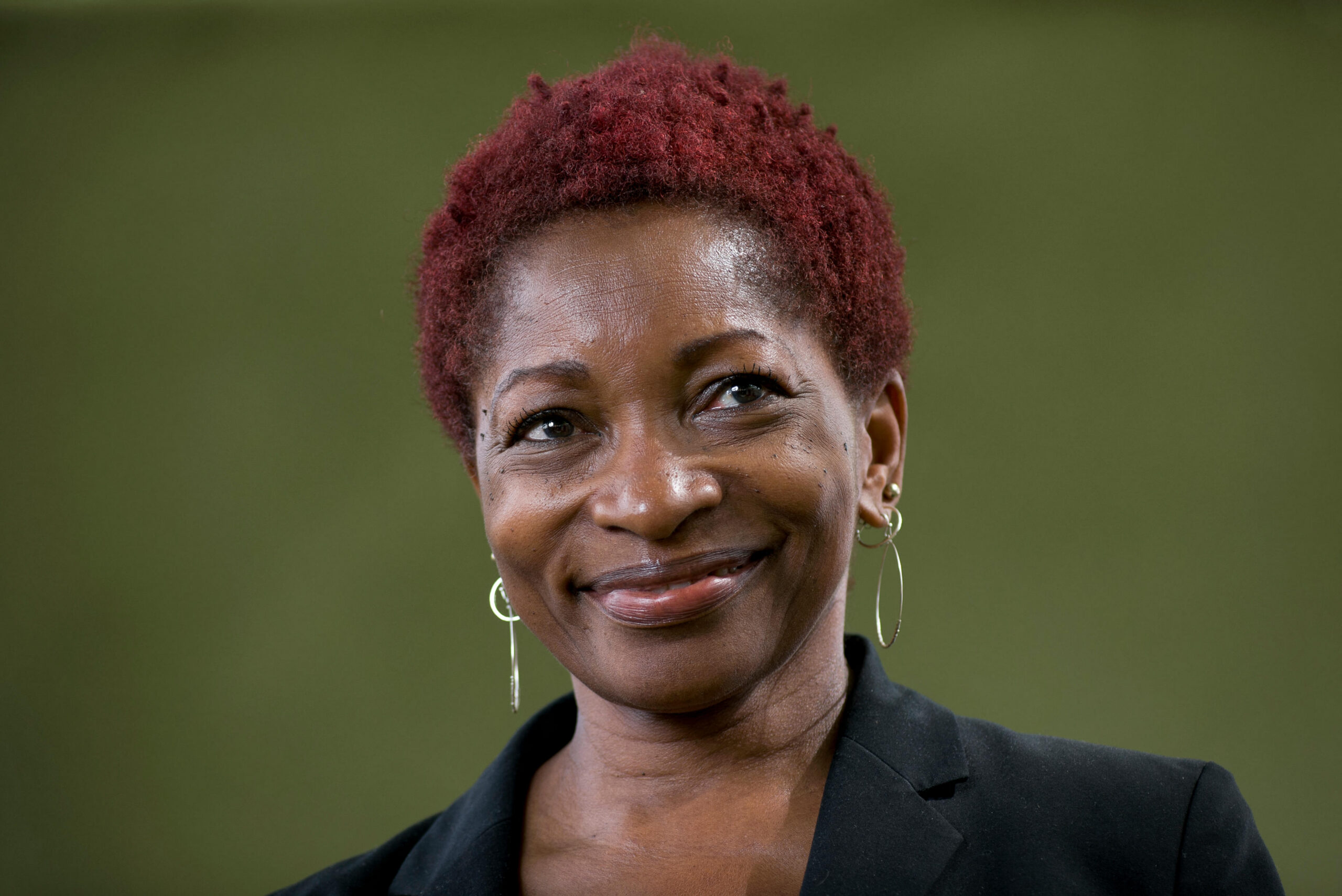
Bonnie Greer built a career around the conviction that a person could contain more than one story. A novelist could also be a playwright; a critic could be deeply attached to popular entertainment; an American upbringing could inform a substantial contribution to British cultural life. Her work moved between fiction, music, broadcasting and the institutions responsible for preserving history. For audiences who knew her through Newsnight Review or Question Time, the books and plays open another route into that broad, questioning intelligence.1
Born on 16 November 1948, Greer died on 15 September 2026, aged 77.2
Chicago, London and the work of becoming a writer
Chicago was her starting point. She grew up on the South Side and studied playwriting with David Mamet, before working with Elia Kazan in New York. That theatrical education mattered to the range of her later practice: words were material for performance, argument and encounter as well as for the printed page. The Royal Society of Literature also records her use of Shakespeare as a tool for literacy. Her relationship with established literature therefore included the practical question of how to make it available to people who might feel excluded from it.3
Greer moved to Britain in 1986 and became a British citizen in 1997. She held writer residencies at Soho Theatre and the Black Theatre Co-operative, developing work within organisations that created opportunities for new dramatic voices. Her play Munda Negra (1993) received the Verity Bargate Award. She wrote more than a dozen plays for BBC radio and helped create Reflecting Skin, a 2004 documentary about representations of Black people in Western art. These projects connected two continuing interests: the lives of women and minorities, and the cultural arrangements through which their experiences became visible, distorted or overlooked.4, 1
Her 2014 memoir, A Parallel Life, approached her own development through the expectations she had been brought up to satisfy. Its account of becoming a woman and a writer considered the pressure to conform in a racist society. Read alongside her fiction, the premise invites a question that extends beyond autobiography: how much of a life is chosen, and how much consists of refusing the identities other people have prepared? The distinction is especially sharp when respectability can promise safety while also narrowing the possibilities of a woman’s future.9
Fiction and the difficulty of belonging
In her first novel, Hanging by Her Teeth (1994), Greer gave those questions to Lorraine, a middle-aged Black American woman teaching Shakespeare in south London. Following her mother’s death, Lorraine’s search for her father takes her through Amsterdam, Paris and London. The journey gradually unsettles the assumption that discovering an origin will explain everything. As the contemporary Kirkus review recognised, the novel resists a simple equation between identity and roots. Its interest lies in the freedom, and uncertainty, of making a self that cannot be tidily accounted for by family or nation. Lorraine’s travels make belonging a problem to investigate, with no guaranteed destination waiting at the end.5, 4
Entropy, published in 2009, returned to absence and connection through a different arrangement of lives. Janet Bookman Baker is trying to understand her father’s death and an earlier unexplained disappearance. A radio voice becomes an intimate presence for her, although its owner, Anna Taylor, does not know she exists and faces difficulties of her own. That premise gives emotional weight to a familiar modern experience: feeling close to someone whose voice enters a room, while remaining a stranger to them. It also offers a useful literary counterpart to Greer’s own public life as a voice heard by people she would never meet.6, 4
Music as a way into history
With Obama Music: Some Notes from a South Sider Abroad (2009), Greer approached an American presidency through community and sound. Gospel, blues, soul and jazz provided ways of thinking about the Chicago environment that had shaped her and that Barack and Michelle Obama came to represent. The book combined personal recollection with the histories of migration, neighbourhood and music. Its method was deliberately intimate: a writer in Britain looking back towards the place she knew, hearing a national political moment through local experience. The result was a perspective on power rooted in the cultural life that preceded an election, rather than a conventional account of a campaign.7
Her biography Langston Hughes: The Value of Contradiction followed in 2011. Even its subtitle establishes a challenge to the neatness often expected of cultural heroes. Greer approached Hughes through the tensions of a writer’s political commitments and the pressures surrounding his choices. The useful principle here is that taking a Black artist seriously requires room for uncertainty and inconsistency as well as accomplishment. A public figure can be studied closely without being reduced either to an exemplary symbol or to a single difficult decision. That willingness to keep competing truths in view links the biography to the questions of identity explored in her novels.8
Her reading was equally resistant to a narrow category. In a 2014 interview with The Irish Times, she named writers including James Baldwin, Jorge Luis Borges, Ernest Hemingway, Nella Larsen and Stefan Zweig. She described writing on scraps of paper, on a computer and in longhand, and identified her own memoir as a particularly demanding research project. She also distinguished the commercial influence of reviews from a writer’s capacity to write. These answers suggest a working literary intelligence: wide in its appetites, practical about its tools, and conscious that a reputation and the act of making work are different things.10
Women, performance and the established classics
Marilyn and Ella brought Greer’s interest in music into a theatrical encounter between Ella Fitzgerald and Marilyn Monroe. Staged at Theatre Royal Stratford East in 2008 and at the Apollo in 2009, the musical play explored their friendship and Monroe’s support for Fitzgerald. Songs formed part of the dramatic material, allowing audiences to hear the artistry around which the relationship developed. As a dramatisation, it gave Greer space to consider the meeting of two women whose public images carried very different meanings. Celebrity, beauty, musical ability and racial exclusion could be examined within a relationship, rather than treated as separate subjects in a lecture.11
In The Hotel Cerise (2016), she worked from the structure of Chekhov’s The Cherry Orchard. Her invented Mountjoy family faced the loss of a resort established for wealthy African Americans. Greer’s accompanying note explained her interest in an affluent Black class that received too little dramatic attention. She wanted to test the supposed universality of the classics by placing women, people of colour and minorities within their territory. Family attachment, inherited privilege and loss were central. That approach also complicated a familiar expectation: Black characters did not have to enter a play solely to demonstrate racist mistreatment. They could possess money, exercise power, misunderstand change and fear losing a world they had taken for granted.12
Her collaboration with composer Errollyn Wallen took a public controversy into another form. Yes, presented in the Royal Opera House’s Linbury Theatre in 2011, used Greer’s libretto and included her on stage. The work considered the fortnight before her 2009 Question Time appearance alongside British National Party leader Nick Griffin. Turning that experience into theatre meant returning to a decision that television had compressed into one evening. It gave the surrounding anticipation and competing voices a form of their own, showing how an encounter in public life could become material for an artist’s continuing investigation.13, 14
The museum as a place for conversation
Greer joined the British Museum’s trustees in 2005 and later became deputy chair. Her relationship with the institution continued through The Era of Reclamation, a discussion series launched in January 2020. The museum described its subject as ownership of identity and of things people consider theirs. That formulation placed questions of interpretation alongside questions of possession. A museum contains objects, but it also determines which relationships between people and objects are explained, which voices visitors hear and whose knowledge is treated as authoritative. Greer helped make those questions part of its public conversation.1, 15
A 2022 event in that series brought together poet Patience Agbabi and the Bishop of Dover, Rose Hudson-Wilkin, to consider refugees, creativity and the possibility of beginning again. The programme included Agbabi’s The Refugee’s Tale and discussion of what cultural institutions might offer people rebuilding their lives. This was an extension of Greer’s interest in belonging into a shared civic space. Literature and historical collections could become starting points for listening, with the purpose of an institution considered through the people who might need it.16
Her eight-part Audible series, In Search of Black History (2019), similarly joined storytelling with historical enquiry. Working with academics and other specialists, she explored lives of African descent across a long timespan, including rulers, religious figures and people whose histories had been neglected. The series combined expert research with imaginative retelling. That combination demanded a distinction between recovered evidence and the devices used to bring it to an audience. Its broader ambition was clear: Black history belonged within the history of humanity, and investigating it could change the familiar account rather than simply add a few names.17
A cultural life with room for others
Greer served as Chancellor of Kingston University from 2013 to 2018, advocating diversity, free speech and higher education’s capacity to support social mobility. An honorary professorship followed her term. Her OBE in 2010 and election to the Royal Society of Literature in 2022 recognised a career whose value lay across several kinds of work. The lasting invitation in that career is to read and listen with greater attention: to a woman seeking her father, a community heard through music, a celebrated writer’s contradictions, or people arriving at a museum with histories of their own.18
Sources and further reading
1. Playwright and novelist Bonnie Greer dies aged 77 — ITV News.
2. Bonnie Greer obituary — The Guardian.
3. Bonnie Greer: Fellow elected 2022 — Royal Society of Literature.
4. Bonnie Greer — SI Leeds Literary Prize.
5. Hanging by Her Teeth — Kirkus Reviews.
6. Entropy: product description — BookXcess.
7. Obama Music: Some Notes from a South Sider Abroad — publisher description — Legend Press / Apple Books.
8. Langston Hughes: The Value of Contradiction — publisher description — Quercus / Apple Books.
9. A Parallel Life — Quercus Books.
10. Brought to book: Bonnie Greer on Hemingway, Borges and Anne Frank — The Irish Times.
11. Marilyn And Ella receives West End premiere — Official London Theatre.
12. A note from Bonnie Greer on The Hotel Cerise — Theatre Royal Stratford East.
13. Sir Alex Beard pays tribute to Bonnie Greer — Royal Ballet and Opera.
14. Yes: review, 23 November 2011 — WhatsOnStage.
15. The British Museum Review 2019–20 — British Museum.
16. Era of Reclamation: Refugee Tales at The British Museum — Comma Press.
17. In Search of Black History with Bonnie Greer — Audible.
18. Kingston University pays tribute to former Chancellor, renowned playwright and broadcaster Bonnie Greer — Kingston University.