Mali’s medieval empire developed within the western Sudan: the broad belt of savanna south of the Sahara and north of the West African forests. This historical geographical term does not mean the modern Republic of Sudan. Farming communities, livestock keepers, merchants and ruling households sustained a political world whose boundaries changed. Mali’s authority rested on relationships between these groups and on routes linking productive regions, towns and desert markets.1
Sunjata and the making of an empire
The thirteenth-century ruler Sunjata, also called Sundiata, stands at the beginning of Mali’s imperial tradition. His story has been transmitted by specialist performers known as jali or griots, whose training encompasses genealogies, praise and accounts of the past. Performances across the Mande world preserve a shared founder while varying in their details. Their history is therefore carried through language, music, professional knowledge and repeated encounters between performers and audiences.2
The epic presents Sunjata’s rise through family relationships, exile, alliances and victory over an adversary. Its concern with ancestry and obligations gives political authority a social setting: a ruler acts among relatives, advisers and allies. These traditions contain historical memory alongside literary invention and supernatural episodes. A written version records a particular telling, rather than replacing the wider tradition. The celebrated founder’s life cannot be reconstructed by treating every episode as an eyewitness account.2
Government across different communities
At the centre of imperial government stood the mansa, or ruler, and a court containing military commanders, financial officials, advisers and religious specialists. The ruler’s principal wife, the qasa, held an important position. A court jeli could act as spokesman, counsellor and organiser of ceremony. Muslim officials brought literacy and contacts beyond the region, while much administration continued through speech. Political authority could draw simultaneously on family standing, armed service and specialised knowledge.3
The provinces were governed in different ways. Some local dynasties retained substantial autonomy under imperial supervision; other districts had an appointed governor, often called a farba, responsible for taxation, security and justice. Control was generally stronger near the imperial heartland and less direct farther away. This arrangement allowed expansion without making every community identical. It also meant that the mansa depended on intermediaries whose local power did not disappear when they acknowledged his superiority.3
Food, transport and gold
Long-distance trade rested on regional production and exchange. Agricultural produce and livestock circulated locally before reaching wider markets, while rulers collected taxes on goods entering and leaving their domains. Horses supported military mobility and elite power; camels made regular desert caravans possible. These animals served different environments and purposes. The empire’s economy consequently extended far beyond the gold that attracted the attention of distant observers.1
Gold from West African producing areas, including the Bure goldfields, entered routes connecting the savanna with North Africa. Salt moved south from Saharan sources, while merchants linked successive markets rather than completing every journey themselves. The prominence of particular routes changed over time as demand and political circumstances shifted. North African centres such as Sijilmasa helped channel gold towards a Mediterranean economy in which it could be minted into coins.4
Mansa Musa’s pilgrimage of 1324–25 made this wealth especially visible. His journey through Cairo towards Mecca involved gifts and spending that contemporary accounts associated with a fall in gold’s value in Egypt. The pilgrimage was an act of Islamic devotion conducted with the resources of a powerful court. Later in the century, the Catalan Atlas depicted Mali’s ruler holding gold. That image records the international reputation of the kingdom, rather than supplying a modern calculation of Musa’s personal fortune.4
A visitor at the royal court
The Moroccan traveller Ibn Battuta visited Mali in 1352–53, during Mansa Sulayman’s reign. His account describes a court where musicians, commanders, attendants and an interpreter gave audiences an elaborate order. He also records hospitality from the judge Abd al-Rahman and other residents. Islamic observance formed part of official life: at a gathering commemorating a deceased Moroccan ruler, the Qur’an was read and prayers offered for both rulers.5
Ibn Battuta praised security on the roads and the protection of property belonging to deceased foreign visitors. He admired attendance at prayer but criticised local forms of dress and behaviour, including women’s social relationships. These judgements reflected his own expectations of Muslim life. His narrative also describes enslaved people serving at court. The account places religious devotion, political hierarchy and coercion within the same society; its praise of public order does not erase those differences in status.5
The empire beneath the ground
Archaeology supplies evidence that royal genealogies and travel narratives rarely describe. At Sorotomo, near Ségou, excavations uncovered successive earthen buildings, gravelled surfaces, pottery, grinding stones, spindle whorls, cowries and a small number of imported objects. The main settlement mound covers about seventy-two hectares. Radiocarbon results from the initial excavations indicated occupation beginning around the early thirteenth century and ending in the fifteenth. Compounds included both round and rectangular spaces.6
Sorotomo belongs to the period of Mali’s imperial power, but identifying one fixed capital remains difficult. Excavations at Niani, often named as the capital, produced dates before or after the crucial imperial centuries in the areas investigated. Royal centres may have changed with rulers, and more than one could operate within a political landscape. Sorotomo’s household objects demonstrate a substantial lived settlement even while its precise relationship to the imperial court remains unresolved.6
Timbuktu under Mali and Songhay
Timbuktu occupied a useful position between Saharan routes and the Niger’s transport network. It passed through Malian and Tuareg control before Sonni Ali incorporated it into Songhay in 1468. Its strongest period of scholarly renown developed in the fifteenth and sixteenth centuries, especially under Askia Muhammad, who ruled from 1493 to 1528. Scholars acquired patronage, travelled and built personal libraries. Timbuktu’s intellectual history therefore continued through major changes in the states governing the region.7
Mosques rebuilt across generations
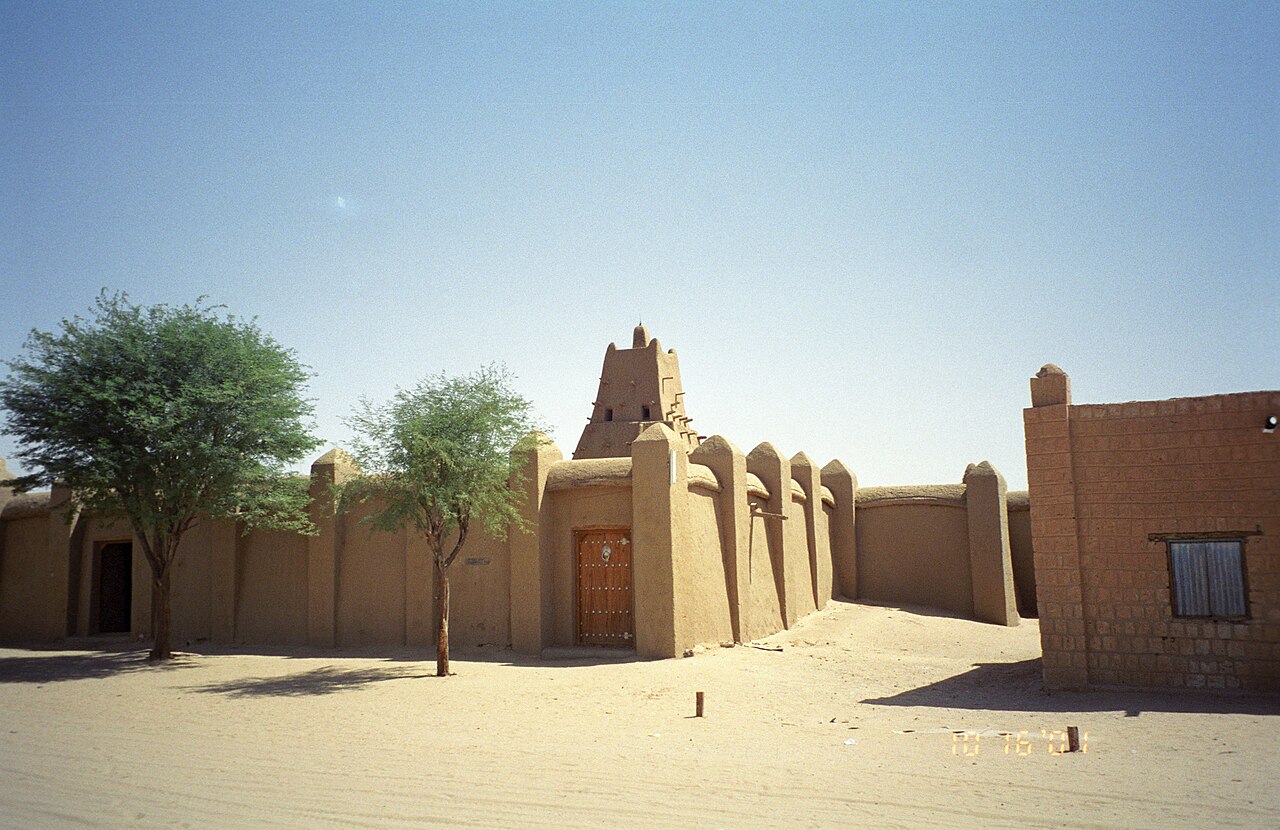
The city’s three great mosques—Djingareyber, Sankore and Sidi Yahia—give this history a physical setting. Their present forms resulted from construction, enlargement, repair and rebuilding over long periods. Djingareyber’s early development is associated with Mansa Musa, but the sixteenth-century qadi Al Aqib also undertook extensive work. Sankore and Sidi Yahia likewise underwent significant sixteenth-century restoration. A medieval foundation date does not mean every visible surface has survived untouched since that moment.8
Earthen architecture depends on recurring maintenance. Walls, terraces and exterior surfaces must be repaired using knowledge of materials and building practice. The mosques consequently preserve the work of successive communities of craftspeople as well as the patronage of named rulers and judges. Their continued religious use also matters: these buildings have been places of worship within neighbourhoods, alongside their association with scholarship and the wider history of the city.8
How scholarship worked
Learning developed through relationships between scholars, students and the owners of books. Timbuktu participated in a regional network that included Walata, Jenne and other settlements, with further contacts across North Africa. Students and teachers moved between centres, carrying texts and forms of expertise. Scholars read established works, copied them, abridged them and composed commentaries. These activities made a manuscript collection a working resource, capable of growing through teaching and exchange.9
Advanced study required a strong command of Arabic grammar and literary expression. Qur’anic interpretation, law, theology and accounts of the Prophet’s life formed central fields. Memorisation and recitation mattered, but so did close reading and discussion. Elementary religious learning and the prolonged education of an accomplished scholar were different experiences. Surviving collections include demanding texts used by a learned minority, and cannot simply be taken as a measure of everyone’s literacy.9
Individual manuscripts show the range and chronology of that work. An astronomical text in the Mamma Haidara collection, copied in 1733, explains seasonal calculations and includes a diagram of the heavens. Legal texts use verse to aid the memorisation of rules about commercial transactions or family rights. Their subjects reached into practical life, while their copy dates show that the manuscript tradition continued long after the medieval period.10
The written record also preserves slavery’s place in economic and legal life. A commercial agreement concerns the transportation and sale of enslaved people between Timbuktu and Ghadamas. In a seventeenth-century response to Moroccan questions, Ahmad Baba discussed the conditions under which Islamic law permitted enslavement. He treated freedom as the original human condition, but his argument imposed legal limits on slavery rather than demanding its general abolition.10
Disruption, inheritance and preservation
Moroccan invasion in 1591 disrupted Songhay rule and Timbuktu’s scholarly communities. Ahmad Baba was exiled to Morocco before returning to Timbuktu in 1608. The loss of political patronage and damage to collections affected learning, although copying and study continued in subsequent centuries.7
The al-Wangari collection illustrates the long histories within a family library. Its origins lie in the books of the sixteenth-century jurist Muhammad Baghayogho, who settled in Timbuktu from Jenne. Descendants preserved the collection, but manuscripts later became dispersed among relatives in several towns. The age of the institution and the age of an individual surviving copy are distinct: its oldest documented manuscript contains Qur’anic passages dated to 1695.11
Mukhtar bin Yahya al-Wangari worked with family members, written records and oral testimony to bring those dispersed holdings together. The library formally opened in 2003. Its recovery depended on generations of private custodianship and on the ability to trace books through family relationships. During the crisis of 2012, this collection remained in Timbuktu, while many others were moved to Bamako. Manuscripts thus survived through different local decisions and circumstances.11
Armed groups destroyed mausoleums and damaged cultural heritage in Timbuktu in 2012. Subsequent reconstruction involved local masons, community members, Malian authorities and UNESCO. Traditional building methods were used to restore the earthen shrines, while related work addressed mosques and manuscript protection. Repair required knowledge of construction and of the places’ religious significance. The buildings standing after that work carry the history of recent destruction and reconstruction alongside the much older history of the city.12
Sources and further reading
1. Empires of the Western Sudan — The Metropolitan Museum of Art.
2. Sundiata — ORIAS, University of California, Berkeley.
3. The Empire of Mali — Sirio Canós-Donnay; Oxford Research Encyclopedia of African History.
4. The Trans-Saharan Gold Trade — The Metropolitan Museum of Art.
5. Travels in Asia and Africa: Mali — Ibn Battuta, translated by H. A. R. Gibb; Fordham University.
6. Sorotomo: A Forgotten Malian Capital? — Kevin MacDonald and colleagues; Archaeology International.
7. Timbuktu’s History — Tombouctou Manuscripts Project, University of Cape Town.
8. Timbuktu — UNESCO World Heritage Centre.
9. Timbuktu Scholarship: But What Did They Read? — Shamil Jeppie; History of Humanities.
10. Ancient Manuscripts from the Desert Libraries of Timbuktu — Library of Congress.
11. Al-Wangari Manuscript Library — Tombouctou Manuscripts Project, University of Cape Town.
12. Community conservation: Timbuktu — UNESCO World Heritage Centre.
Featured image. Sankore Mosque in Timbuktu, Mali, photographed on 20 March 2005. Photograph: upyernoz, 20 March 2005, Flickr, via Wikimedia Commons. Image record · CC BY 2.0
