In the 1930s, C. L. R. James argued that British workers and people resisting colonial rule should act together. His criticism of imperialism extended to Britain as well as its rivals. He pursued that argument through journalism and political organisation, addressing readers who were themselves being asked to choose sides in international conflicts.4
From Trinidad to British socialist politics
James had worked as a teacher and journalist in Trinidad before coming to Britain in 1932 at the invitation of the cricketer Learie Constantine. He stayed in Nelson, Lancashire, and became a cricket correspondent for the Manchester Guardian. He also joined the Independent Labour Party and became prominent in the Trotskyist movement. Earning a living through journalism and taking part in socialist politics developed together during these early British years.2
His first substantial work of nonfiction, The Life of Captain Cipriani, appeared in 1932. Written in Trinidad and published in England, it used the career of a Trinidadian political leader to make a case for West Indian self-government. An extract followed through the Hogarth Press in 1933 as The Case for West-Indian Self Government. Biography allowed James to connect the work of an individual leader with arguments about colonial rule and the political future of a whole society.1
Associations, newspapers and a London stage
In London, James attended India League meetings, joined the League of Coloured Peoples and wrote for its journal, The Keys. These associations placed him among people campaigning against different forms of colonial domination. His work also reached a theatre audience. In 1936, his play Toussaint L’Ouverture was staged at the Westminster Theatre, with Paul Robeson in the leading role. Drama offered another way to present a Black revolutionary leader within British public culture.3
The argument over Ethiopia
Writing in the New Leader in October 1935, James challenged the League of Nations’ proposals for Ethiopia, then commonly called Abyssinia in Britain. He argued that plans presented as assistance would transfer control over policing, finance and administration to European powers. Opposing Mussolini’s aggression did not, in his view, require trusting British or French imperial policy. He urged workers to organise independently and use their own collective strength in support of Ethiopians. The argument connected opposition to invasion with a warning about intervention that might preserve the language of independence while removing the substance of political control.4
Revolution, leadership and historical conditions
The Black Jacobins, first published in 1938, examined the Haitian Revolution. James placed the transformation of enslaved people into an organised revolutionary force at the centre of his account. Toussaint Louverture was a major figure, but James insisted that leadership developed within a movement and the possibilities created by its circumstances. Individual ability could influence events without escaping the economic and social conditions in which it operated. This approach brought collective action and political leadership into the same explanation. The book asked how people subjected to slavery had built the capacity to confront powerful European states, making their struggle a subject of world history.5
Participation beyond elected representation
James’s essay Every Cook Can Govern, published in 1956, explored democracy through his interpretation of ancient Athens. He was interested in practices such as choosing citizens by lot and rotating public responsibilities. These arrangements supported his argument that the ability to govern belonged to ordinary people and could develop through participation. He contrasted that confidence with government left to a separate body of specialists and officials. He did not propose copying Athens in every detail; he argued that larger modern societies made direct democratic participation more necessary because bureaucracy could grow so powerful. The question was how people could exercise authority themselves, as well as select representatives who exercised it on their behalf.6
Political work across later decades
James spent fifteen years in the United States after leaving Britain in 1938. He broke with the Trotskyist movement in 1951 while remaining a Marxist, and returned to Britain in 1953. His later work included Caribbean politics, lecturing and continued engagement with movements for African independence.2
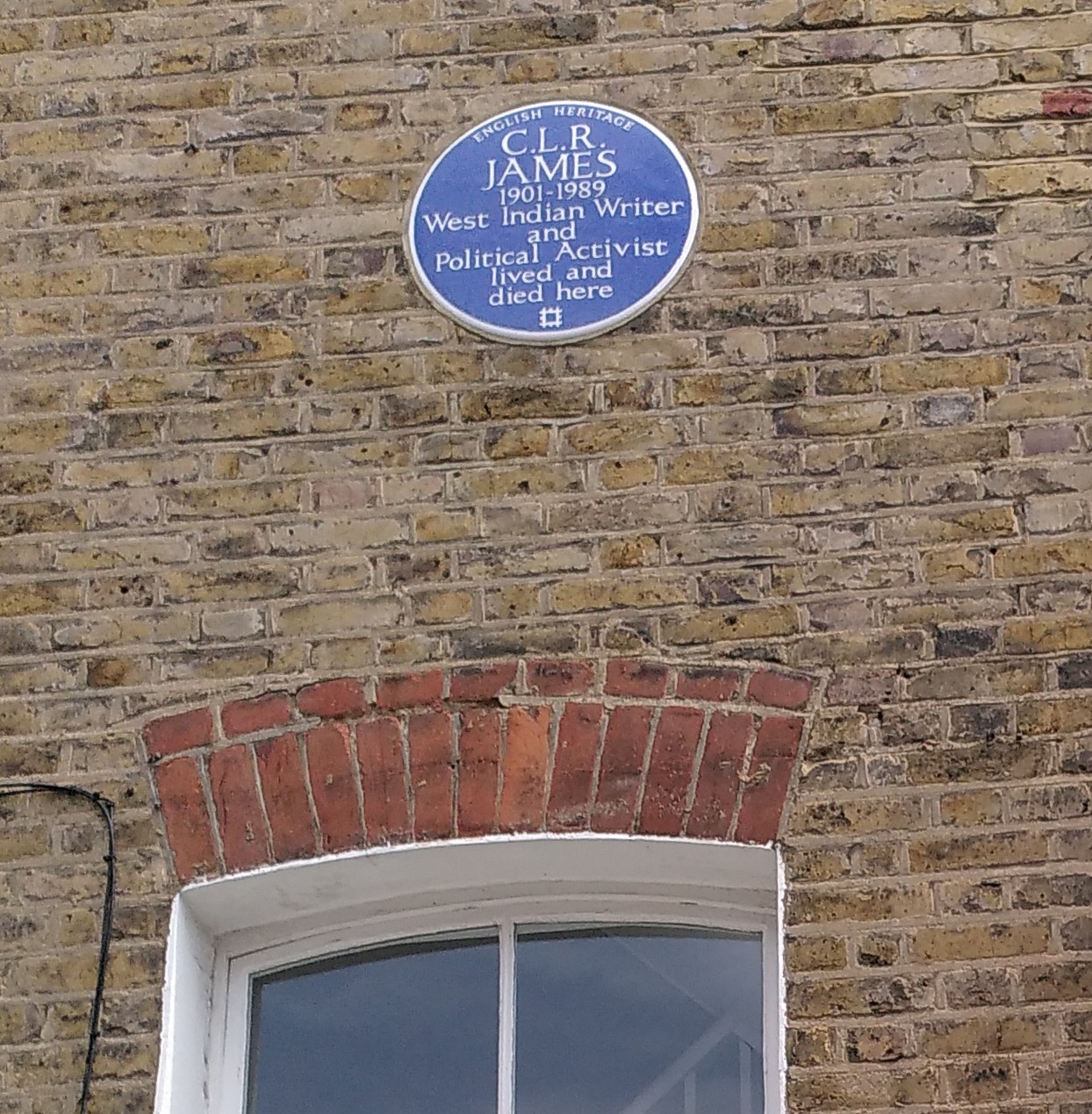
From 1981 until his death in 1989, he lived at 165 Railton Road in Brixton, above the offices of Race Today. As his health made him increasingly housebound, students, journalists and politicians visited the flat. His home became a place where people could encounter a writer whose experience extended across several generations of political debate. Those visits continued the exchange between his published work and people engaged in contemporary public life.7
Sources and further reading
1. The Life of Captain Cipriani and The Case for West-Indian Self Government — Duke University Press.
2. C. L. R. James papers, ICS40 — University of London, Institute of Commonwealth Studies.
3. C. L. R. James — South Asian Britain.
4. Intervening in Abyssinia — C. L. R. James; New Leader, 1935–1936.
5. The Black Jacobins: prefaces — C. L. R. James; Vintage edition.
6. Every Cook Can Govern, June 1956 — C. L. R. James; Correspondence.
7. C. L. R. James — English Heritage.
Featured image. The blue plaque commemorating C. L. R. James at 165 Railton Road, Brixton, photographed in May 2025. Photograph: A J Paxton / Blue Plaque to C L R James, 165 Railton Road, Brixton, 31 May 2025, Geograph, via Wikimedia Commons. Image record · CC BY-SA 2.0
