William Davidson was a cabinetmaker whose involvement in London radical politics ended with a conviction for high treason. Born in Jamaica, he became one of the men prosecuted after the Cato Street conspiracy of 1820.1
A craftsman in radical London
Davidson studied law in Scotland before earning his living as a cabinetmaker. He settled in London in 1816 and became active in local working-class political groups. His career combined skilled work with insecurity and racial prejudice. The city offered places where artisans could exchange political ideas and participate in movements challenging the existing distribution of power.1
One influential network followed the radical writer Thomas Spence. After Spence’s death in 1814, supporters formed the Society of Spencean Philanthropists to continue his work. Arthur Thistlewood, later the central figure in the Cato Street plot, belonged to this circle. Its attempts to encourage an insurrection had already brought members into conflict with the authorities before 1820.3
After Peterloo
The Peterloo massacre in Manchester in August 1819 intensified hostility towards the government. A cavalry attack on a meeting for parliamentary reform left demonstrators dead and many more injured. Some radicals concluded that existing methods of protest could not secure change. The Cato Street conspirators planned to kill cabinet ministers at a dinner believed to be taking place in Lord Harrowby’s house. They expected the attack to lead to the seizure of important buildings, a provisional government and a wider rising. This was a plan for revolutionary action by a small group, based on the expectation that others would join once it began.2
A plot watched by the authorities
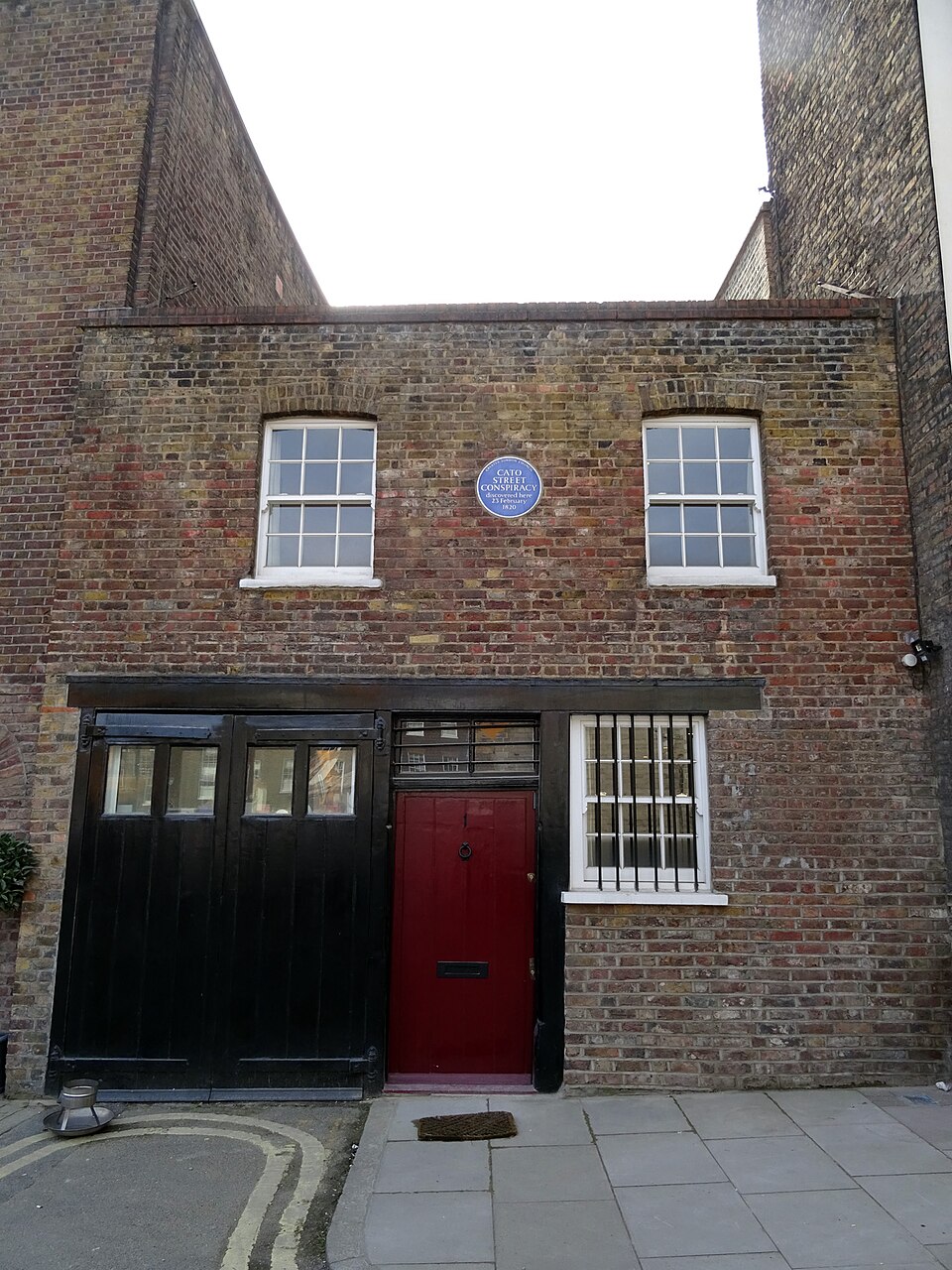
The supposed cabinet dinner was a trap. Government informer George Edwards had entered the radical group, and no such dinner was planned. On 23 February 1820, Bow Street officers raided the conspirators’ premises above a stable in Cato Street. During the confrontation Thistlewood killed an officer. Some men escaped temporarily; others were seized there. The projected attack never reached Harrowby’s house.3
A warrant issued that day by the justice of the peace Robert Baker named Davidson among fourteen men to be brought before a magistrate. It recorded allegations that they had assembled with the intention of setting fire to houses and committing murder. The formal pursuit of the group thus concerned planned violence against people and property, as the authorities moved to detain its suspected participants.4
An allegation about a pawned gun
The Bow Street magistrate Richard Birnie reported to the Home Office that Davidson had received thirty shillings from the Mendicity Society, supposedly to recover pawned tools. Birnie alleged that he had instead redeemed a blunderbuss, and linked the transaction to a weapon recovered in Cato Street. This account made a request for charitable assistance part of the case against a working man. The report presented the use of the money as deception.5
The defence and the verdict
Davidson was tried with Richard Tidd at the Old Bailey on 26 and 27 April. In the contemporary published account of the trial, he denied knowing about the plot and blamed Edwards and another acquaintance for drawing him into the situation. He challenged differences between the witnesses’ accounts and disputed the identification of him as an active participant. He also argued that one Black man could be mistaken for another, describing an earlier occasion on which he said that had happened. Alongside these objections, he appealed to his record of work, family responsibilities and attachment to Britain. His defence contested both the prosecution’s reconstruction of events and the assumption that his appearance established his identity reliably. The jury nevertheless found him guilty.6
Sarah Davidson’s petition
Davidson and four other convicted men were executed outside Newgate Prison on 1 May 1820. They were hanged and their bodies were then beheaded.3
Sarah Davidson joined the other condemned men’s widows in a petition to the king after the executions. They asked permission to take away their husbands’ remains for burial. The request brought the consequences of the punishment into the lives of surviving families. Sarah’s name appears among the petitioners seeking control over the burial of men whose bodies remained subject to the authority that had executed them.7
Sources and further reading
1. William Davidson — National Portrait Gallery.
2. The Cato Street Conspiracy, 1820 — University of Sheffield; Colin Reid.
3. Cato Street: London’s ultra radicals — Society for the Study of Labour History.
4. Cato Street plotters: arrest warrant — The National Archives, HO 44/4/44.
5. William Davidson: Birnie’s report — The National Archives, HO 44/4/100.
6. An Authentic History of the Cato-Street Conspiracy — George Theodore Wilkinson; Project Gutenberg.
7. Cato Street widows’ petition — The National Archives, HO 44/6/271.
Featured image. The building at 1a Cato Street, London, with a plaque commemorating the discovery of the Cato Street conspiracy. Photographed in March 2017. Photograph: Spudgun67, 6 March 2017, via Wikimedia Commons. Image record · CC BY-SA 4.0
