Una Marson’s poems range across love, landscape, racial prejudice and the expectations placed on women. That variety is a useful starting point for a writer whose name is often attached to a broadcasting milestone. Her public career involved several ways of reaching an audience: the printed page, the stage, the meeting room and the microphone. Following the writing through those settings reveals how much she brought to the BBC before she began producing programmes there.1
A writer before London
Born in Jamaica in 1905, Marson developed her early career in Kingston. In 1926 she became assistant editor of The Jamaica Critic. Two years later, she founded and edited The Cosmopolitan, a magazine that addressed women’s lives alongside literature and social questions. Its subjects included employment, single motherhood and the difficulties facing market traders. Editing meant selecting other people’s contributions as well as developing a voice of her own.2
Her first poetry collection, Tropic Reveries, appeared in 1930, followed by Heights and Depths in 1931. She worked with forms including lyrics and sonnets. The early poems make room for pleasure, desire and the natural world; the publishing record shows an author already at work before her first period in Britain. London would change her circumstances and subjects, but it did not create her literary interests.2
Poems such as Running Water and Beside the Sea attend to landscape, while others explore love. Their presence matters when reading the later campaigner. Marson’s imagination was not confined to public argument. The emotional and descriptive writing forms part of the same body of work as her criticism of racial and gender inequality.1
London, print and public argument
Marson arrived in London in 1932 and initially stayed at the Peckham home of Harold Moody, the doctor who led the League of Coloured Peoples. She became involved in the League’s work and in its journal, The Keys. Senate House Library’s research traces her contributions through surviving issues: her poetry appeared in the first issue in 1933, and by March 1935 she was listed as editor.3
The journal places literary work alongside practical campaigning. Marson organised and performed at events, while also speaking about barriers faced by Black people seeking employment. In 1934, she drew attention to discrimination against qualified Black nurses. Her activities connected the production of culture with arguments over who could work, participate and be treated fairly in British society. Poetry and politics occupied the same working week.3
Writing women’s work for the stage
At What a Price, credited by the National Theatre’s Black Plays Archive to Marson and Horace D. Vaz, follows a young Jamaican woman who leaves the countryside for a stenographer’s job in Kingston. She becomes involved with her white employer, whose behaviour towards women is unreliable. Employment, desire and unequal power are built into the situation. The comedy’s workplace setting makes a woman’s livelihood central to its story.4
The play was staged in London in 1933 by the League of Coloured Peoples, and Marson appeared in the cast as Ruth Maitland. Writing and performance were therefore connected parts of her practice. The surviving production record also identifies a wider company of actors and organisers. It places the play within a collective effort to bring Black dramatic work before a London audience.4
The questions inside the poems
Her 1937 collection, The Moth and the Star, includes Little Brown Girl. In the passage reproduced by the National Library of Jamaica, a questioning voice tries to place the girl geographically, moving uncertainly between Africa, India and the Caribbean. The questions expose the speaker’s confused knowledge. The girl becomes someone to be classified before she has been understood.5, 9
Read this way, the poem makes an ordinary exchange carry a larger argument about belonging. Its force comes through the structure of the encounter: one person asks and assumes, while the other is made the object of attention. Marson lets the language of apparent curiosity reveal its limitations. A poem can explore that pressure differently from a speech or newspaper report, giving the reader time to notice what a question presumes.5
The play London Calling, completed and produced in 1937, also drew on colonial relationships and the treatment of Caribbean and African people in London. These works show her returning to the city through different literary forms. Britain was a setting to examine, with social relationships and habits of thought that could be put under scrutiny.5
Reaching listeners across the Atlantic
Marson returned to Britain in 1938. Her BBC work developed in stages, including early freelance contributions and a talk printed in The Listener in July 1939. The National Library of Jamaica records a full-time assistant appointment in 1941 and production responsibility for West Indian programming in 1942. It identifies her as the BBC’s first Black female producer. The sequence shows how her responsibilities grew across several years, from contributing to the service to shaping its output.6
Calling the West Indies carried messages between people serving or working in Britain during the war and listeners in the Caribbean. Marson’s responsibilities included interviews, talks and material for the war effort. The programme operated inside the BBC’s overseas broadcasting system, with its institutional priorities, but it also made space for recognisable voices and personal news across a long separation.6
In 1943, Caribbean Voices emerged as a literary programme from that broadcasting work. It presented poetry, fiction and discussion, creating another route through which Caribbean writing could reach an audience. Marson’s experience as an editor and author was directly relevant: choosing material, working with contributors and thinking about how language would sound were already part of her professional life.7
The series continued after her departure and remained on air until 1958. Over its lifetime, it broadcast writers including Sam Selvon and Kamau Brathwaite. Successive producers, writers and readers expanded the programme after her departure. Its long life built on the broadcasting space she helped establish, which others continued to use and reshape.7
Returning to the page
Marson published another collection, Towards the Stars, in 1945 and returned to Jamaica in 1946. By 1949 she was working as an editor at Pioneer Press, a publishing project intended to make books by Jamaican authors more affordable. The work extended her long involvement in creating opportunities for writers: a magazine, a broadcast and a publishing list each needed someone to help bring material into public circulation.8
She died in 1965, leaving poems, plays, journalism and records of an extensive working life. Reading across those forms changes the balance of her story. The broadcaster who helped Caribbean literature travel was also an author asking how women could earn, love and belong. Her own pages deserve the same attention as the voices she helped bring to the microphone.1
Sources and further reading
1. Una Maud Marson (1905–1965) — National Library of Jamaica.
2. Little Brown Girl: Una Maud Victoria Marson — 1925–1935 — National Library of Jamaica Digital Collection.
3. Una Marson: Writer, Activist and the first Black woman broadcaster at the BBC — University of London, Senate House Library; Leila Kassir.
4. At What A Price — National Theatre, Black Plays Archive.
5. Little Brown Girl: Una Maud Victoria Marson — 1935–1945: Writing and Advocacy — National Library of Jamaica Digital Collection.
6. Little Brown Girl: Una Maud Victoria Marson — 1935–1945: England — National Library of Jamaica Digital Collection.
7. West Indies Calling: Poetry from the radio feature Caribbean Voices — Victoria and Albert Museum.
8. Little Brown Girl: Una Maud Victoria Marson — 1945–1955 — National Library of Jamaica Digital Collection.
9. Little Brown Girl: Una Maud Victoria Marson — Publications, Dramatic Works, References — National Library of Jamaica Digital Collection.
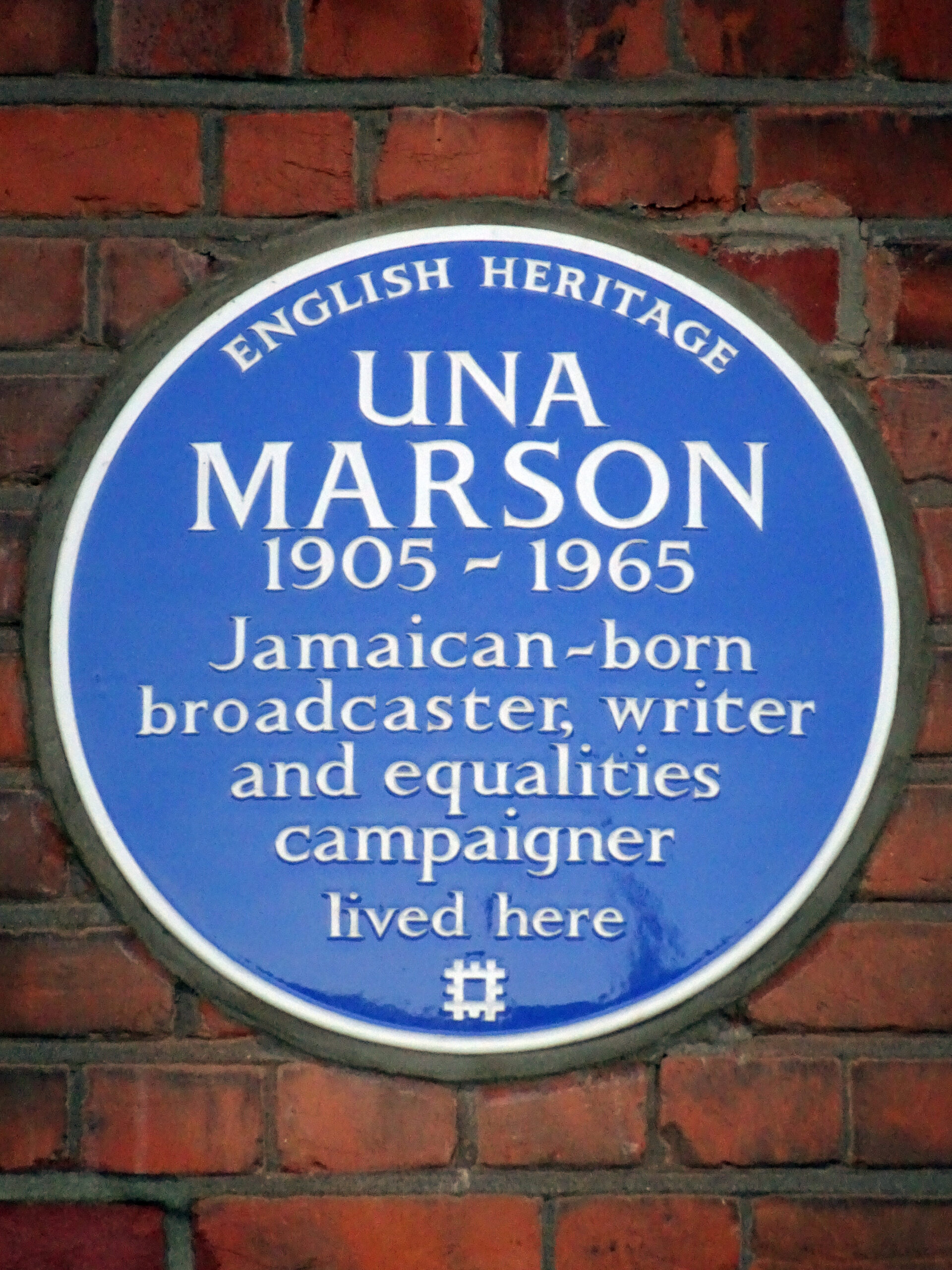
Featured image. The blue plaque commemorating Una Marson at The Mansions, Mill Lane, West Hampstead, photographed in March 2025. Photograph by Spudgun67, 15 March 2025, via Wikimedia Commons. Image record · CC0
