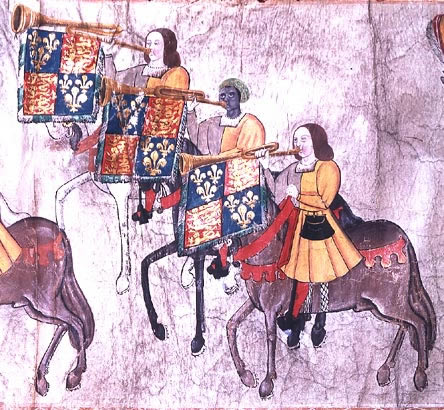
Among the mounted musicians painted on the Westminster Tournament Roll is a Black trumpeter wearing a wrapped head covering. He shares the procession with men in matching royal livery, their instruments hung with banners. The image survives from 1511. A different kind of record, an entry in the royal accounts, supplies a name: John Blanke. Read alongside his petition for higher pay, these documents reveal a working musician who knew the value of his service to the Crown.1, 2, 3
A name in the king’s accounts
On 7 December 1507, a royal account recorded a payment of twenty shillings to Blanke for the previous November. His rate was eight pence a day. The arithmetic fits the month: thirty daily payments made 240 pence, or twenty shillings. That tells us how the payment was calculated; it does not establish that he performed on every one of those days. The entry identifies an occupation and a regular place on the royal payroll.1
The clerk also identified him by his colour. This was a description written for an administrative purpose, rather than Blanke’s own account of who he was. His name and wages appeared because money had to be accounted for. A document produced to record royal expenditure has consequently preserved something much more personal: evidence of a named Black man earning his living at the Tudor court.1
There is no secure account of his birthplace, childhood or journey to England. Suggestions that he arrived with Katherine of Aragon remain possibilities, rather than a documented itinerary. The distinction matters because the surviving career is substantial enough to examine without supplying an imagined beginning.3
A musician between two reigns
Blanke served Henry VII and continued under Henry VIII. In 1509 he received black livery for Henry VII’s funeral and scarlet clothing for the new king’s coronation. These changes of dress placed the same musician within two different ceremonies: mourning for one sovereign and the public presentation of his successor.3
Clothing helps connect the accounts with the painted procession. The trumpet was visible as well as audible. On the roll, instruments, banners, horses and matching garments make the musicians part of a carefully arranged royal display. The surviving image cannot tell us the tune Blanke played, or how it sounded in the open air. It does show that producing ceremony required identifiable people with particular jobs. Royal magnificence had a payroll.2
Reading the tournament roll
The Westminster tournament of February 1511 celebrated the birth of Henry VIII and Katherine’s son, Henry, Duke of Cornwall. Heralds recorded the occasion in a long painted roll, now held by the College of Arms. Blanke appears twice within it. This gives the wage entry an unusual companion: a contemporary visual record of a Black Tudor whose name can also be recovered from written sources.2
In the mounted scene reproduced on the National Portrait Gallery’s research page, the trumpeters ride together towards the right. Their pale, patterned garments create a repeated shape across the group, while red banners carry the royal arms. The horses differ in colour, and the men’s faces remain distinct within the formal arrangement. Blanke’s wrapped head covering sets him apart from companions wearing dark caps. His instrument and position nevertheless place him within the same musical company.2
The roll rewards looking slowly. A small figure can disappear when attention settles only on the king, the heraldry or the tournament’s splendour. Once the musicians become the subject, the picture records skilled work as part of royal representation. Their coordinated appearance is itself an element of the event.2
A painted head covering cannot establish religious belief. Nor can ceremonial dress settle questions about private relationships or treatment elsewhere. The image offers evidence about how Blanke was represented in a particular royal occasion. Reading more into it would turn a valuable document into an answer to questions it cannot resolve.2, 3
The case for a better wage
Blanke’s surviving petition brings his employment into sharper focus. Addressed to Henry VIII, it sought the position left vacant by the death of another trumpeter, Dominic Justinian. Blanke asked for sixteen pence a day, with payment reckoned from the preceding 1 December. The document itself is undated, so that reference should not be turned into a precise year without further evidence.3
The request was specific. It named an available post, attached a rate of pay and appealed to Blanke’s faithful daily service. It also promised continuing service for the rest of his life. These were practical terms for persuading a royal employer: experience already supplied, work still to come, and a recognised vacancy through which the improvement could be made.3
Sixteen pence was twice the daily rate recorded in 1507. Historic Royal Palaces records that the petition succeeded. The document therefore preserves more than a wage figure. It shows Blanke pursuing advancement within the organisation that employed him, using the language and procedures available to a royal servant.3
It does not establish that he wrote the words in his own hand. Petitions could be prepared through others, and this one should not be treated as a private diary. Even with that qualification, its central purpose is clear. A named musician was asking for a particular improvement to the conditions of his work.3
A wedding and an unfinished story
In 1512 the king provided for clothing as a wedding gift to Blanke. The surviving records include violet cloth, headwear and the cost of making the outfit. Such practical details bring another occasion into view: a royal employee was marrying, and his employer contributed to what he would wear.4
The evidence does not securely identify his wife or describe their married life. The wedding provision is the last surviving reference to him, and he is absent from the next complete list of royal trumpeters in 1514. That absence supplies no date of death and no destination. His story closes in the records with a gap, while leaving three unusually tangible things to examine: the money paid for his labour, his argument for a better wage, and his place among the mounted musicians.3
Sources and further reading
1. The National Archives; original account E 36/214, folio 109. John Blanke: royal wage entry, 7 December 1507. The entry pays the preceding November’s wages at eight pence a day.
2. National Portrait Gallery; original 1511 roll held by the College of Arms. John Blanke and the Westminster Tournament Roll. Includes the scene of the mounted trumpeters examined in this article.
3. Historic Royal Palaces; includes the original petition, The National Archives E 101/417/2 (105). John Blanke. Read the petition separately from the modern account of Blanke’s career.
4. The National Archives. John Blanke: petition for a pay rise. Background on the wedding clothing and the related royal provision.
Featured image. A detail from the Westminster Tournament Roll of 1511, showing the Black trumpeter generally identified as John Blanke among the royal musicians. Unknown artist; College of Arms, Westminster Tournament Roll. Reproduction via The National Archives and Wikimedia Commons. Image record · Public-domain artwork (PD-Art)
