Buchi Emecheta’s son Sylvester Onwordi remembered books as ordinary household objects, and writing as something his mother did at the kitchen table. Exercise books filled with handwriting became manuscripts on a typewriter. When he read her first published novel, familiar experiences appeared in a newly unfamiliar form. His recollection captures an essential part of her achievement: she made literature from a life in which work, children and money constantly competed for attention.1
Education and a living
Born in Lagos in 1944, Emecheta built a career that included employment as a librarian, teacher and community worker. She gained a sociology degree from the University of London while also developing her writing. After the breakdown of her marriage in her early twenties, she was raising five children. Education, paid work and authorship were intertwined activities in a demanding household, and each helped shape the material and perspective of her books.2
She had arrived in Britain in 1962 to join her husband. Interviewing her years later, the scholar Jane Bryce encountered a writer whose relationship with London had changed as her professional independence grew. The city became both the place where she established a career and material for examining who could secure a decent life there.6
Turning experience into a book
In her own account of becoming an author, Emecheta described the publication of In the Ditch in June 1972 as the outcome of almost five years spent sending pieces to magazine editors. She was twenty-seven. Writing about circumstances she knew intimately gave her depth of understanding, she explained; she no longer felt that she had to wait until middle age to become a writer. The observation is practical as well as personal: experience could provide material, but getting that material into print required persistence.3
Her editor Margaret Busby traced In the Ditch to Emecheta’s columns in the New Statesman. Its account of a mother’s life on a council estate makes room for neighbours, humour and the daily workings of welfare. Busby’s recollection underlines the writer’s alertness to other people: the book’s interest extends beyond its central character’s difficulties to a wider social world.7
Adah wants to write
Second Class Citizen centres on Adah, a young Nigerian woman who moves to London and struggles to provide for her family while holding on to the ambition to become an author. Racism and an oppressive marriage limit her choices, but the novel also attends to her determination to make choices at all. Writing is one of the things she wants from life. That aspiration gives the book a particularly sharp question: who has the time, security and recognition to imagine themselves as a writer?4
Onwordi emphasises the humour and observation in his mother’s treatment of Adah. His account also makes clear that fiction transforms lived experience. Family members can recognise events while encountering a version shaped by somebody else’s perspective. Emecheta’s authorship involved selecting and arranging that material, turning personal history into a work other readers could enter.1
Women in a changing Nigeria
Emecheta’s fictional world reached far beyond Britain. The Joys of Motherhood, first published in 1979, follows Nnu Ego in colonial Nigeria. The pressure to become a mother shapes her social position, yet motherhood brings obligations and insecurity as well as status. Movement to Lagos and the effects of war place the family within a changing economy. The title raises a question that runs through this account of women’s work: what happens when a society celebrates mothers while leaving the costs of caring largely to them?5
Bryce links Emecheta’s Nigerian fiction to oral storytelling remembered from childhood. Her range also included the wartime narrative Destination Biafra and the imagined African setting of The Rape of Shavi. The variety gives a sense of a writer testing different settings for questions about power and survival.6
Making a professional life
Granta selected Emecheta among its Best of Young British Novelists in 1983. Her work also extended into television and radio plays. That range belongs beside the novels when considering her career: she worked across forms and audiences, developing a professional identity larger than any single book.2
She also established the publishing house Ogwugwu Afor. Publishing added another practical dimension to independence: taking responsibility for how books entered the world. Her career joined the imaginative work of storytelling to the labour of building and sustaining a literary life.6
Sources and further reading
1. My mother, the pioneer: how Buchi Emecheta captured immigrant life in 1970s London — Sylvester Onwordi, Penguin.
2. Buchi Emecheta — Granta.
3. A Nigerian writer living London — Buchi Emecheta, University of Wollongong repository.
4. Second-Class Citizen — Penguin.
5. The Joys of Motherhood — Penguin Australia.
6. A Sort-of Career: Remembering Buchi Emecheta — Jane Bryce, Wasafiri.
7. Where to start with: Buchi Emecheta — Margaret Busby, The Guardian.
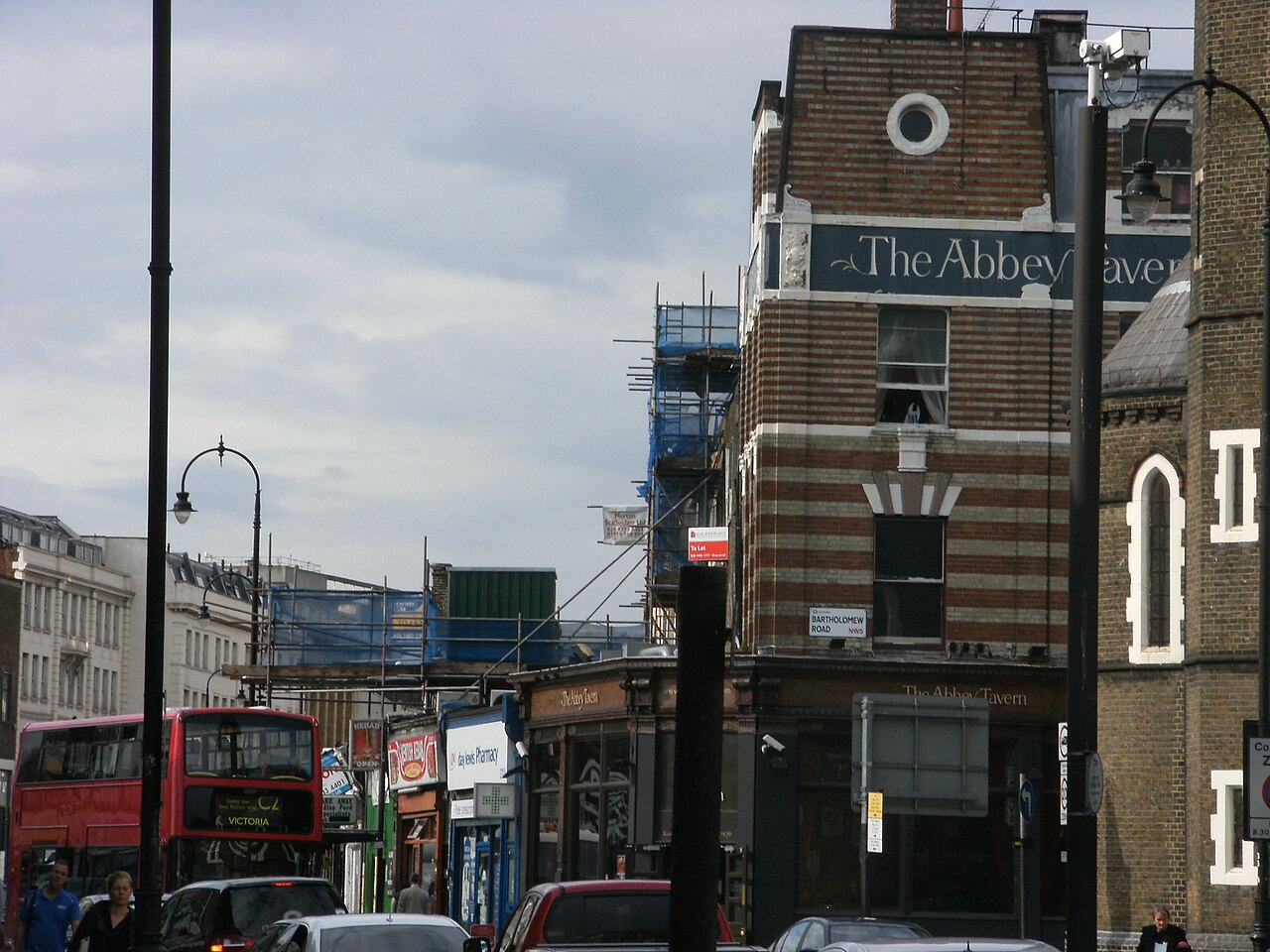
Featured image. Kentish Town Road at its junction with Bartholomew Road, photographed in June 2011. This is a later view of the north London neighbourhood associated with Buchi Emecheta’s family life. Photograph: Mark Ahsmann, 3 June 2011, via Wikimedia Commons. Image record · CC BY-SA 3.0
