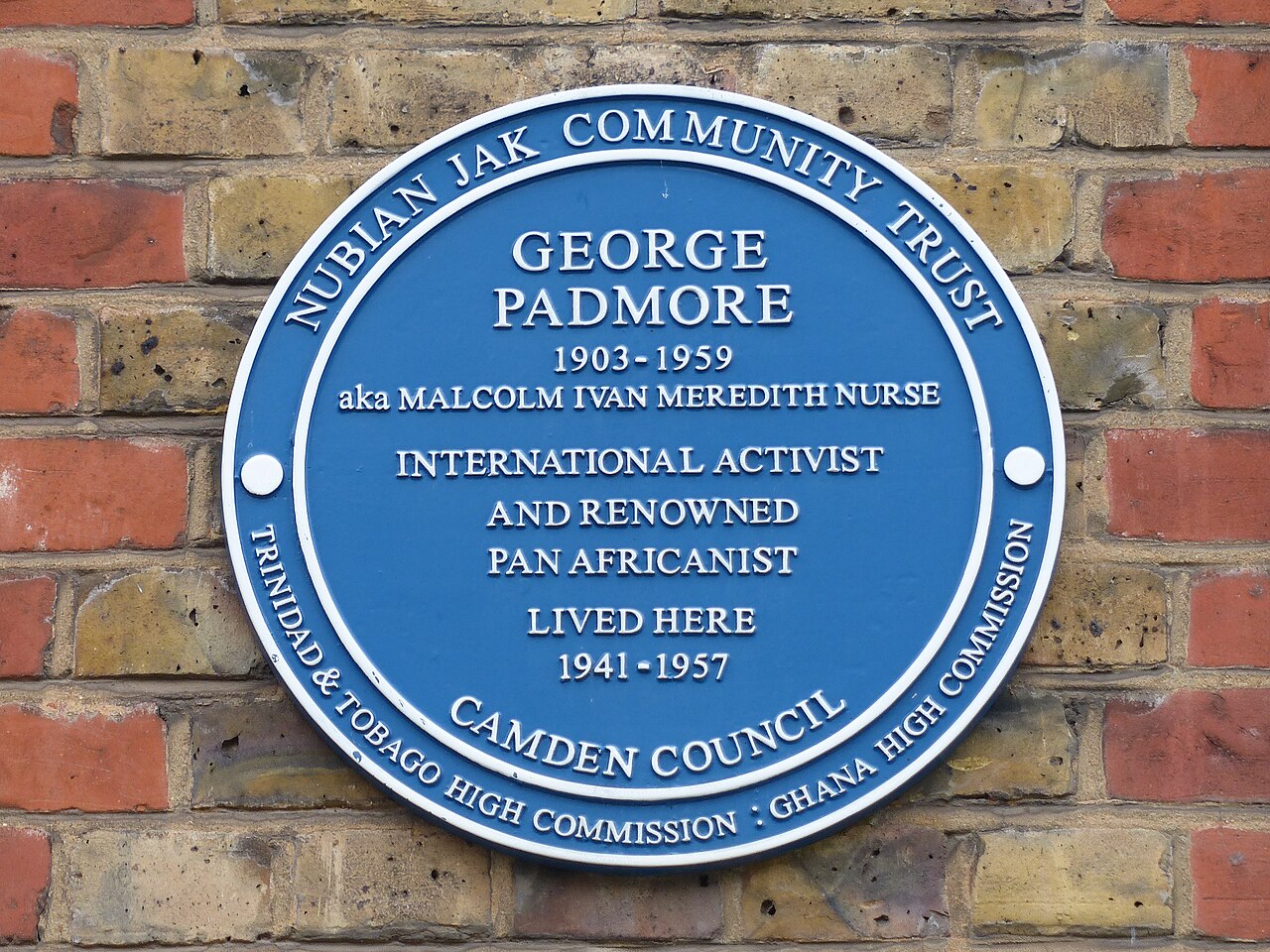
George Padmore worked as a journalist and political organiser before becoming an adviser to Kwame Nkrumah in Ghana. His public life connected campaigns against colonial rule with the formation of an independent African government. For years, London provided a base for the writing, relationships and organisations through which he pursued Pan-African politics.6
Labour politics across continents
Born in Trinidad as Malcolm Nurse, he moved to the United States in the 1920s, studied at American universities and joined the Communist Party. He adopted the name George Padmore and became involved in international labour organising. By 1931 he was editing the Negro Worker in Hamburg. This work placed the conditions of Black workers within a wider struggle against exploitation and colonial power. His political connections extended through Europe and the Americas before London became his principal base. He broke with the Communist movement in the 1930s, but continued organising against imperial rule. Journalism remained central to that work: editing and publishing could circulate arguments among people separated by national borders and colonial administrations.1
Connections with Indian campaigners
Padmore’s London relationships included Indian advocates of independence. In 1936 he met K. D. Kumria at an Indian National Congress rally. Kumria’s Swaraj House in Percy Street also provided a venue for African protest meetings. Padmore maintained links with Krishna Menon, and in 1944 spoke at a gathering marking Jawaharlal Nehru’s birthday. These connections brought different movements into conversation through shared places and public events. In 1948 Padmore joined Douglas Rogers and Kundan Lal Jalie in a letter to the Socialist Leader announcing Swaraj House as a meeting place for wider anti-colonial activity. London’s political geography allowed a campaign associated with one part of the empire to supply space for people concerned with another.2
A bureau and a congress
The International African Service Bureau, founded in 1937, brought Padmore together with figures including C. L. R. James, Amy Ashwood Garvey and Jomo Kenyatta. Its politics connected opposition to empire with the organisation of workers. Padmore later helped organise the Pan-African Congress held in Manchester in 1945, working with Peter Abrahams, Ras Makonnen, Peter Milliard and Nkrumah. The gathering gave considerable weight to labour organisations and to workers and farmers as agents of political change. Demands for self-government were connected with economic democracy and methods of collective pressure, including strikes and boycotts. Padmore’s contribution belonged to an organising group that linked delegates, political arguments and practical arrangements. The congress offered a setting in which campaigns in different territories could consider common demands without erasing their separate circumstances.3
Introductions between the meetings
Correspondence helped sustain these connections. On 20 December 1946, Padmore wrote from Cranleigh Street in London to W. E. B. Du Bois, introducing E. T. Richards, a Barbadian barrister living in Bermuda. Richards was returning through the United States, and Padmore sought help in establishing useful contacts. The letter involved the practical business of putting people in touch across distance. Such introductions carried political relationships beyond the dates of a conference. Travel created opportunities for meetings, while correspondence helped turn an itinerary into a route through an existing circle of contacts.4
From campaigning to an advisory role
Padmore became an adviser to Nkrumah, whose leadership was central to Ghana’s independence in 1957. Their association connected the networks of Pan-African campaigning with the work of a newly independent government. The relationship extended across the transition to independence, giving Padmore a role alongside a leader with whom he had already worked in international politics. His concerns about African political cooperation now had a place within the responsibilities of a sovereign state.6
Interpreting Ghana’s independence
In April 1957, The Crisis published Padmore’s essay The Birth of a Nation, a review of Nkrumah’s autobiography. He treated the book as an account of political strategy with significance beyond Ghana. Writing as an ally of Nkrumah, he presented the achievement of independence as an example from which other African movements might learn. His interpretation connected leadership, organisation and a programme for ending colonial rule. Independence appeared as the beginning of a wider process of African emancipation, with Ghana occupying a place in that continuing struggle. The essay addressed readers outside Africa as well as people concerned directly with its political future. It made the meaning of a newly independent state the subject of an international argument about what should follow elsewhere.5
Sources and further reading
1. Padmore, G. — Encyclopaedia Africana; J. R. Hooker.
2. George Padmore — South Asian Britain.
3. The Fifth Pan-African Congress, 75 Years On — History Workshop.
4. Letter from George Padmore to W. E. B. Du Bois, 20 December 1946 — University of Massachusetts Amherst Libraries.
5. The Birth of a Nation, April 1957 — George Padmore; The Crisis.
6. About George Padmore — George Padmore Institute.
Featured image. A plaque commemorating George Padmore, photographed in October 2020. Photograph: Megalit, 24 October 2020, via Wikimedia Commons. Image record · CC BY-SA 4.0
