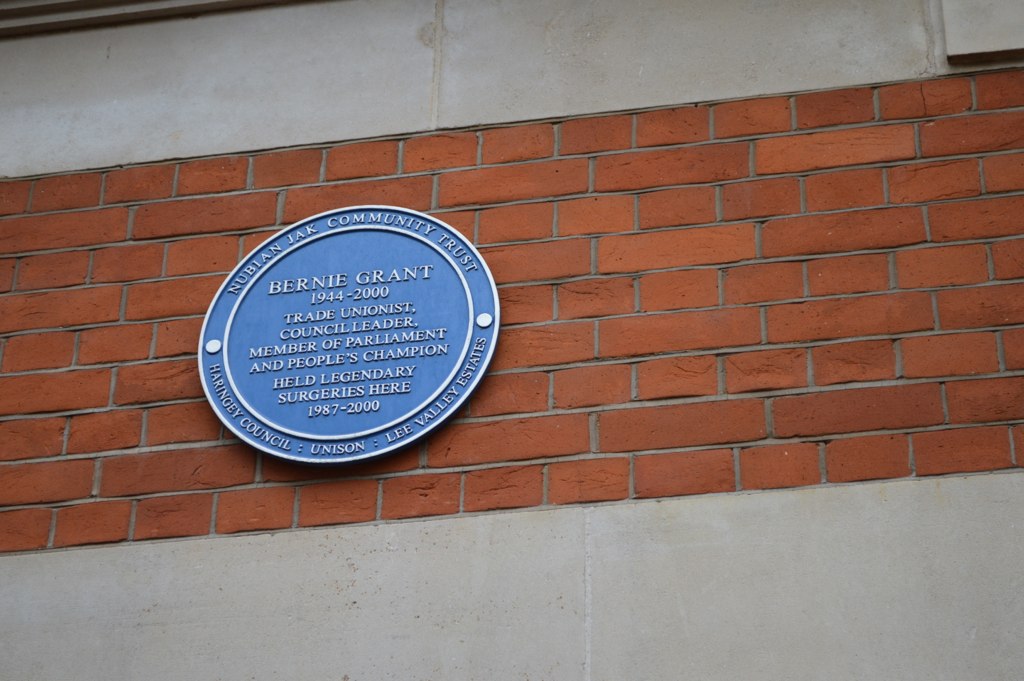
Before Bernie Grant became an MP, he worked as an international telephonist and organised in the trade-union movement. That experience belongs near the centre of his political biography. His route into elected office developed through arguments about working conditions, public services and the way institutions treated Black people. 1
Work and local politics
Born in Georgetown in 1944 to schoolteacher parents, Grant came to Britain in 1963. He attended Tottenham Technical College and studied engineering at Heriot-Watt University before leaving his studies in 1969. His subsequent employment in telecommunications brought him into the Union of Post Office Workers. He joined Tottenham Labour Party in 1973 and was elected to Haringey Council in 1978. 1
Bishopsgate Institute’s account records that Grant became a full-time area officer for the National Union of Public Employees in 1978, representing local-authority and health workers. He also founded the Black Trades Unionists Solidarity Movement and worked for it between 1981 and 1984. His organising addressed both workers’ collective interests and discrimination within working life. 2
As Haringey’s council leader from 1985, Grant supported equalities policies covering race, gender, disability and sexual orientation. The breadth of that agenda matters. Decisions about services, access and employment could affect residents in different but connected ways. The council became an arena in which such questions entered public policy and attracted argument far beyond the borough. 2
Who could represent the Labour Party?
Grant supported Labour Party Black Sections, a movement established in 1983 for African Caribbean and Asian members. Its aim was to increase political representation. Winning support involved organising within a party whose leadership did not simply accept the demand. The surviving papers include committee minutes, constitutions, newsletters, recruitment material and correspondence about that struggle. 3
Bishopsgate’s collection also records a Birmingham meeting held in April 1987 despite a party ruling against Black Sections. Such documents complicate an account focused only on successful candidates. Election victories depended partly on earlier disputes about membership, selection and influence. Grant’s work belonged to a collective attempt to alter who could speak and hold office within the party. 3
Tottenham in Parliament
Grant was elected MP for Tottenham on 11 June 1987 and represented the constituency until his death on 8 April 2000. He won the seat again in 1992 and 1997. His parliamentary record also lists service on the International Development Committee from July 1997 until his death, giving him a formal role in the scrutiny of Britain’s development policy. 4
Reparations as a political programme
A major strand of Grant’s later work concerned reparations for enslavement and colonialism. In 1993 he attended the Pan-African Conference on Reparations in Abuja, Nigeria. That May, he tabled a parliamentary motion welcoming the resulting Abuja Proclamation. His position in Parliament offered one route for bringing the movement’s arguments into a wider political discussion. 5
The African Reparations Movement in Britain was formally launched at a Birmingham conference in December 1993. Grant worked alongside figures including Linda Bellos, Dorothy Kuya, Sam Walker and Stephen Small. Its proposals concerned historical recognition and the continuing consequences of exploitation, as well as compensation. Meetings, speeches and international contacts made reparations an organised political programme rather than an occasional statement of grievance. 5
A cultural home in Tottenham
Grant also wanted a major performing-arts centre in his constituency, with room for artists, audiences and creative businesses. The Bernie Grant Arts Centre opened in 2007, seven years after his death. Designed by David Adjaye, it brought performance, rehearsal and working spaces into a new building beside Tottenham’s town hall. 6
The centre’s programme places Black artists and Black-led work at its core across theatre, dance, music, literature and visual art. Its existence gives a concrete form to one part of Grant’s ambitions for Tottenham: cultural production required premises and sustained opportunities, alongside recognition. The building belongs to the work carried forward after his death, rather than to projects he lived to see completed. 6
His papers at Bishopsgate preserve another record: constituency cases, trade-union material, speeches, photographs, recordings and documents from the organisations he helped establish. Read together, they connect the public parliamentary figure with the everyday work and collective campaigns behind that visibility. 2
Sources and further reading
1. The Bernie Grant Digital Archive. Bernie Grant Archive.
2. Bernie Grant Archive. Bishopsgate Institute.
3. Labour Party Black Sections. Bishopsgate Institute.
4. Parliamentary career of Bernie Grant. UK Parliament.
5. Reparations. Bernie Grant Archive.
6. What We Do. Bernie Grant Arts Centre.
Featured image. The plaque commemorating Bernie Grant at Tottenham Green, photographed in November 2014. Photograph: Matt Brown, 22 November 2014, via Wikimedia Commons. Image record · CC BY 2.0
