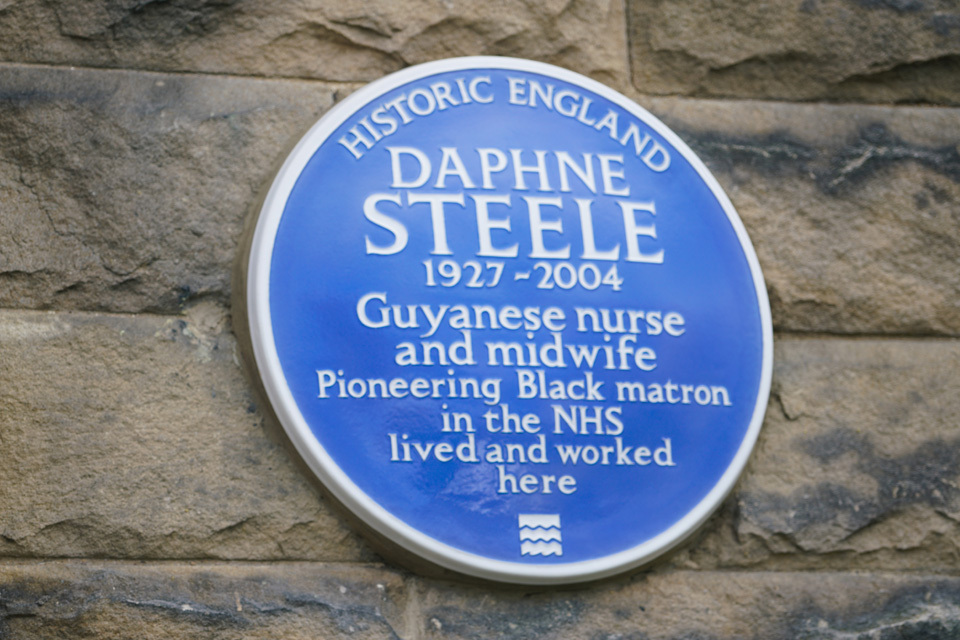
In September 1964, Daphne Steele began work as matron of St Winifred’s, a maternity home in Ilkley. Historic England recognises her as the first Black matron in the NHS. She was 36 when appointed. The institution had fourteen beds and handled around 250 to 300 births a year: a small workplace with substantial responsibility for mothers and babies.1
A career across several countries
Born in what was then British Guiana, Steele came to Britain in 1951. She trained in nursing and midwifery at St James’ Hospital in London, then moved to a hospital in New Jersey in 1955. Five years later she returned to Britain. Her subsequent employment included RAF Brize Norton and a deputy matron’s post at a Manchester nursing home. The route to Ilkley therefore involved several institutions and different working environments. The town’s local history account also records her recollections of prejudice and difficulty finding accommodation. Movement between jobs and countries did not remove the restrictions a Black nurse could encounter outside the hospital.2
From maternity care to health visiting
St Winifred’s closed in October 1971, ending that particular chapter of her work. Steele moved to Wharfedale Children’s Hospital at Menston and later studied at Leeds University to become a health visitor. She then worked in Ilkley. Her career continued through this change of setting, taking her from responsibility for a maternity home into work with children and families in the community.1
Ilkley became a lasting home as well as a place of employment. Steele participated in Christchurch and Soroptimist International, and served as vice-president of the Association of Guyanese Nurses and Allied Professionals. Local involvement and continuing connections with Guyana formed parts of the same working life.2
Nursing knowledge across the Atlantic
The association, generally known as AGNAP, provided a practical structure for professional links with Guyana. Its own history describes donations of teaching materials, education projects and visits by health professionals. A 1992 mission brought together fifty-one participants, while later work included textbooks and seminars for nurses. Such activity involved the circulation of knowledge and resources alongside migration. Steele’s name subsequently became attached to a lecture series: AGNAP dates the launch of its Daphne Steele Memorial Lectures to 2014. This form of remembrance placed her within continuing professional discussion, giving a nursing audience an occasion to return to questions of practice, training and leadership.4
Who enters the history of nursing?
Recognition came in several forms during and after Steele’s lifetime. The Royal College of Nursing records a Guyanese High Commission award in 2001 and her participation in the Golden Jubilee relay at Shipley in 2002. It also describes the historical work behind her later public profile. Nursing historian Claire Chatterton contributed her biography to a project expanding the range of nurses represented in the Oxford Dictionary of National Biography. Bradford Civic Society and the district council supported the blue plaque nomination after the community’s Bradford Lasses project. The plaque therefore followed research and local campaigning, as well as the earlier achievement it marked.3
Remembering a nurse in today’s hospitals
On 16 October 2023, the St George’s, Epsom and St Helier hospital group held its first Daphne Steele Day. Chief Nurse Arlene Wellman planted a tree at St George’s, and Steele’s sister Jeune Singh attended. Singh had herself worked in the trust as a nurse and midwife between 1972 and 1992. The occasion brought a family’s nursing connections into a contemporary workplace. Its programme connected commemoration with discussion of leadership and race equality, while the tree provided a physical marker within hospital grounds rather than requiring visitors to encounter the story only in an archive.5
A further institutional connection followed in 2024, when the University of Huddersfield officially opened the Daphne Steele Building, with her son Robert present. The building houses education in nursing, midwifery and several allied health professions, including occupational therapy and physiotherapy. Its teaching spaces include simulated clinical environments and facilities for developing practical skills. The choice of name places Steele’s career before students preparing for their own work in health services. It also returns attention to the substance of that career: training, care, responsibility and the movement between different forms of professional practice.6
Sources and further reading
1. Daphne Steele — Historic England.
2. Hillside — Ilkley Civic Society.
3. A quiet revolutionary: the NHS first Black matron — Royal College of Nursing.
4. History — Association of Guyanese Nurses and Allied Professionals UK.
5. Daphne Steele Day — St George’s NHS.
6. Daphne Steele Building official opening — University of Huddersfield.
Featured image. The blue plaque commemorating Daphne Steele in Ilkley, pictured in the government’s February 2024 announcement. Image: Department for Culture, Media and Sport / Crown copyright, via GOV.UK. Image record · Open Government Licence 3.0