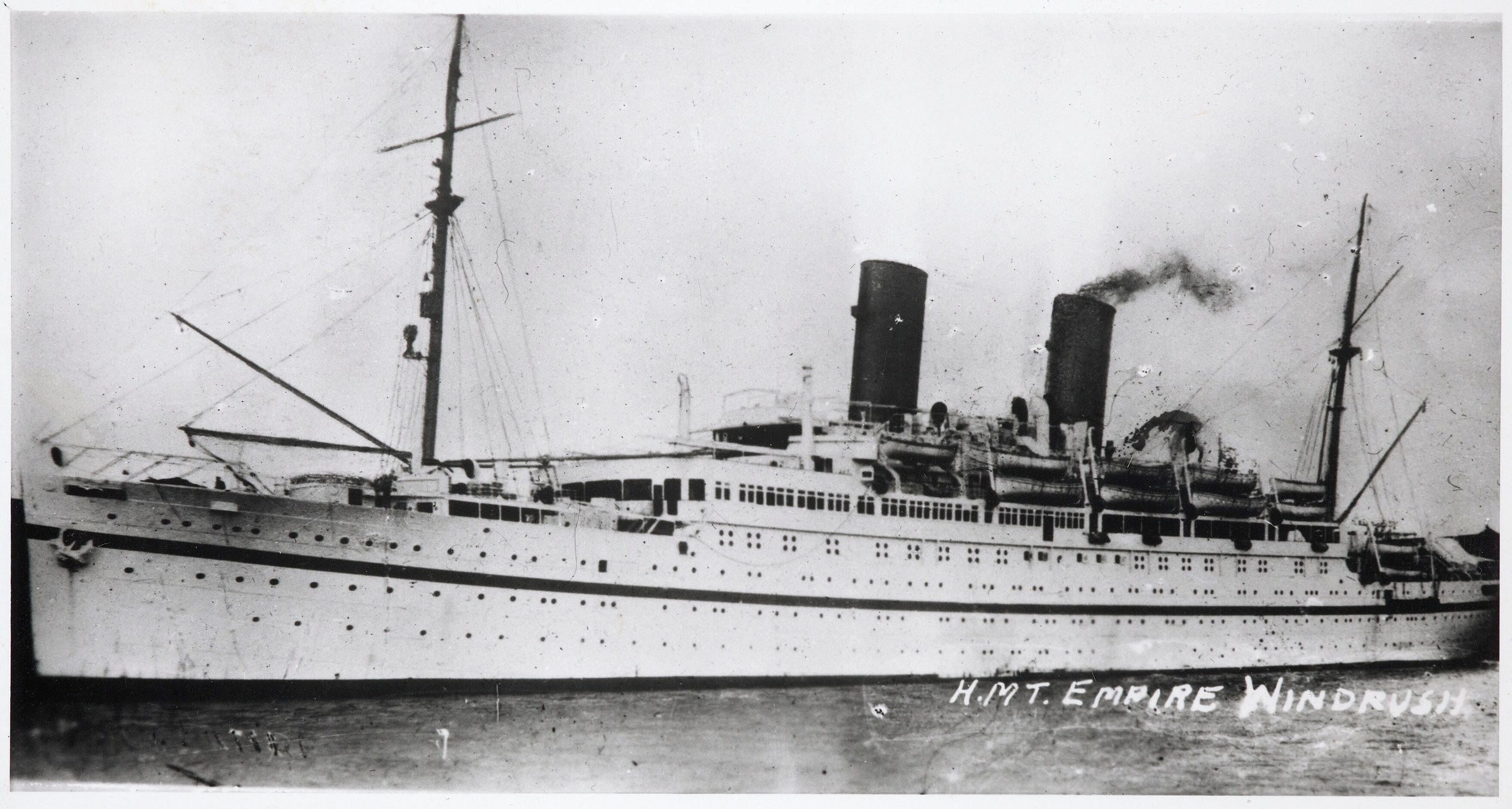
Empire Windrush docked at Tilbury in Essex on 21 June 1948. Its passengers disembarked on 22 June, the date remembered as Windrush Day. Keeping those two dates distinct helps us follow the journey accurately: reaching port and stepping ashore were separate moments, even though they are often compressed into a single anniversary.
The passenger lists and shipping records examined by Royal Museums Greenwich record men, women and children travelling from the Caribbean. Behind the shared name of the ship were individual decisions about work, family and the future. A list can preserve a name and an itinerary; it cannot, on its own, tell us what someone hoped for or what happened after the journey. [1]
British subjects in an imperial world
The legal and political setting matters. Many of the Caribbean passengers came from British colonies and were British subjects. Their journey took place within a world Britain had helped shape through empire. Treating them simply as strangers arriving from an unrelated place removes that relationship from the story.
A letter written by Prime Minister Clement Attlee on 5 July 1948 makes the position unusually clear. Replying to concerned MPs, he defended the established principle that British subjects from the colonies and Dominions should be able to enter the United Kingdom regardless of race. He also pointed to the employment already found for some passengers who had been accommodated temporarily in Clapham Shelter.
Yet the letter was cautious. Attlee doubted that another similarly large arrival would follow and discussed the group in terms of labour needs and colonial relations. It records an uneven official response: recognition of people’s rights alongside anxiety about further migration. This is a more revealing starting point than a simple account of an unqualified national welcome. [2]
A journey that could also be a return
For Sam King, travelling on Empire Windrush meant returning to a country he already knew. Born in Jamaica, he volunteered for the Royal Air Force in 1944, trained in Britain and served during the Second World War. After demobilisation he went back to Jamaica, then took the opportunity to travel to England again in 1948.
King rejoined the RAF and later worked for Royal Mail. His subsequent life included public service of another kind: he became mayor of Southwark in 1983–84. In 1995, he and Arthur Torrington established the Windrush Foundation to preserve the memory of the post-war settlers.
His experience connects wartime service, migration, employment and civic participation. It also shows a passenger helping to shape how the journey would be remembered. The Foundation’s account of its co-founder gives the familiar ship a particular human history. Other passengers’ lives need the same attention; one prominent biography cannot stand for every person who travelled. [3]
Work, housing and the making of a home
Post-war migration continued through different routes and arrangements. London Transport provides a clear example of organised recruitment that developed later. Facing labour shortages, it began recruiting in the Caribbean in February 1956, at the invitation of the government of Barbados. The work it needed doing could involve demanding shifts and long hours. The institution’s needs and the recruits’ ambitions met in practical decisions about wages, training and moving overseas. [4]
Having a job did not remove the difficulties of settling. London Transport Museum’s collection-based learning material records racism and discrimination experienced by Caribbean workers. A photograph from June 1955 shows two Caribbean men looking at rooms-to-let notices. It places the search for somewhere to live alongside the better-known images of people arriving with luggage.
The museum also documents workplace clubs and societies that helped people form friendships. Those ordinary connections deserve a place in the history. A new home involved colleagues, neighbours, shared interests and the daily work of keeping relationships going, as well as an address and a wage. [5]
The history reaches further back
Windrush belongs within a much longer Black British history. Historic England’s research describes Black people living in eighteenth-century London, Liverpool and Bristol, and in smaller towns and villages. Their lives included domestic service, seafaring, trades, business and music. Some had been enslaved and brought to England; others worked in different circumstances.
That variety matters. A history told only through arrival dates can leave Black people permanently at the point of entering the country. Looking at where people lived, whom they worked with and what they made or organised changes the questions we ask. It also makes room for differences of class, occupation and experience.
The 1948 voyage remains a useful landmark for understanding post-war Caribbean migration. Its significance becomes clearer when it sits within that longer history of presence and connection. The earlier lives should be studied in their own right, alongside the generations who came later. [6]
When belonging was challenged
The Windrush scandal exposed the consequences of failing to recognise people’s lawful place in Britain. Long-settled residents found themselves required to prove a status they had understood to be secure. Some lost jobs or access to housing and services. Others were detained, removed or prevented from returning after travelling abroad.
Wendy Williams’s independent Windrush Lessons Learned Review, published on 19 March 2020, examined how this happened. It found that the scandal could have been foreseen and avoided. The report criticised a culture of disbelief and carelessness, ignored warnings, and failures to understand the history and circumstances of those affected.
The review makes the human cost inseparable from the administrative decisions. A missing document was not evidence that a person had no right to live in the country. For families, the consequences extended beyond an application or official letter into income, health, relationships and the ability to plan a future. Any account of Windrush’s legacy needs to hold those experiences alongside the achievements being commemorated. [7]
Reading the records today
Passenger records also have uses in the present. Royal Museums Greenwich notes that passenger and voyage information has helped people establish when they entered Britain. Documents created to record a journey can acquire a different importance decades later. Preserving their details carefully matters, including the distinction between a photograph of the ship and evidence of a particular arrival. [1]
Remembering lives beyond the ship
The most useful remembrance follows people beyond the dockside: into their working lives, their neighbourhoods and the institutions they helped sustain. It takes their rights seriously and leaves room for their own accounts. Windrush can then help us understand how Britain was made, and how belonging has been experienced, defended and sometimes denied.
Sources
1. Royal Museums Greenwich: Windrush passenger lists in the National Maritime Museum collection.
2. The National Archives: Clement Attlee on Windrush arrival.
3. Windrush Foundation: Sam King MBE.
4. London Transport Museum: London Transport’s Caribbean recruitment.
5. London Transport Museum: Artsmark: Caribbean Journeys.
6. Historic England: Black Lives in England.
7. UK Government / Home Office: Windrush Lessons Learned Review.
Image credit. Royal Navy official photographer / Imperial War Museums, FL 9448. Public domain, via Wikimedia Commons. View the image record. The photograph shows the ship between 1945 and 1954; it is not identified as the June 1948 arrival.
