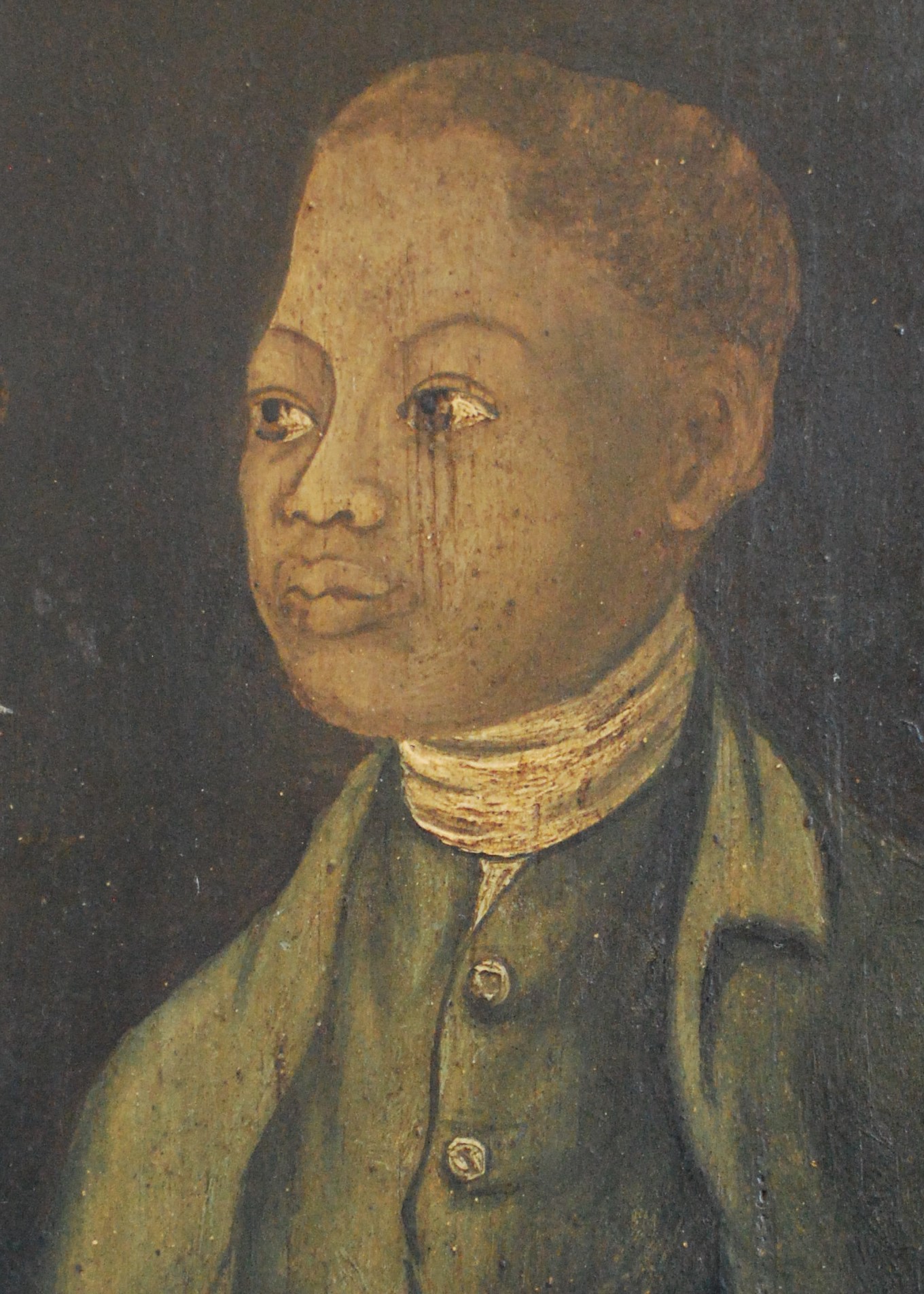
An oil portrait dated 11 May 1754 preserves the likeness of a young Black man known as John Ystumllyn. A later wood engraving after the painting is held by the National Library of Wales. The image gives a face to a man whose adult life was spent working, marrying and raising a family in north Wales. 1, 2
Ystumllyn learned Welsh and English and became a skilled gardener. His story belongs to the estates and communities around Criccieth, far from the ports and metropolitan households that often dominate accounts of early Black Britain. Yet the circumstances that brought him there were connected to a much wider world of displacement and enslavement. 2
A childhood whose details remain uncertain
His original name, birthplace and precise age are unknown. The name Ystumllyn came from the Wynn family’s estate, where he was taken as a child. Much of the familiar story of his capture comes from a Welsh pamphlet published in 1888 by Robert Isaac Jones, who wrote as Alltud Eifion. Jones had been born after John’s death and drew on family recollections and local traditions. 3
The pamphlet itself preserves different versions. One describes a child seized in Africa; another says that children had arrived in London and that a member of the Wynn family sent John to Wales. Ages differ too. The dramatic account of a mother pursuing the people taking her child is therefore a remembered story, transmitted through others, rather than a surviving statement written by John. 4
Some later interpretations suggest a journey through the West Indies. A reference to India on his memorial has added to the debate. None of these possibilities establishes a secure route from his birthplace to Wales. What can be said is that a child was brought into the Wynn household and given a name that attached him to its estate. 3
Learning a trade in the garden
In Wales, John learned to speak and write in both Welsh and English. He also learned horticulture in the estate gardens. Accounts of his working life describe a capable maker as well as a gardener: someone who could produce wooden spoons, small boats and wicker baskets, and who took particular pleasure in flowers. These are useful details of skill, rather than a vague description of a valued servant. 5
Gardening and making required observation, judgement and repeated practice. The range of work remembered about John suggests a person able to learn by watching and turn that knowledge into useful objects. His working reputation rested on what he could do with his hands. It also places a Black craftsman within the ordinary material life of eighteenth-century Wales: its gardens, household utensils and estate labour. 5
Jones’s language about John’s arrival is often demeaning, treating unfamiliar speech as though it were no language at all. That prejudice belongs to the telling. It is not a reliable measure of the child’s abilities. The same account goes on to describe his command of two new languages and several crafts, evidence that requires a very different understanding of the person being described. 4
Margaret Gruffydd and a household of their own
John married Margaret Gruffydd at Dolgellau on 9 April 1768. The Dictionary of Welsh Biography cites the parish marriage records. Margaret came from Hendre Mur, Trawsfynydd, and had worked as a maid at Ystumllyn before moving elsewhere for employment. 3
The remembered account describes a courtship sustained as Margaret moved between places of work. John left his employment to marry her and lost his position at Ystumllyn. According to that account, his best man was Griffith Williams, the son of the local vicar. The wedding involved other people in the community as well as the couple’s determination to establish a life together. 6
After marrying, John and Margaret settled for a time at Ynysgain Fawr, near Criccieth, where John worked as a land steward. John later returned to work at Ystumllyn. Towards the end of his life he was given possession of Nanhyran, a cottage with a garden, in recognition of his service. Work, housing and dependence on estate families remained closely connected even as the couple formed their own household. 6
Children and connections across north Wales
John and Margaret had seven children. Their family made lasting connections in the area rather than remaining confined to the estate where they had first met. Cadw’s account notes that they continued working on neighbouring estates, and that later writers remembered John as widely liked. Such acceptance coexisted with curiosity about his appearance and attention to his marriage to a white woman. 2
Two children died in infancy. Their surviving children included Ann, who married a musical instrument seller in Liverpool, and Richard, who became a huntsman at Glynllifon. These details extend the family story into the next generation and beyond a single Welsh household. 4
A name kept in the landscape
John was buried at St Cynhaearn’s church, Ynyscynhaearn. His sandstone memorial bears an englyn, a traditional Welsh verse, attributed to the local poet Dafydd Siôn Siâms. It places birth elsewhere alongside baptism and burial in Wales. The stone is a substantial public remembrance of someone who had arrived as an outsider and made his life in the surrounding communities. 7
There is an error in the inscription: it gives 1791 as his death year, whereas the parish-based account gives 1786. The discrepancy is a reminder that a memorial preserves an act of remembrance, as well as information about a life. Its date should not override the earlier record. 7, 3
In 2021, a rose was named after John Ystumllyn. Remembering him through a living plant connects his name to the work for which he was known. His place in Welsh history rests on that work, his languages and his family, alongside the violence and uncertainty surrounding his childhood. 2, 5
Sources and further reading
1. John Ystumllyn, 1754. National Library of Wales, via People’s Collection Wales.
2. John Ystumllyn (c.1738–1786). Cadw / Welsh Government.
3. YSTUMLLYN, JOHN (d. 1786), gardener and land steward. Dictionary of Welsh Biography / National Library of Wales.
4. John Ystumllyn, or ‘Jack Black’: history and traditions. R. Isaac Jones, Tremadoc, 1888; English PDF hosted by the Black Boy Inn.
5. On John Ystumllyn: A Black British gardener and craftsman. Garden Museum.
6. Help us save the portrait of John Ystumllyn. Garden Museum.
7. Gravestone of John Ystumllyn, NPRN 545001. Royal Commission on the Ancient and Historical Monuments of Wales / Coflein.
Featured image. Portrait of John Ystumllyn by an unidentified artist, dated 11 May 1754. Unidentified artist, 1754; reproduction via Andrew Green and Wikimedia Commons. Public domain. Image record · Public domain
