In July 1572, an African man approached the English boats at Nombre de Dios, on the Caribbean coast of what is now Panama. Francis Drake’s men were attacking the Spanish port. The man asked whether the boats belonged to Drake and repeatedly asked to come aboard. The English account says shots were fired at him before the sailors finally brought him in. 1
His name was Diego. He was escaping Spanish enslavement, and his knowledge soon became valuable to the expedition. He later travelled to England and sailed with Drake again. His life connects Tudor Plymouth with African resistance in the Americas and a voyage across the Pacific. No surname is securely known. 2
An escape during a raid
Nombre de Dios mattered because it was part of the route carrying Spanish colonial wealth across the isthmus of Panama. Silver and other valuables moved towards the Caribbean, where ships could take them to Spain. Drake hoped to seize some of that wealth. His assault on the town was dangerous, and he was wounded. Diego entered the story amid an armed struggle over the proceeds of empire. 1
Drake himself had participated in slave-trading voyages with John Hawkins during the 1560s. Those expeditions captured Africans and attacked Portuguese ships carrying enslaved people. His willingness to cooperate with Africans against Spain should therefore be understood alongside his own involvement in enslavement. For Diego, joining an English expedition offered an escape from a particular enslaver; it did not turn the English captain into an opponent of the slave trade. 3
Finding the Cimarrons
Diego brought information about the port’s defences. He reported that soldiers had recently arrived to protect it from the Cimarrons: Africans who had escaped slavery and established communities beyond Spanish control. His account helped the English assess the people and forces around them. Being able to explain conditions ashore gave him a role that could not be filled simply by adding another armed sailor. 1
Later in the expedition, Diego directed Drake’s brother John towards a place where he could meet Cimarrons. Representatives travelled between the two groups, and Englishmen remained with the Cimarron leader while two of his men came aboard. A meeting was arranged at a river the English called Rio Diego. Cooperation developed through introductions, exchanges and agreements, rather than through an English captain issuing orders to strangers. 1
The Cimarrons had their own reasons for resisting Spain. The voyage narrative describes settled communities, leaders, cultivated food and a detailed understanding of the terrain. Their guides knew routes through woods and across rivers, as well as the movements of Spanish traffic. The English depended on people whose freedom already rested on resisting colonial authority. Diego helped bring those people into contact with the expedition. 1
Building, guiding and taking treasure
Communication was only part of Diego’s contribution. The English narrative also credits the African man who had joined them with particular skill in putting up storehouses quickly. Food and supplies had to be kept in several locations so that the loss of one store would not leave the expedition helpless. This was practical construction work in unfamiliar conditions, as necessary to survival as sailing or fighting. 1
The account separately describes Cimarrons cutting palm branches and raising shelters for the company. A ship’s crew could bring tools and weapons across the ocean, but its local partners knew where to build and how to move between supplies. Diego’s contribution belonged to this wider African effort, made by people whose own communities faced the threat of Spanish attack. 1
In April 1573, English, French and Cimarron participants intercepted a mule train carrying silver towards Nombre de Dios. The narrative describes a haul too heavy for the raiders to remove in full. The success depended on reaching the route and then finding a way back to the boats. The treasure that made Drake’s expedition profitable came through an alliance whose local knowledge the Europeans could not supply for themselves. 1
From Plymouth to the Pacific
Diego returned with Drake to Plymouth and joined his next great expedition in 1577. Kaufmann’s research identifies him as Drake’s personal servant and an interpreter who spoke Spanish and English. Both roles placed him close to the business of the ship. The surviving evidence does not support a detailed reconstruction of his domestic life in Plymouth. 2
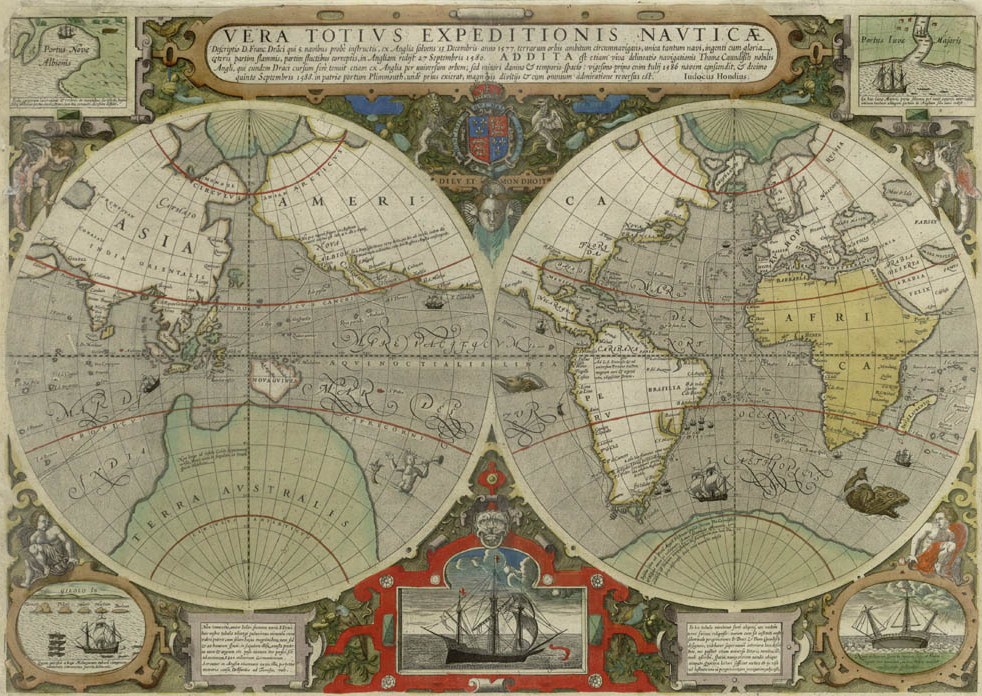
The fleet’s first departure in November was interrupted by severe weather. After repairs, it sailed again in December. The voyage carried the English across the Atlantic, down the coast of South America and through the Strait of Magellan. The ship later known as the Golden Hind continued into the Pacific. Navigation, provisioning, trade and raids on Spanish shipping were all part of its journey. 4
A voyage he did not finish
Diego was wounded during the landing at Mocha Island, off Chile, in November 1578. He survived the immediate attack: testimony discussed by Kaufmann places him aboard months later, in April 1579. He died near the Moluccas, now the Maluku Islands of Indonesia, later that year. The precise medical cause cannot be established. 2
The voyage account describes the crew’s serious shortage of medical expertise after the Mocha attack. Its chief surgeon was dead and another had been separated from the ship. Such details make the risks of the journey tangible. They also come from an English narrative anxious to praise Drake and explain his conduct. Its characterisation of the islanders should not be mistaken for their own account of what happened. 4
Diego never completed the return to England. His place in this history nevertheless rests on documented work: supplying information, helping establish an alliance and contributing to an expedition’s survival. Following him through those tasks changes the cast of the familiar Drake story. Alongside the commander stand African builders, interpreters and independent communities, without whom parts of that story would have unfolded very differently. 1, 4
Sources and further reading
1. Sir Francis Drake Revived. Project Gutenberg; text from a 1910 P. F. Collier & Son edition. Public-domain historical text.
2. The Untold Story of How an Escaped Slave Helped Sir Francis Drake Circumnavigate the Globe. HISTORY / A+E Television Networks.
3. Sir Francis Drake facts. Royal Museums Greenwich.
4. The World Encompassed by Sir Francis Drake. Nicholas Bourne, London, 1652; digital transcription hosted by Spirasolaris. Public-domain historical text.
Featured image. Jodocus Hondius’s 1595 world map, plotting the voyages of Francis Drake and Thomas Cavendish. It was made after the voyage on which Diego travelled. Jodocus Hondius, 1595; Library of Congress, Kraus Collection, via Wikimedia Commons. Public domain. Image record · Public domain
