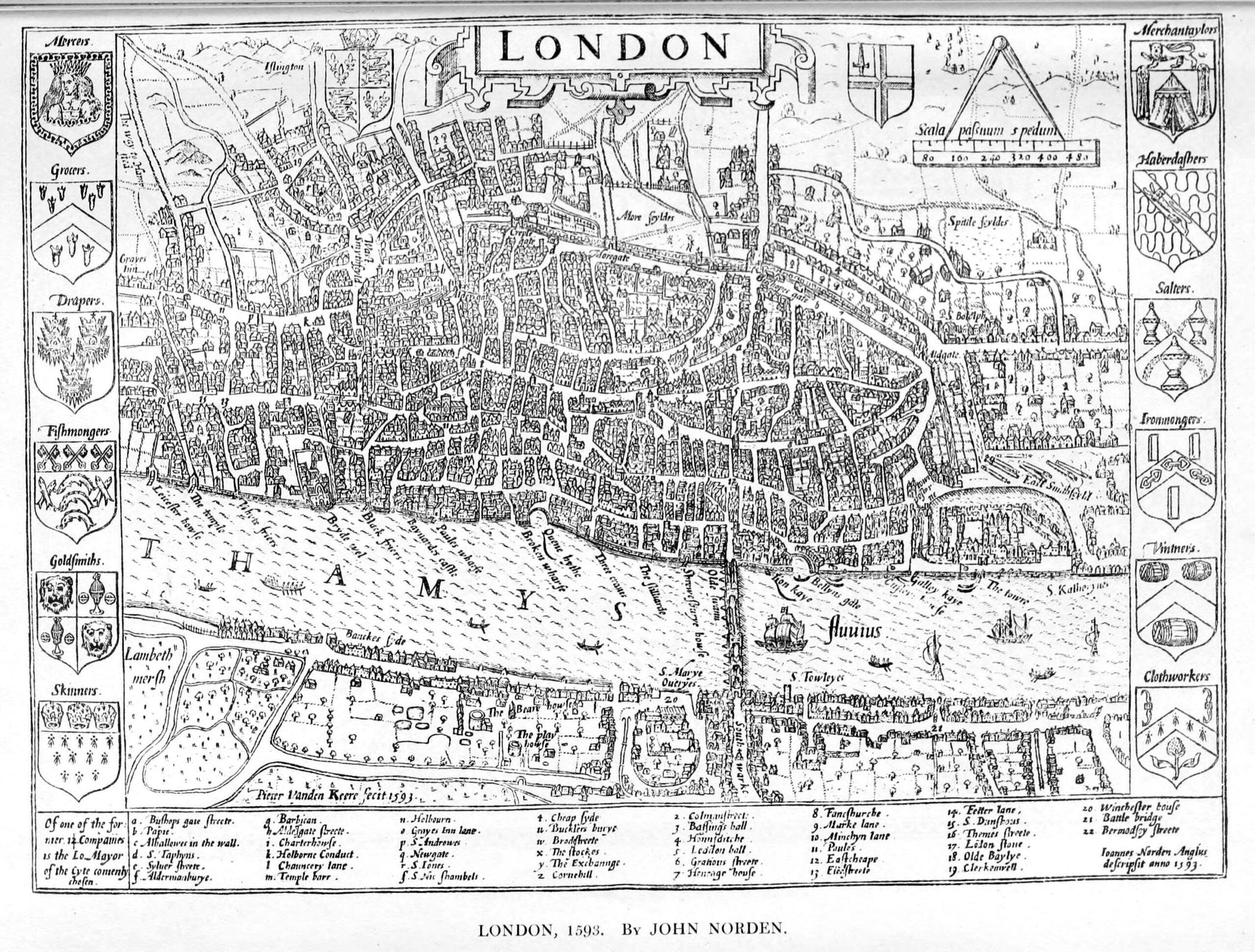
In the later sixteenth century, a silk weaver usually known as Reasonable Blackman lived with his family in Southwark. His history belongs to the working borough south of the Thames: a place of crafts, migrant households and uncertain livelihoods. Parish entries and research into London’s textile trades allow us to place a Black artisan within that economy, while leaving much of his individual career unknown.1
A name in Southwark
The names require care. Historian Imtiaz Habib draws attention to records for Jane and Edmond, children of “Reasonable”, in St Olave’s, Tooley Street. The entries include the description “blackmor”. Habib also explains why names such as Blackmore or Blackman cannot, by themselves, prove African ancestry: they had other uses in England. Here, scholars have considered the descriptive wording alongside the family entries. Reasonable Blackman is the name under which the resulting biography is generally known, although the records preserve variations rather than a single, consistently written identity.2
Kaufmann’s reconstruction places him on the west side of St Saviour’s parish in 1579 and in St Olave’s by 1587. These are points in an adult working life, not dates of birth or death. They locate him within Southwark across a number of years, among people practising trades connected to the expanding capital.3
Making a living from silk
Silk weaving placed him in a skilled branch of textile production. Demand for silk increased in Elizabethan England, where expensive clothing helped express social standing. Raw materials arriving from abroad could be turned into goods for an English market. The surviving accounts do not identify a particular fabric woven by Blackman, his customers or the size of his output. His occupation connects him to that trade without supplying the details of an individual business.3
Southwark offered work to migrants and artisans who faced restrictions in the City of London. Its working population lived alongside the district’s prisons, taverns and places of entertainment. The neighbourhood’s reputation for disorder can obscure this productive life. A silk weaver belonged to a community in which making and selling goods were part of the borough’s daily economy, and where someone with useful skills might find a place to practise them.1
Skills and migration
The textile historian Lien Luu shows how strongly Southwark’s silk industry was connected to migration from continental Europe. Of fifteen silk weavers recorded as strangers in St Olave’s in 1571, twelve came from Flanders, Brabant or Holland. The qualification matters: this was a count of migrant weavers, not necessarily every person weaving silk in the parish. It establishes a substantial community with skills and connections extending across the North Sea.4
Luu also shows that the movement of a craft involved people teaching, adapting and sometimes guarding their knowledge. Access to training and guild membership could be restricted, and the spread of skills between immigrant and English workers was uneven. This helps explain why a neighbourhood of fellow workers could matter to a livelihood. It supplies the setting in which Blackman worked, while leaving his own teacher and training unidentified.4
A journey through the Netherlands has been suggested for Blackman because of those wider links. It remains a possibility. Neither a continental birthplace nor a particular African place of origin has been securely established for him.3
A family recorded in the parish
Kaufmann identifies at least three children in the family: Edward, Edmund and Jane. Their mother’s identity has not been securely recovered. These names give the biography a domestic scale beyond its account of a trade. They also expose the limits of descriptions of Blackman as prosperous. The existence of a family does not tell us his income, the quality of the household’s accommodation or whether work was reliably available. Such details should not be supplied from the prestige of silk alone.5
Plague in 1592
Plague reached St Olave’s in July 1592. In October, Jane and Edmund died. Kaufmann’s account places both losses within the same outbreak, which continued into the following year. The record brings a wider disaster into the history of one household: two children named in the parish were lost within a month. The parish entries preserve the children’s names, but leave their father’s response unrecorded.6
The tension between earning a living and avoiding infection appears in a later text by James Bamford, curate of St Olave’s, published in 1603. He challenged people who denied that plague was contagious and criticised those who went into company while visibly ill. He also described the fear of being shut away from company and business, because neglected work could undermine a household’s means of support. Written eleven years after the deaths of Jane and Edmund, his words offer a local account of pressures surrounding outbreaks, rather than a description of the Blackman home.7
Blackman’s later life has not been securely traced. His surviving history joins skilled work to the everyday demands of family life and to the vulnerability of a London household during epidemic disease. The surviving names of Edward, Edmund and Jane keep that family at the centre of the story.5
Sources and further reading
1. The Story of Reasonable Blackman — Dr Miranda Kaufmann, FutureLearn: Black Tudors, The Untold Story.
2. Black Lives in the English Archives, 1500–1677: Imprints of the Invisible — Imtiaz Habib, Old Dominion University; Ashgate, 2008.
3. Skilled Black Tudors in the Silk, Cloth and Needle Crafts — Dr Miranda Kaufmann, FutureLearn: Black Tudors, The Untold Story.
4. Immigrants and the diffusion of skills in early modern London: the case of silk weaving — Lien Luu, Institute of Historical Research, University of London; Documents pour l’histoire des techniques 15 (2008), pp. 32–42.
5. Black Faces of Tudor England: The prosperous silk weaver — Dr Miranda Kaufmann, BBC History Magazine.
6. Were there burial records during the plague? — Dr Miranda Kaufmann, FutureLearn: Black Tudors, The Untold Story.
7. A Short Dialogue Concerning the Plague’s Infection, 1603: excerpts — James Bamford, curate of St Olave’s; historical text reproduced in FutureLearn’s Black Tudors course.
Featured image. John Norden’s 1593 map of London. Southwark appears at the bottom, across the Thames from the City of London. John Norden, 1593; reproduced in G. E. Mitton’s Maps of Old London (1908), via Wikimedia Commons. Public domain. Image record · Public domain
