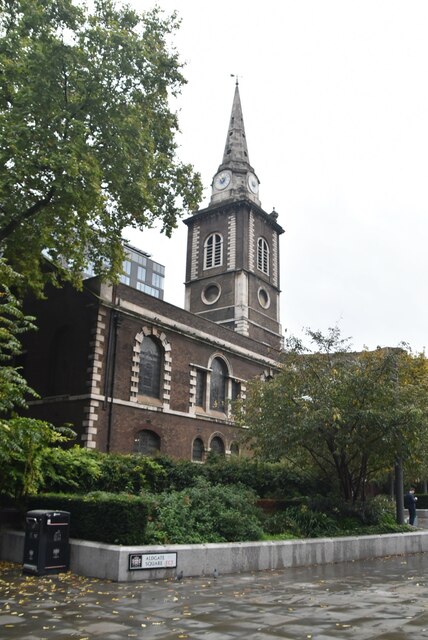
On 3 June 1597, Mary Fillis was baptised at St Botolph’s, Aldgate, in London. She was about twenty and had already spent much of her childhood in England. An unusually detailed parish account records her father’s occupation, two households in which she had worked, her request for instruction and the people present at the ceremony. A young woman’s life emerges through these particular connections.1
A childhood journey
The memorandum says that Fillis had been in England for thirteen or fourteen years. Taken with her approximate age, this places her arrival around 1583 or 1584, when she was about six or seven. It names her father as Fillis of Morisco and records that he made baskets and shovels. Those details preserve something of her family before London, although they do not tell us whether her father travelled with her or what happened to him afterwards.1
Historian Miranda Kaufmann identifies Fillis as coming from Morocco. The exact circumstances of her journey remain uncertain. Her childhood arrival belongs within a period of growing contact between England and North Africa, and it should not be turned into a precisely reconstructed voyage for which no account survives.2
Trade and diplomacy made those connections increasingly visible. In 1600, three years after Fillis’s baptism, the Moroccan ruler Ahmad al-Mansur sent an embassy to Elizabeth I. The surviving portrait of its leader, Abdel-Ouahed ben Messaoud ben Mohammed Anoun, is discussed by the Metropolitan Museum of Art in the context of commercial relations and a proposed alliance against Spain. Moroccan sugar was among the goods traded with England. This was a relationship with political and commercial purposes, providing a wider setting for journeys between the two countries.3
Work in two London households
By the time of her baptism, Fillis had changed employers. The memorandum names her former mistress as a widow, Mistress Barker, living in Mark Lane. It then identifies Millicent Porter, a seamstress in East Smithfield, as the woman she was serving in 1597. These addresses locate Fillis’s working life in and around the eastern part of the City. The account records movement between households, without explaining the terms of either employment or the reason for the change.1
Porter’s occupation gives this second household a particular character. Sewing was skilled work, and living with a seamstress may have given Fillis opportunities to learn it. Kaufmann raises that possibility when considering how she might later have supported herself. The documented description is nevertheless that of a servant to a seamstress. It does not establish that Fillis owned a workshop, sold garments independently or had completed an apprenticeship.2
Preparing for baptism
The request for baptism is attributed to Fillis herself. According to the parish memorandum, she asked through Porter to speak with the curate. Her employer therefore helped arrange a conversation that the account presents as something Fillis wanted. The clerk also described her as developing Christian faith. These are the reasons recorded at the time; they leave room for a personal religious life that the document cannot fully disclose.1
Before baptism, she answered questions about her faith. The curate, Christopher Threlkeld, asked her to say the Lord’s Prayer and recite the articles of her belief. The clerk judged her responses favourably and said she performed the recitations well. This is evidence of religious learning expressed aloud: she could respond and repeat what was required. It does not by itself establish whether she could read or write. The account gives us a glimpse of an exchange in which Fillis spoke and her answers mattered.4
Religious instruction could help a convert participate more fully in parish life. It also operated within a society where servants, women and newcomers faced unequal expectations and opportunities. Historians continue to debate how far particular African residents could exercise freedom in practice. A baptism entry cannot resolve a person’s employment conditions or legal status on its own. Fillis had lived in England for many years before this ceremony; it marks a change in religious membership within an existing life.5
The people at the ceremony
The memorandum names several of those present, including Margerie Barrick, Gertrud Ponder and Millicent Porter. Parish officials appear too: Thomas Harridance, the clerk whose name also occurs as Harrydance, and Thomas Ponder, the sexton. The writer added that other people attended. Their presence made the baptism a public occasion. The list allows us to identify participants, although it does not establish that every witness was a close friend or explain what brought each person there.1
After Millicent Porter
Porter died in 1599. No secure account of Fillis’s subsequent life has been established. The possibility that she continued in sewing is attractive, but remains a possibility. Her baptism record already preserves a substantial stretch of lived experience: a childhood journey, family knowledge, household work, a change of employer and the steps she took towards entering the parish’s Christian community. The account preserves her decisions and the connections through which her London life can still be followed.6
Sources and further reading
1. The 1597 memorandum of Mary Fillis’s baptism, transcribed in “Mary Fillis, baptised at St Botolph’s Aldgate in 1597” — Thomas Harridance, parish clerk; transcription reproduced by Sarah Jackson, East End Women’s Museum.
2. Out of Africa: Stories of pioneering black women in Early Modern England — Dr Miranda Kaufmann, University of London.
3. Abdel-Ouahed ben Messaoud ben Mohammed Anoun, Moorish Ambassador to Queen Elizabeth I, British Painter, 1600 — Adam Eaker, The Metropolitan Museum of Art.
4. Mary Fillis’s 1597 examination before baptism, quoted in Black Tudors: Three Untold Stories — Thomas Harridance’s parish account; reproduced by Dr Miranda Kaufmann, Gresham College.
5. Understanding the Lives of Black Tudor Women — Dr Miranda Kaufmann, FutureLearn: Black Tudors, The Untold Story.
6. 10 Black Tudors: Mary Fillis — Dr Miranda Kaufmann.
Featured image. The present St Botolph’s Aldgate, photographed in October 2022. Mary Fillis was baptised in the parish in 1597; the church shown here was built in 1741–44. Photograph by N Chadwick, 30 October 2022, via Geograph. Used unchanged under CC BY-SA 2.0. Image record · CC BY-SA 2.0