Russet cloth, red kirtles, green ribbon and new shoes: the Scottish royal accounts preserve the presence of African women through purchases made for their lives at court. Two women remembered as Ellen More and Margaret appear in the history of James IV’s household. Following their story means keeping names, dates and descriptions distinct, because the earliest payments concern women whom the clerks did not name.1, 2, 3
At the king’s daughter’s household
In 1504, two young African women described in the records as “More lasses” became associated with the household of Lady Margaret, James IV’s daughter, at Edinburgh Castle. Lady Margaret’s mother was Margaret Drummond. She had her own household, with attendants and provision appropriate to her royal connections.1, 4
It is easy to confuse the Margarets in this history. The king’s daughter was Lady Margaret; his queen was Margaret Tudor; the African attendant later appears under the name Margaret. Distinguishing them makes it possible to follow purchases and changes of household without transferring one woman’s clothing, marriage or travels to another.1, 3
The African women were among people whose daily support generated repeated expenditure. Their clothing appears alongside provision for others in the castle. The accounts also record payments to an African drummer, described as the “More taubronar”. The women consequently belong within a wider African presence at the Scottish court, although shared descriptions do not prove that these people were relatives or had travelled together.2
Names written by other people
The forms More, Moir and Mor occur in Older Scots. The historical dictionary records their use for people described as African or Black, as well as for performers representing a “Moor” in pageants. The context of each entry matters. The word is not a precise statement of a person’s birthplace, language or religion.4
For Ellen and Margaret, it should not be read automatically as a family surname inherited at birth. Nor does “Moor” establish that either woman came from a particular part of Africa or practised Islam. Those details cannot be recovered merely by expanding a clerk’s label into a biography.
The historian Miranda Kaufmann points out that the names Margaret and Elene appear in the records in 1511–12, several years after the earlier unnamed women. They are often connected in modern accounts, but a continuous identification is not certain. The familiar paired story contains both documented entries and an attempt to connect them.3
Clothing, materials and the people paid to make them
The clothing accounts give particularly concrete evidence. In 1507, seven ells of russet cloth were bought for gowns for two women described as “Moris”. At seven shillings an ell, the cloth cost forty-nine shillings. Separate payments covered lining and the making of the gowns. These were recorded costs of materials and work, rather than a wage paid directly to the women.2
The same group of entries includes red kersey for kirtles for Marjory Lindsay and the two African women. Black lining, linen, green ribbon and the cost of making the three garments follow. Kirtles were garments worn as part of layered clothing; the account’s separate components show how an outfit was assembled through purchases and skilled work.2
Other entries provide shirts, collars, stockings and shoes. Such purchases make the women visible within the recurring business of a household. They needed replacements and more than a single ceremonial costume. The repeated grouping of their clothes with those of other residents also places them within shared arrangements for buying and making clothing.2
These records do not reveal who chose the colours or how much say each recipient had. They do establish an investment of money and labour in their dress. A tailor’s payment and a length of ribbon tell us something different from a court poet’s description of an African woman: they concern practical provision.2
Later households and New Year gifts
Historic Environment Scotland tentatively links Ellen with a Black attendant to Queen Margaret Tudor in 1512. It also notes a joint New Year gift of ten gold coins to two Black women, whose names the entry does not give.1
These entries do not turn every possible connection into a certainty. A gift to two unnamed recipients is evidence for those recipients, even where historians suggest their names. Provision of clothes and money also cannot settle every question about dependence, legal status or freedom to leave. The women’s own account of their position does not survive.
Court spectacle and the limits of identification
James IV’s tournaments of 1507 and 1508 included a figure called the Black Lady. Ellen has often been identified with this role, and with the woman attacked in William Dunbar’s poem Of Ane Blak-Moir. The poem’s degrading treatment of a Black woman is part of the evidence for the court’s racial attitudes, but it does not supply her own voice.5
The identification remains disputed. As Kaufmann explains, the treasury entries do not explicitly name Ellen or Margaret as the tournament figure. Costume evidence has also produced different interpretations of who performed the role. The event can be discussed without assigning its part to either woman as an established fact.3
The quieter entries remain valuable in their own right. They record clothing made, materials purchased and recipients remembered in royal expenditure. Alongside the later names, they locate African women within the households of early-sixteenth-century Scotland. Their history includes the practical arrangements of life at court as well as the spectacles through which that court chose to display itself.2, 3
Sources and further reading
1. Samuel Wilson, Historic Environment Scotland, 16 October 2019, drawing on Edinburgh Castle research. The King’s Daughter and the ‘Moorish Lassies’. Used selectively for the household setting and qualified discussion of later entries.
2. Original Scottish royal accounts, published by H.M. General Register House; University of California Libraries digitisation. Accounts of the Lord High Treasurer of Scotland, volume III, edited by James Balfour Paul (1901). See clothing entries on printed pages 101 and 321–322, footwear entries and payments to the drummer. The volume includes earlier accounting material as well as 1506–1507.
3. Miranda Kaufmann, University of Oxford; especially the discussion on page 43. Africans in Britain, 1500–1640: Introduction, DPhil thesis (2011). Discusses the chronological gap between unnamed and named women and competing readings of the tournament evidence.
4. Dictionaries of the Scots Language; entry first published in 1971. Mor(e, Moir, noun: A Dictionary of the Older Scottish Tongue. Includes examples from the treasurer’s accounts and distinguishes descriptions of people from pageant disguises.
5. Jennifer Melville, National Trust for Scotland, 14 October 2020. Africans at the court of James IV. Used for the tournament dates and discussion of Dunbar’s poem.
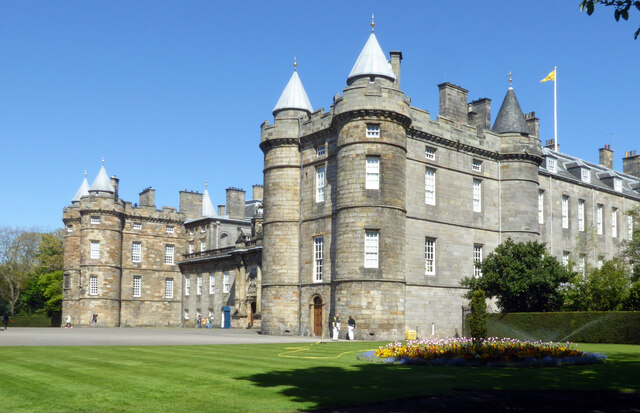
Featured image. The Palace of Holyroodhouse in Edinburgh, photographed in May 2017. James IV developed a palace on this site; the visible buildings include extensive work from later reigns. Photograph by Kay Williams, 3 May 2017, via Geograph. Used unchanged under CC BY-SA 2.0. Image record · CC BY-SA 2.0