A block of red sandstone found at Beaumont in 1934 had spent part of its later life face down in a cottage wall. It had originally been a Roman altar. Its surviving lettering names a military unit with a North African connection: the numerus Maurorum Aurelianorum. The stone helps explain why Burgh-by-Sands, the site of the Roman fort of Aballava, belongs within the history of movement between Africa and Britain.1
An altar with a military name
The inscription is catalogued as RIB 2042 in Roman Inscriptions of Britain. Its base and upper mouldings had been cut away when it was adapted for building. It was therefore recovered from a place of reuse, rather than standing where Roman soldiers had originally dedicated it. The distinction between its Beaumont findspot and its association with nearby Aballava matters.1
The text records a dedication to Jupiter and the imperial divinities. It identifies the Aurelian Moors and names officers: Flavius Vibianus, the unit’s commander, and Julius Rufinus, who oversaw the dedication. Public religion, military organisation and allegiance to the emperors appear together in a compact piece of writing.1
References to the emperors Valerian and Gallienus allow the inscription to be dated to AD 253–258. That is evidence for the unit in Britain during those years. It is not a record of when every member arrived, and it supplies no founding date for the regiment. The stone marks an occasion within a longer history of service.1
Who were the Aurelian Moors?
Numerus here identifies a military unit. Maurorum connects its name with the Mauri, the people known in English as Moors. North East Museums places the unit’s origins in north-west Africa, in the broad area of present-day Morocco and Algeria. These modern country names help locate the region; they should not be mistaken for the political boundaries or national identities of Roman times.2
Roman units often retained names associated with where they had first been raised. Recruitment could subsequently draw both on that area and on places where the soldiers served. The North African name is therefore significant without being a birthplace certificate for every man in the ranks. Some members might have travelled from Africa themselves; others could have joined a unit whose name carried an older connection.2
The altar gives a collective military identity. It does not describe the appearance of individual soldiers. Equating every North African origin with a modern Black identity would claim more than this evidence establishes. Geography, a regiment’s history and the identities of its members are related questions, each requiring its own evidence.
Aballava in the wider frontier
A second written source places the unit at Aballava. The Notitia Dignitatum, a late Roman compilation of civil and military offices, lists its prefect at a station written as Aballaba. The entry appears among the forces assigned along the Wall, within the command of the dux Britanniarum, a senior military commander in Britain.3
Reading the surrounding entries gives the posting a setting. Other units bear names associated with Asturians, Batavians, Tungrians and Dacians. The Aurelian Moors occupy a place in this organised chain of commands and stations. Their presence was recorded as part of the frontier’s military administration.3
The list and the altar serve different purposes. One assigns an office to a station; the other records a dedication made under named officers. Together they support the connection between the unit and Aballava. Neither provides a continuous diary of its movements, a complete muster of its members or a count of local families.1, 3
A fort surrounded by working lives
At Burgh-by-Sands much of the Roman site survives below ground. Excavation and geophysical survey have identified parts of the fort and changes in the Wall’s alignment. Beyond the fort’s eastern side, excavators found buildings fronting a road. Slag and charcoal indicate metalworking in the surrounding settlement, known as a vicus.4
This evidence brings the fort into a working landscape. Buildings needed construction and repair; roads connected activities outside the defences. The settlement’s remains help us look beyond a line of soldiers stationed on a wall. They do not, however, identify the ancestry of a particular metalworker or establish which buildings housed the Aurelian Moors’ relatives. Those personal connections remain unrecorded.4
When an inscription names a home town
Another stone from the Wall region offers a useful comparison. A damaged tombstone found near Birdoswald in 1961 names Gaius Cossutius Saturninus and identifies him with Hippo Regius, now Annaba in Algeria. The published reconstruction identifies him as a soldier of the Sixth Legion. This is evidence about a named individual’s place of origin, rather than the inherited name of a regiment.5
Saturninus should not be added to the Aurelian Moors simply because both inscriptions point towards North Africa. His tombstone belongs to a different place and military context. Keeping the records distinct makes the history more precise: there were several kinds of African connection within the Roman frontier, expressed through individual lives as well as unit traditions.1, 5
At Aballava, the strongest starting points remain tangible ones: a named unit on a reused altar, its posting in a military list, and the buried remains of the place where it served. They put north-west Africa within the history of Hadrian’s Wall while leaving room for questions that the surviving names cannot answer.1, 3, 4
Sources and further reading
1. Roman Inscriptions of Britain, incorporating the ancient inscription and its scholarly editions. RIB 2042: altar associated with Aballava. The original Latin names the unit and officers; the catalogue records the Beaumont findspot and dating by imperial titles.
2. Bill Griffiths, Head of Programme and Collections, North East Museums. Africans on Hadrian’s Wall. Used for the unit’s regional origin and the distinction between unit names and individual recruitment.
3. Ancient administrative compilation; Latin text based on Otto Seeck’s 1876 edition. Notitia Dignitatum, western section XL: Dux Britanniarum. The entry for the prefect of the Aurelian Moors appears under the stations along the Wall, at Aballaba.
4. Historic England. Burgh by Sands Roman fort and associated remains: National Heritage List entry 1018457. See the detailed account of excavation, geophysical survey and the settlement outside the fort.
5. Roman Inscriptions of Britain; stone recorded at Tullie House Museum and Art Gallery, Carlisle. RIB 3445: tombstone for Gaius Cossutius Saturninus. The damaged inscription names Saturninus and Hippo Regius; the legion’s name is restored in the edition.
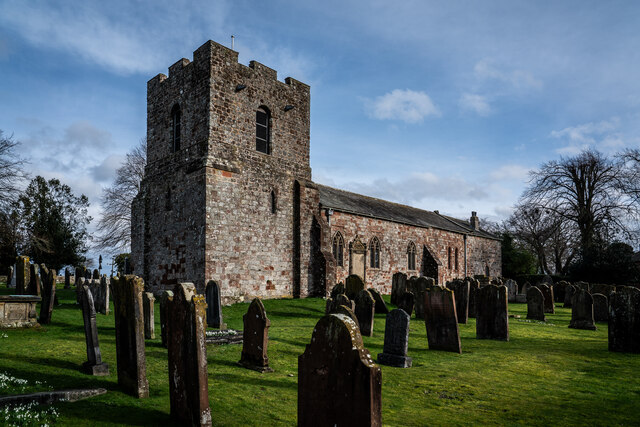
Featured image. St Michael’s Church at Burgh-by-Sands, photographed in February 2026. The church stands on the site of the Roman fort of Aballava. Photograph by Brian Deegan, 18 February 2026, via Geograph. Used unchanged under CC BY-SA 2.0. Image record · CC BY-SA 2.0