On 6 May 1971, New Beacon Books published Bernard Coard’s How the West Indian Child is Made Educationally Sub-Normal in the British School System. Campaigners took the book into communities, including through door-to-door selling. A publication became part of parents’ efforts to understand and challenge what schools were doing to their children. 1
That connection between books and public action ran through New Beacon’s history. Founded in 1966 by John La Rose and Sarah White, it joined publishing, bookselling and international distribution in one venture. Its importance lay in the relationships through which writing reached readers and became available for discussion. 2
An independent place for books
La Rose was a poet and political activist from Trinidad. His own collection, Foundations, appeared in 1966. Writing and the means of publishing it were connected concerns: an author needed ways to reach people, while readers needed access to books that might otherwise be difficult to find. 3
New Beacon’s account of its origins describes publishing as a way to sustain knowledge of culture, history and politics across generations. Its range included poetry, fiction, history, non-fiction and children’s books from the Caribbean, Africa and elsewhere. The work involved deciding what to publish and making writing from other presses available too. 2
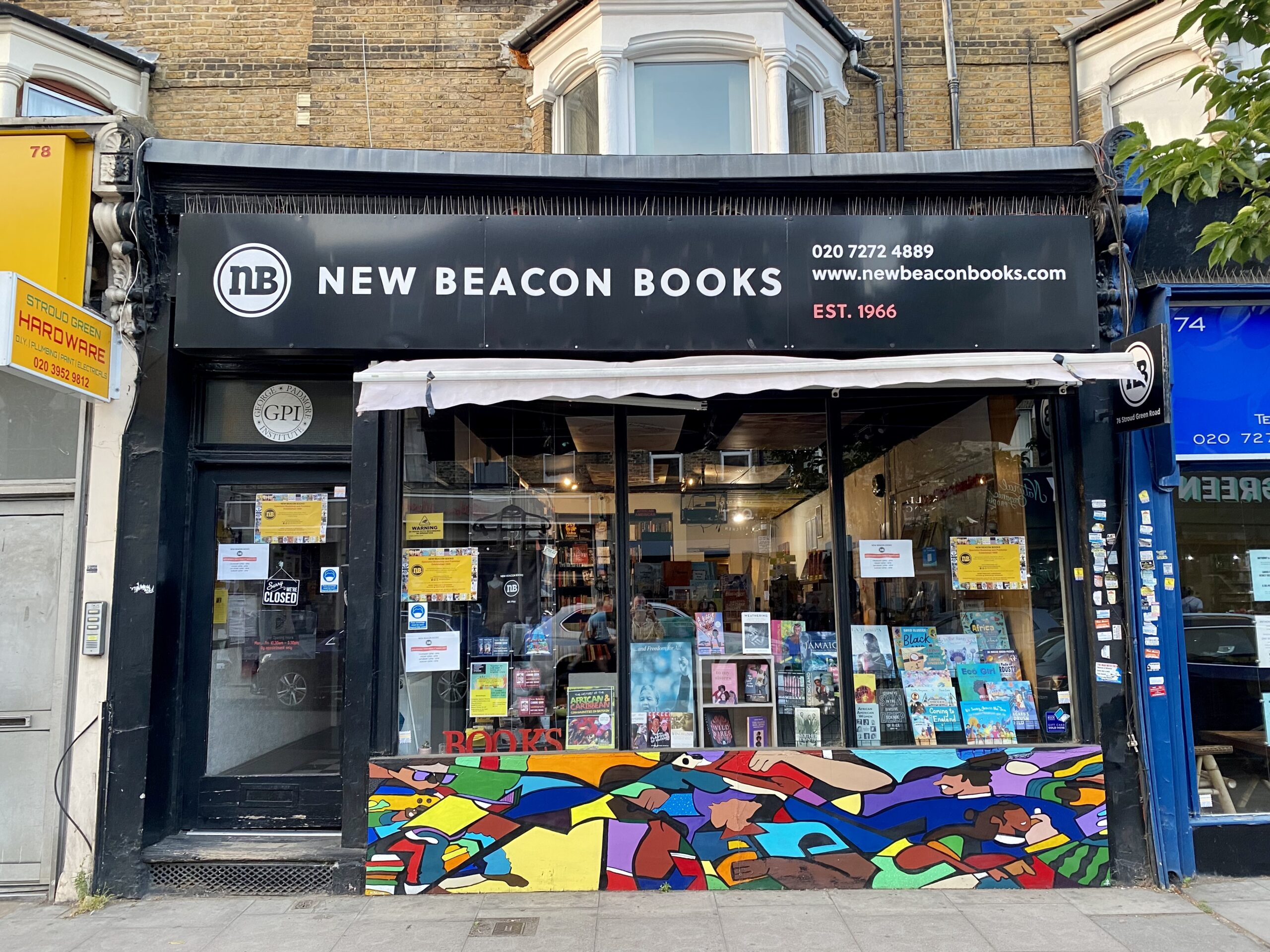
The business developed through rooms in people’s homes before establishing itself at 76 Stroud Green Road in north London in the mid-1970s. Its beginnings depended on domestic space and persistent practical work. The familiar idea of a specialist bookshop grew from the labour of building a stock of books and a community of readers. 4
Readers, writers and the Caribbean Artists Movement
The Caribbean Artists Movement emerged in London in late 1966. Its co-founders were Edward Kamau Brathwaite, Andrew Salkey and La Rose. They wanted opportunities for writers, artists and critics to meet and discuss work that was often marginalised. The movement developed through conversation, readings, exhibitions and debate. 5
The West Indian Students Centre in Earl’s Court became a regular venue for public sessions from 1967. La Rose and White brought books from New Beacon to the meetings. A discussion could therefore lead to further reading; a bookstall could introduce someone to a writer they had just heard. 5
These connections helped create an audience without assuming that a single Caribbean voice existed. Participants came with different experiences and artistic commitments. A forum and a bookstall gave those differences somewhere to be expressed, read and argued over. 5
Publication also meant bringing earlier writing back into circulation. In 1971 New Beacon reissued C. L. R. James’s Minty Alley, first published in 1936. In their history of Black British publishing, Sarah White and fellow organiser Roxy Harris explain the importance of making out-of-print Caribbean writing accessible to another generation. A catalogue could connect new work with a longer literary past. 6
Publishing became part of the education campaign
Coard’s 1971 book appeared on behalf of the Caribbean Education and Community Workers Association. The association brought together people concerned about Black children’s education, including inappropriate placement in schools carrying the damaging official label reproduced in the book’s title. Members gathered evidence, informed parents and supported supplementary education. 1
The book provided an argument that could travel beyond a meeting. Someone could read it at home, share it with another parent or use it to question an authority’s account. Distribution was therefore part of the campaign itself. The people selling and discussing the publication helped turn written analysis into shared knowledge. 1
White and Harris describe an activist approach among small independent publishers: promoting books at meetings and readings, and selling directly. This was both a practical answer to limited resources and a way of building relationships with readers. The audience was being reached through the same community networks in which debates about education and racism were taking place. 6
A network of presses and an international book fair
New Beacon worked within a growing publishing network. Eric and Jessica Huntley founded Bogle L’Ouverture Publications in 1968; Allison & Busby also brought Black writers into print. These were distinct ventures with their own authors, choices and histories. Their combined activity widened the routes through which a book could reach its readers. 6
The Huntleys’ work developed from their Ealing home. Bogle L’Ouverture published Walter Rodney’s The Groundings with My Brothers in 1969 and How Europe Underdeveloped Africa in 1972. Its authors also included poets and fiction writers. Political analysis and imaginative writing were both part of this developing publishing world. 7
In 1982 New Beacon, Bogle L’Ouverture and Race Today Publications launched the International Book Fair of Radical Black and Third World Books. La Rose and Jessica Huntley became joint directors. The first London fair took place at Islington Town Hall, followed by fairs at Lambeth and Acton town halls, reflecting the organisers’ different bases. 8
A leaflet for the second fair, preserved by London Museum, gives a sense of the wider programme. Wole Soyinka opened the Brixton event in 1983. The Ritzy Cinema hosted documentaries and a concert, while Tate Library displayed work by Black sculptors and painters. Books formed part of a programme involving several art forms and local venues. 9
Twelve London fairs took place between 1982 and 1995, with additional events in Manchester, Bradford, Leeds and Glasgow. Publishers and participants travelled from the Caribbean, Africa, Asia, the Americas and Europe. The fairs created opportunities to encounter writing, establish contacts and discuss cultural and political questions across borders. 8
The programme returned to practical questions facing its participants. Forums examined publishing, women’s writing, education and the organisation of campaigns. Workshops included schoolchildren, and related discussions travelled to cities beyond London, where different speakers and audiences gave them a different character. The fair’s reach depended on local settings as well as international visitors. It enabled a debate started in one place to be taken up elsewhere, with fresh experiences brought to it. 8
The people who kept the work going
New Beacon’s colleagues remembered Sarah White’s work on production and proofreading, as well as the organisation of the physical book fairs and their brochures. White and Janice Durham ran the bookshop for many years with help from volunteers. These tasks were essential to the public life of the books: a manuscript had to become a readable edition, an event had to be organised and a reader had to receive an order. 4
New Beacon’s own history names volunteer workers, including Claire Shepherd, Barbara Beese and Rawle Callender. Naming them changes the scale at which the institution can be understood. Its public reputation rested on more than the founders’ ideas: it depended on people returning to the work, alongside their other commitments. The history of an independent press is also a history of that accumulated time. 2
The George Padmore Institute, established in 1991, grew from the community connected with New Beacon. Its archive preserved records of cultural organisations and campaigns involving Black communities in Britain. The work of publishing and organising could itself become a history available to later readers. 3
New Beacon’s contribution is visible in these connections: between a writer and a publisher, a parent and a campaigning book, or a small press and an international audience. A publication could offer pleasure, preserve an argument or help someone recognise their experience. Making those possibilities available required people willing to do the sustained work of putting books into circulation.
Sources and further reading
1. Black Education Movement. George Padmore Institute.
2. The Story of New Beacon Books. New Beacon Books.
3. About the George Padmore Institute. George Padmore Institute.
4. Sarah Swinburne White. New Beacon Books; New Beacon Staff.
5. Caribbean Artists Movement. George Padmore Institute.
6. The Roots of Independent Black British Publishing. Bocas Lit Fest; Roxy Harris and Sarah White.
7. Bogle-L’Ouverture Publications. Friends of the Huntley Archives at LMA Foundation.
8. The International Book Fairs. George Padmore Institute.
9. Leaflet: Second International Book Fair of Radical, Black and Third World Books. London Museum; Book-fair organisers; catalogue by London Museum.
Featured image. The New Beacon Books shopfront on Stroud Green Road in north London, photographed in June 2023. Photograph by No Swan So Fine, 9 June 2023, via Wikimedia Commons. Image record · CC BY-SA 4.0
