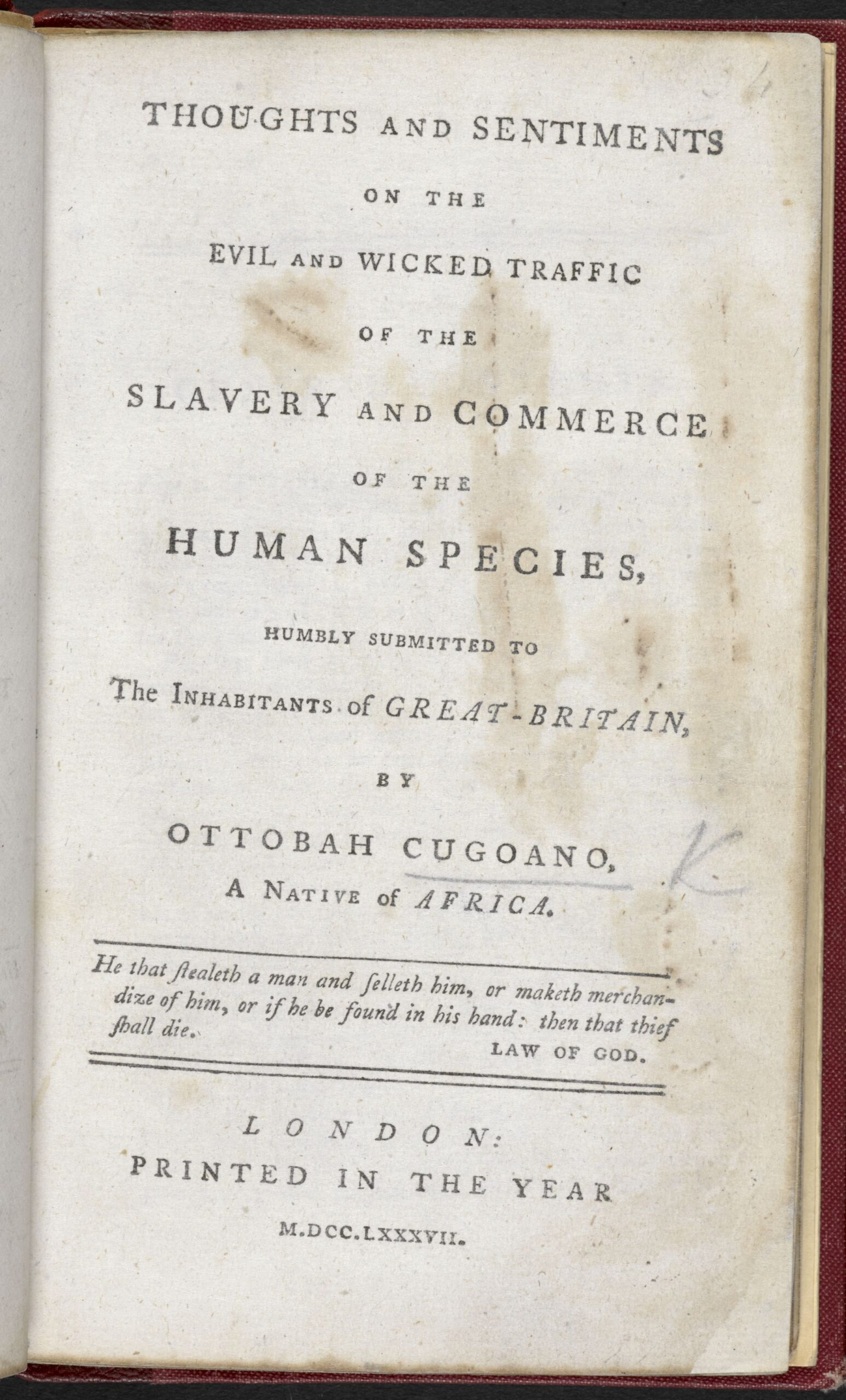
In 1787 Ottobah Cugoano published a book addressed to the inhabitants of Great Britain. He had been kidnapped as a child and enslaved in the Caribbean before coming to London. In Thoughts and Sentiments, his account of those experiences formed part of a much wider argument. He examined the claimed right to own another person, challenged Christian participation in slavery and proposed changes to government, labour and trade.1
Taken from the Fante country
Cugoano identified his birthplace as Agimaque in the Fante country, generally associated with Ajumako in present-day Ghana. His birth is usually placed around 1757. In his own account, he was gathering fruit and catching birds with other children when armed men seized them. The captors accused the children of an offence and used that claim to begin a journey away from their homes.1, 2
He described being passed between people, moving into places where the language was unfamiliar, and eventually reaching the coast. Enslavement dismantled his access to family and familiar surroundings in stages. In Grenada he encountered plantation labour and the punishments used to enforce it. These recollections gave readers an account of violence extending well beyond the moment of capture.1
Cugoano acknowledged the role of African captors and intermediaries. He also insisted on the demand created by those purchasing people. That connection was essential to his argument: the commercial system gave buyers an interest in the violence through which captives were obtained.1
London, baptism and a book
He came to England in 1772. How and when he secured his freedom remain uncertain. On 20 August 1773, St James’s Church, Piccadilly, recorded his baptism under the name John Stuart, giving his age as sixteen. The entry helps explain the approximate birth date. Baptism was a religious event, rather than an automatic legal release from enslavement.2, 4
During the 1780s Cugoano worked for the artists Richard and Maria Cosway at Schomberg House in Pall Mall. He also became involved in the Sons of Africa, alongside Olaudah Equiano, taking part in collective opposition to slavery. His writing belonged to a London world of employment, religious life and Black political activity.3, 4
The 1787 book brought his name into a public argument on his own terms. Its autobiographical passages were brief beside its sustained discussion of justice, Scripture and government. Readers who approached it only for an account of suffering would encounter an author making demands of them.1
Slavery’s claim to ownership
Cugoano began with a fundamental objection: taking a human being by force could not create a legitimate right of ownership. Purchase did not repair the original wrong. Nor did laws made by societies profiting from slavery settle the moral question. A system could recognise a transaction while remaining unjust in its foundations.1
This argument made supposedly respectable commerce answerable for kidnapping. Money changing hands and documents recognising an owner’s claim could not turn the person being sold into lawful property. Cugoano rejected attempts to excuse slavery through claims about African inferiority. He defended the right to resist enslavement and to help others resist it, placing responsibility on people beyond the individual captive.1
He also confronted a familiar evasion: the claim that enslaved people might live better than some poor people who were free. Poverty within a free society required a remedy of its own. It did not justify depriving others of liberty. His comparison distinguished material hardship from the additional injustice of being held as someone’s property; one wrong could not excuse another.1
Christian Britain called to account
Cugoano’s Christian faith ran through the book. He treated divine law, common humanity and obligations towards other people as grounds for condemning slavery. Those who professed Christianity faced a particularly direct challenge: their conduct had to answer to the beliefs they claimed to hold.1
Clergy could not escape scrutiny by leaving the question to merchants or legislators. Nor could the wider public regard enslavement as a distant affair involving only exceptionally cruel individuals. Cugoano addressed the British people and their government together. He proposed national mourning, fasting and inquiry as responses to a wrong sustained over many years.1
The argument reached into an everyday purchase. He answered the objection that paying workers might make West Indian produce more expensive, and reported knowing women in England who refused sugar in their tea because of the treatment of the people producing it. Cheapness was no defence for injustice. The price paid at home belonged within the same discussion as labour in the Caribbean.1
A programme for ending slavery
Cugoano wanted the slave trade and enslavement brought to an end. His practical proposals, however, need to be read in detail. They did not amount to an entirely immediate, unconditional release of everyone. One scheme linked emancipation to a period of instruction, assessed conduct and years already spent in the colonies.1
He proposed freedom for people who had been there more than seven years and met stated conditions, including Christian knowledge and conduct. Others would gain freedom during that period as they satisfied the requirements; at seven years, those he considered honest should be released. He assumed their labour would by then have covered purchase and educational costs. These conditions left a substantial role for other people to judge readiness for freedom.1
The contrast between his sweeping condemnation of ownership and this staged proposal belongs within an accurate reading of the book. His Christian educational assumptions were part of the programme, alongside his demand for liberty. Describing every element simply as immediate emancipation would conceal that tension.1
He also proposed sending warships to the African coast to stop forced transportation. Merchant ships would be inspected regardless of nationality, and the consent of those travelling, together with their friends’ approval, would matter. Here the government’s power was to be directed against a trade that commercial transactions had helped sustain.1
Plans after publication
In 1791 Cugoano proposed a school for Africans. The surviving record does not establish that it opened. Plans involving travel also remain uncertain, and his later whereabouts and date of death are unknown. An intended project should not be turned into a completed institution simply to give his biography a definite ending.4
Education had already occupied an important place in his book, alongside paid employment and contact with families in Africa. He considered how people would live after release as well as how enslavement could be ended. Those proposals contain assumptions that deserve scrutiny, but they also show the range of the work he had undertaken: from identifying a wrongful sale to considering wages, learning and the responsibilities of government.1
Sources and further reading
1. Ottobah Cugoano; original London edition. Thoughts and Sentiments on the Evil and Wicked Traffic of the Slavery and Commerce of the Human Species (1787). See the opening autobiographical passages; pages 18, 73–74 and 104; and the proposals and discussion on pages 129–136.
2. Lucy Winkett, Ayla Lepine and Mariama Ifode-Blease, St James’s Church, Piccadilly; register image courtesy of Westminster City Archives. Quobna Ottobah Cugoano: historical essay and baptism record. The 20 August 1773 register records John Stuart, aged sixteen.
3. English Heritage. Ottobah Cugoano: blue plaque biography. Background on Cugoano’s employment by Richard and Maria Cosway at Schomberg House.
4. London Museum. Ottobah Cugoano: a powerful critic of slavery. Context on arrival in England, the Sons of Africa and the uncertain record after 1791.
Featured image. The title page of Ottobah Cugoano’s Thoughts and Sentiments on the Evil and Wicked Traffic of the Slavery and Commerce of the Human Species, published in London in 1787. Ottobah Cugoano, 1787. British Library copy, reproduced through Wikimedia Commons. Image record · Public domain
