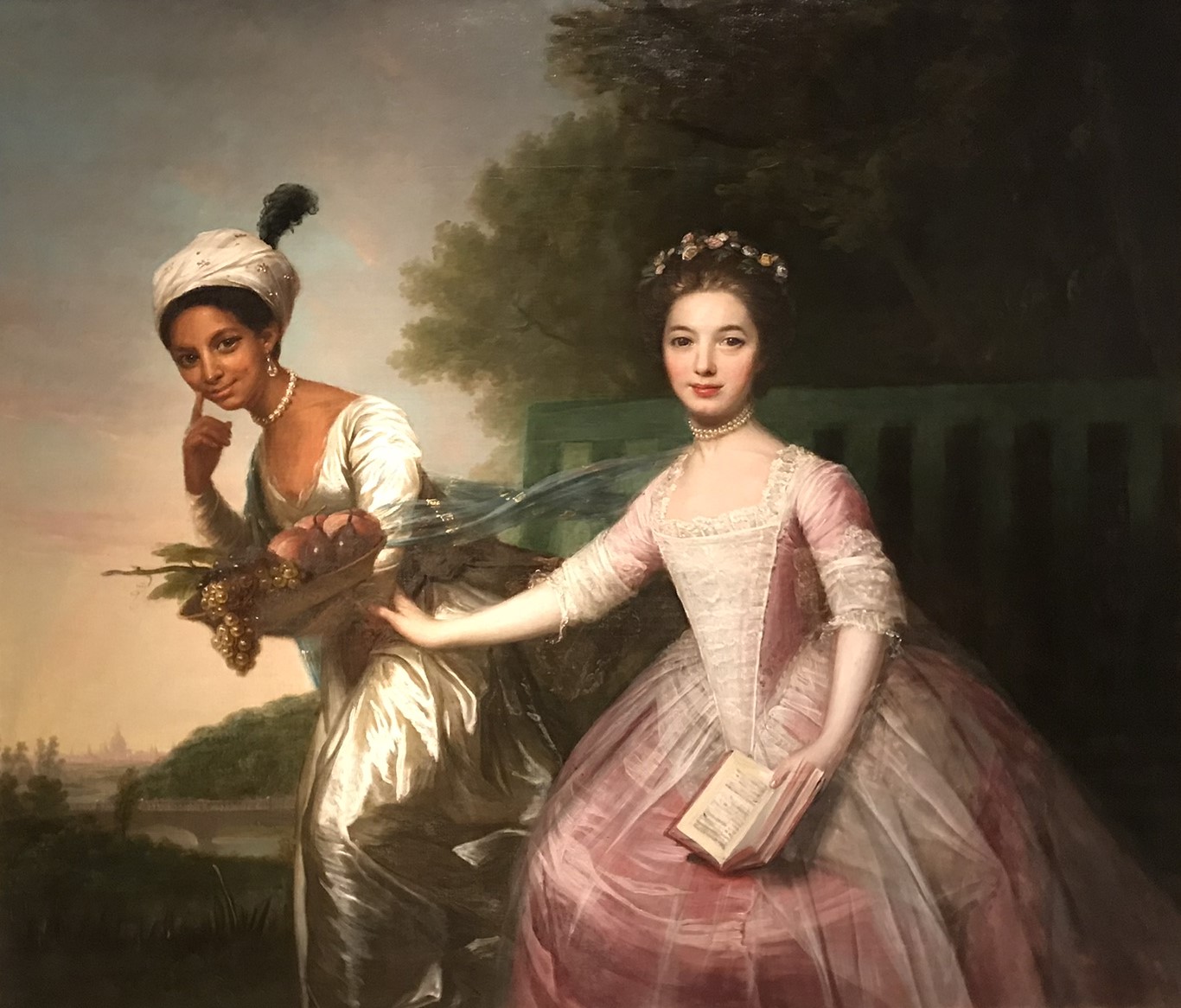
When Thomas Hutchinson visited Kenwood in 1779, he recorded the arrival of a young Black woman after dinner. She sat with the ladies, took coffee and later walked in the garden, arm in arm with one of them. His account also described her responsibilities for the dairy and poultry. Dido Elizabeth Belle occupied a place within this household that caught his attention, although his prejudices and incomplete knowledge shaped what he wrote.1
Growing up at Kenwood
Belle was born around 1761. Her father was the naval officer Sir John Lindsay; her mother, recorded as Maria Bell or Belle, was an African woman believed to have been enslaved. Stories about the parents’ meeting have often been repeated with more certainty than the evidence allows. The location and circumstances remain uncertain. Dido was baptised in London in November 1766.2, 5
She grew up at Kenwood, the Hampstead home of her great-uncle William Murray, first Earl of Mansfield, and his wife. Her cousin Lady Elizabeth Murray was also raised there. An education and a place within this wealthy household were important features of her childhood. Exactly how family membership, domestic responsibility and racial difference worked together in daily life is harder to reconstruct.2
Different records catch different parts of that arrangement. A visitor noticed the social company she kept. Household accounts show money paid to her. A portrait gives her a visible presence beside her cousin. None provides the complete account that Belle herself might have written.
A visitor’s account, and its limits
Hutchinson’s diary describes a particular visit. Belle joined the women after dinner; it cannot establish a rule that she was excluded from every family dinner throughout her life. His report of the garden walk places her in close company with another young woman. He also described Mansfield calling on her for information and reported her management of the dairy and poultry yard.1
These details give her responsibilities as well as a social setting. She answered questions about matters under her care. The account does not specify every task she performed, whether she did physical work herself or how responsibilities were shared. It does, however, connect her to the running of the estate rather than describing someone present only for a family visit.1
Hutchinson judged her appearance and manner in disparaging terms. He called her Dido and treated his limited knowledge of her name as though it described her entire identity. His writing therefore needs to be read in two directions: for the activities he witnessed, and for the assumptions he brought to a Black woman’s position in an aristocratic home. The diary preserves observations, alongside gossip and speculation that cannot all be accepted as fact.1
Two women in one portrait
The double portrait of Belle and Lady Elizabeth Murray, now at Scone Palace and attributed to David Martin, offers a very different encounter. Both young women look towards the viewer. Elizabeth wears a pink gown and holds a book. Belle wears pale, lustrous clothing, a wrapped headdress with a feather and a string of pearls. She carries fruit and lifts a finger towards her cheek.4
The composition gives Belle an animated pose, while Elizabeth appears more settled. Elizabeth extends an arm towards her cousin, connecting the figures across the centre of the painting. Different clothes and objects distinguish the women, yet both faces command attention. Belle is readily visible within the picture’s central relationship.4
A commissioned portrait is a constructed representation. The fruit, book, gestures and clothing were selected for the image; they are not a list of what each woman habitually carried or wore. The painting allows us to examine how the pair were presented together. It cannot, by itself, tell us that their allowances, prospects or treatment were identical.4
That distinction leaves room to appreciate the picture closely. Belle’s face, elaborate dress and direct gaze have a presence that administrative entries cannot supply. At the same time, interpreting her gesture as a definite statement of personality or private feeling would ask the artist’s arrangement to do too much.4
The household’s money
Research by Gene Adams into the Kenwood accounts found payments that expose a difference within the family arrangement. Accounts kept by Lady Anne Murray between 1785 and 1793 record five pounds a quarter for Belle, compared with fifty pounds every half-year for Elizabeth. The figures concern these recorded allowances, rather than the total cost of either woman’s support, but the inequality is clear.3
Mansfield’s will explicitly confirmed Belle’s freedom and provided a lump sum of five hundred pounds and an annuity of one hundred pounds. He died in 1793. These provisions combined money with a written statement about her status. They deserve attention in their own terms, without assuming that a family relationship had removed every uncertainty created by slavery and racial hierarchy.3, 5
Mansfield, slavery and the danger of a simple story
Belle’s upbringing has encouraged speculation about her influence on Mansfield’s judgments. Hutchinson himself repeated a claim from a Jamaican planter that the presence of a Black woman in Mansfield’s household explained his position. The diary records the circulation of that allegation; it offers no evidence that Belle directed judicial decisions.1
During the visit, Mansfield also discussed the Somerset case of 1772. As Hutchinson recorded the conversation, Mansfield explained the decision narrowly: a master could not compel the person concerned to be taken out of the country. This account did not describe a general emancipation of enslaved people.1, 2
There is no surviving evidence establishing that Belle caused that ruling. Her presence at Kenwood and the legal work of its owner belong in the same history, but the connection requires more care than a dramatic scene in which she persuades him to change the law. Hutchinson’s pages preserve both a legal explanation and an insinuation about the household. They should not be collapsed into one account.1
A household of her own
In 1793 Belle married John Davinier, a Frenchman who worked in domestic service. They lived in Pimlico and had three sons. Belle died in 1804, leaving a family history that continued beyond Kenwood.5
Her marriage and children add another setting to the portrait through which she is usually remembered. The painted young woman beside Elizabeth was also someone who managed household responsibilities, received an income and established a home elsewhere in London. These recorded particulars give her life a shape beyond the interests of the visitor who watched her cross the garden.1, 3, 5
Sources and further reading
1. Thomas Hutchinson; edited by Peter Orlando Hutchinson in the nineteenth-century published edition. The Diary and Letters of Thomas Hutchinson, volume II: the 1779 Kenwood visit, pages 274–277. Read the observations of Belle alongside the visitor’s assumptions and his account of Mansfield’s legal explanation.
2. Historic England. Kenwood House, National Heritage List entry 1379242. Background on Belle’s parents, baptism and relationship to the Kenwood household.
3. Gene Adams, Camden History Review 12 (1984), pages 10–14. Dido Elizabeth Belle: A Black Girl at Kenwood. Used selectively for the recorded allowances and financial provision.
4. Scone Palace; original late-eighteenth-century portrait attributed to David Martin. Dido Belle: the double portrait at Scone Palace. The original portrait supplies the article’s close visual reading.
5. English Heritage. Dido Belle. Further context on uncertain origins, the will, marriage and life after Kenwood.
Featured image. Dido Elizabeth Belle, at left, with her cousin Lady Elizabeth Murray, in a portrait by David Martin dating from about 1778. The original painting is held at Scone Palace. David Martin (1737–1797); Scone Palace collection. Digital reproduction via Philip Mould and Wikimedia Commons. Image record · Public domain
