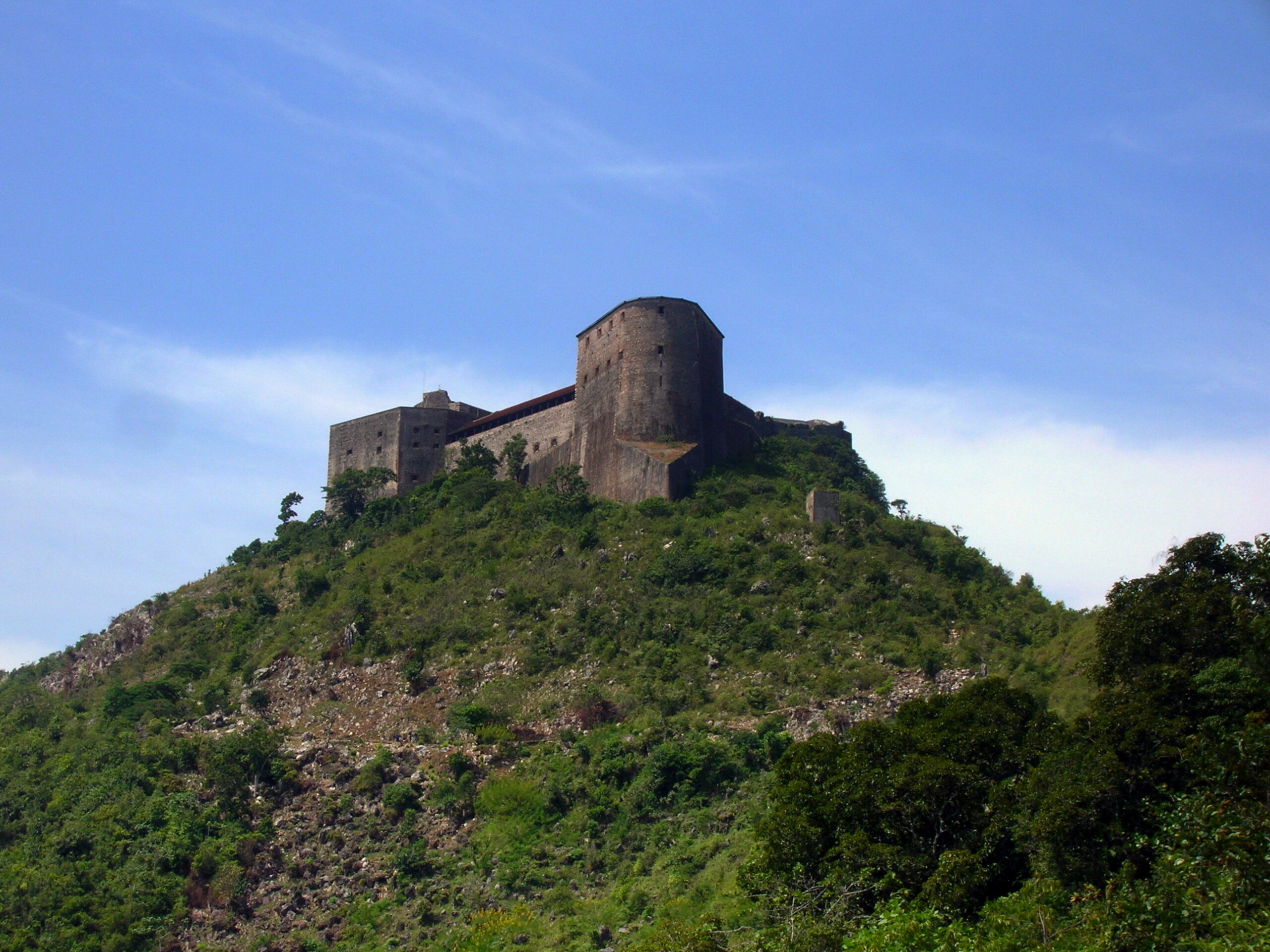
High above Milot in northern Haiti, Citadelle Laferrière makes independence visible in stone. The fortress rose from the revolution that established Haitian independence. Together with the palace of Sans-Souci and the Ramiers site, it entered UNESCO’s World Heritage List in 1982. Understanding it means looking beyond its commanding outline to the military choices, political ambitions and human effort that made the monument possible.1
Freedom in a hostile Atlantic
The setting was a country created through the destruction of a slave colony. French Saint-Domingue’s wealth rested on the exploitation of enslaved Africans in sugar and coffee production. The uprising beginning in 1791 developed into a prolonged struggle involving formerly enslaved fighters, colonial factions and competing European powers. The French Revolution’s promises of rights became entangled with the struggle against enslavement. The people who fought in Saint-Domingue made freedom a political and military reality, rather than waiting for European opinion to settle the question.2
The danger of renewed enslavement was concrete. Napoleon dispatched an expedition in 1802 to restore French control. Although slavery was not formally reintroduced in Saint-Domingue during that campaign, its restoration in Guadeloupe helped convince Black cultivators that their freedom was threatened. Under Jean-Jacques Dessalines, the victorious army expelled the French, and independence was proclaimed on 1 January 1804. A fortress intended to withstand another invasion grew from this recent experience, rather than from an abstract fear of foreign enemies.3
Military victory did not produce international acceptance. The United States traded with Saint-Domingue before independence, while its governments alternated between supporting colonial interests and assisting Toussaint Louverture. Under Thomas Jefferson, fear of the revolution’s influence encouraged isolation. Washington withheld recognition of Haiti until 1862. This history matters to the Citadelle because a sovereign Black state confronted an Atlantic order still organised around enslavement and racial hierarchy. The distinction between having defeated an enemy and securing recognition remained fundamental to the new country’s position.2
Christophe’s kingdom
Haiti also divided internally. After Dessalines’s death in 1806, Henri Christophe established a northern state, becoming its president in 1807, while Alexandre Pétion led a southern republic. In 1811, Christophe’s government reorganised the north as a hereditary monarchy. Its council argued that a single continuing ruler would overcome faction and instability. These were competing answers to the problem of building a state after revolution, shaped by differences of power and social position. Christophe’s subsequent title of king should not obscure the fact that he ruled only part of Haiti.4
The monarchy claimed to protect emancipation. Christophe’s coronation oath in June 1811 committed him to the territory’s independence and to preventing slavery’s return. Contemporary foreign commentary often treated Black kingship itself as an absurdity, exposing assumptions about who could exercise sovereign authority. Yet rejecting that racism does not require accepting the regime’s own account of its justice. The same state that insisted on freedom from ownership imposed exacting demands on its population. Its monuments must be read through both commitments.5
Engineering a defence
The choice of mountain terrain changed the logic inherited from colonial coastal defence. The Citadelle was designed as a stronghold in the interior, where an invading army would face a different struggle from capturing a port. Its plan combined heavy defensive walls, batteries and barracks arranged around a courtyard. Water supply and cisterns supported the possibility of sustained occupation. These provisions make clear that height and mass were only part of its engineering: defence also required shelter, supplies and the capacity to keep an armed community functioning.1
The fortress’s projecting batteries coordinated artillery across its approaches. Guns occupied different levels, while the central place of arms organised the buildings around an open interior. The Coidavid battery, whose form is often compared to a ship’s bow, is one of several named elements of this complex. Reading those arrangements gives the building back its practical intelligence: its builders were solving problems of position, firepower and access, not merely creating an impressive object on a summit.6
Attributing that achievement to one designer is difficult. Architectural historian Peter Minosh notes the absence of surviving construction records adequate to settle the architects’ identities. Names repeated in heritage accounts should therefore be treated with caution. The building itself remains evidence of planning, skill and coordinated work, but it cannot identify every person responsible. This gap also warns against reducing construction to the king’s will alone. Christophe commissioned and directed a political project whose material execution depended on people largely absent from the surviving written record.9
The labour within the monument
Those workers did not all participate by free choice. Historian Marlene Daut describes labour demanded in place of taxes from people unable to pay, alongside a penal system that imposed imprisonment and hard labour. The 1812 Code Henry regulated life within a highly militarised state. Calling the Citadelle a monument made by a liberated population is therefore only the beginning of its labour history. Emancipation from chattel slavery and the ability to refuse government demands were different conditions, and the distinction belongs at the centre of any account of its construction.7
The regime also presented itself as a protector of cultivators. Extracts from its laws published in Prince Saunders’s Haytian Papers promised plantation labourers a quarter of gross production, provision grounds, care during illness and support in old age. Complaints were to move through military and royal authorities. These provisions are evidence of what the government prescribed and advertised, rather than proof that every worker received it. Read beside the demands of the state, they reveal a paternal system that claimed responsibility for people’s welfare while keeping authority over their working lives.8
Christophe sought resources and allies for more than fortifications. His correspondence with the British abolitionist Thomas Clarkson, preserved in the British Library, deals extensively with public education and foreign policy. The collection includes educational ordinances and statistics as well as letters involving Haitian officials. Such records place the fortress within a broader effort to sustain an independent country through institutions and international connections. They also prevent its history from becoming a portrait of a ruler interested only in weapons or ceremonial display.10
French pressure continued after Napoleon’s defeat. As Daut’s research shows, former colonists urged reconquest during the Bourbon restoration, while Christophe’s government publicised French attempts to undermine Haitian independence. The threat helped the regime justify its army and fortifications. It also created an argument that could strengthen royal power at home: demands for labour and obedience could be presented as necessities of collective survival. Recognising the external danger does not settle whether particular burdens or punishments were just. That question remained bound to the experience of the people required to bear them.5
Three connected places
Sans-Souci was a separate palace and administrative complex at Milot, below the fortress. Royal apartments stood within an ensemble containing gardens, workshops, barracks, a hospital, a library and offices of government. Its ceremonial architecture organised the display and business of monarchy. Describing it merely as the king’s luxurious house overlooks those functions, just as merging it with the Citadelle confuses residence and administration with mountain defence. Both belonged to Christophe’s state, but they expressed its authority through different spaces and daily activities.6
Ramiers formed another distinct element: a fortified site containing redoubts and the remains of a residential ensemble. Later conservation work treated its surviving structures as a separate problem, favouring consolidation of what remained. Keeping the three places distinct helps explain why their heritage designation embraces a landscape. The significance lies partly in relationships between defensive positions, royal residence and the territory in which state power was organised.13
After the king
The monarchy ended in 1820. Following a stroke and the collapse of support among military associates, Christophe took his own life. His heir was killed shortly afterwards; his widow, Marie-Louise, and daughters survived and left Haiti. The fortress outlasted the political order that had created it. Its endurance should not turn that order into an inevitable stage of national progress. The ruler’s commitment to sovereignty, his subjects’ burdens and the violence accompanying his fall remain parts of the same history.7
Independence continued to face pressures that walls could not remove. In 1825, France tied recognition to an indemnity imposed on Haiti, beginning a long period of financial subordination. The demand reversed the moral direction of compensation: the country that had defeated slavery was made to bear the cost of its former colonisers’ losses. Seen against that history, the Citadelle represents a determination to defend sovereignty whose challenges exceeded military invasion. Its strength could answer one kind of danger while leaving other forms of external coercion unresolved.4, 12
Preserving a demanding inheritance
Preservation has required another generation of skilled work. A programme involving Haiti’s heritage institute, ISPAN, UNESCO and the United Nations Development Programme began in 1979 and formally concluded in 1990. Its work included detailed surveys where documentation was scarce, protection against rainwater and training for Haitian architects, engineers and technicians. The restoration record emphasises national capacity as well as repaired fabric. Maintaining the monument was therefore also a matter of developing the expertise needed to interpret and care for it.13
Conservation reports demonstrate why apparent solidity cannot be taken for permanence. An ICOMOS mission in 2015 documented moisture, cracking and unstable vaults, including problems around the Coidavid battery. Such dated observations describe the issues examined during that mission; they are not a statement of present conditions. They reveal the difficult work behind preservation: understanding how walls, floors and water interact before selecting interventions. The engineering history continues through the careful reading of damage, including the consequences of earlier repairs.11
The surrounding landscape also belongs to that responsibility. UNESCO’s account of a botanical survey, published in 2020, connected vegetation, erosion and slope stability with protection of the monuments. Trees could help stabilise ground, while damaged ecosystems created other risks. Preservation therefore extends beyond masonry to the environments and communities around it. The Citadelle’s commanding position is inseparable from the mountain that supports it; conserving that relationship requires knowledge of living systems alongside architectural expertise.14
Haitian attention to the monument is preserved in another kind of archive. Radio Haiti’s papers include material on Citadelle and Sans-Souci conservation from 1977 to 1999, with photographs, maps, reports and press coverage. These records document the later work of making heritage publicly meaningful. The story continues through people who study, maintain and debate what the buildings represent, giving the surviving stones a history beyond the reign that first raised them.15
Sources and further reading
1. UNESCO World Heritage Centre: National History Park – Citadel, Sans Souci, Ramiers.
2. United States Department of State, Office of the Historian: The United States and the Haitian Revolution, 1791–1804.
3. Bibliothèque nationale de France, Patrimoines Partagés; Philippe Girard: The 1802 Expedition to Saint-Domingue (Haiti) and the Louisiana Purchase.
4. John Carter Brown Library; Malick Ghachem, guest curator: The Other Revolution: Haiti, 1789–1804 — annotations on monarchy, Pétion and French recognition.
5. African American Intellectual History Society; interview by Nathalie Frédéric Pierre (2025): The First and Last King of Haiti: An Interview with Marlene L. Daut.
6. UNESCO (2019; updated 2023): La Citadelle Henri, le Palais Sans-souci et le Site de Ramiers : une trilogie spectaculaire.
7. Yale News; Lisa Prevost interviews historian Marlene Daut (7 April 2025): Recalling the life of Henry Christophe, Haiti’s first and last king.
8. Prince Saunders; Boston edition, 1818; Emory University digitisation via Wikimedia Commons: Haytian Papers: extracts from Code Henri, printed pages xiii–xv.
9. Journal of the Society of Architectural Historians 77(4), 2018, pp. 410–427; Peter Minosh; University of California Press: Architectural Remnants and Mythical Traces of the Haitian Revolution: Henri Christophe’s Citadelle Laferrière and Sans-Souci Palace.
10. British Library Archives and Manuscripts Catalogue: Add MS 41266: Clarkson Papers, volume VI, Haiti and Jamaica papers.
11. ICOMOS; UNESCO World Heritage Centre: Report on the ICOMOS Advisory Mission to National History Park – Citadelle, Sans-Souci, Ramiers, 20–26 February 2015.
12. Fondation pour la mémoire de l’esclavage, with Archives nationales (17 April 2025): Bicentenaire de l’indemnité d’Haïti — la double dette, et après ?.
13. UNESCO World Heritage Centre: State of Conservation 1991: National History Park – Citadelle, Sans Souci, Ramiers.
14. UNESCO (30 July 2020; updated 20 April 2023): The Historic National Park: Citadelle, Sans-Souci, Ramiers and its Biodiversity.
15. Duke University Libraries, David M. Rubenstein Rare Book & Manuscript Library: Citadelle, 1977–1999 — Radio Haiti records.
Photograph
Citadelle Laferrière near Milot, Haiti, seen from its access path, summer 2006. Photograph: Rémi Kaupp (Korrigan), Wikimedia Commons, CC BY-SA 3.0. Photo: Rémi Kaupp (Korrigan), Citadelle Laferrière, seen from the access path, CC BY-SA 3.0. Original Commons file supplied byte for byte; no edits made.
