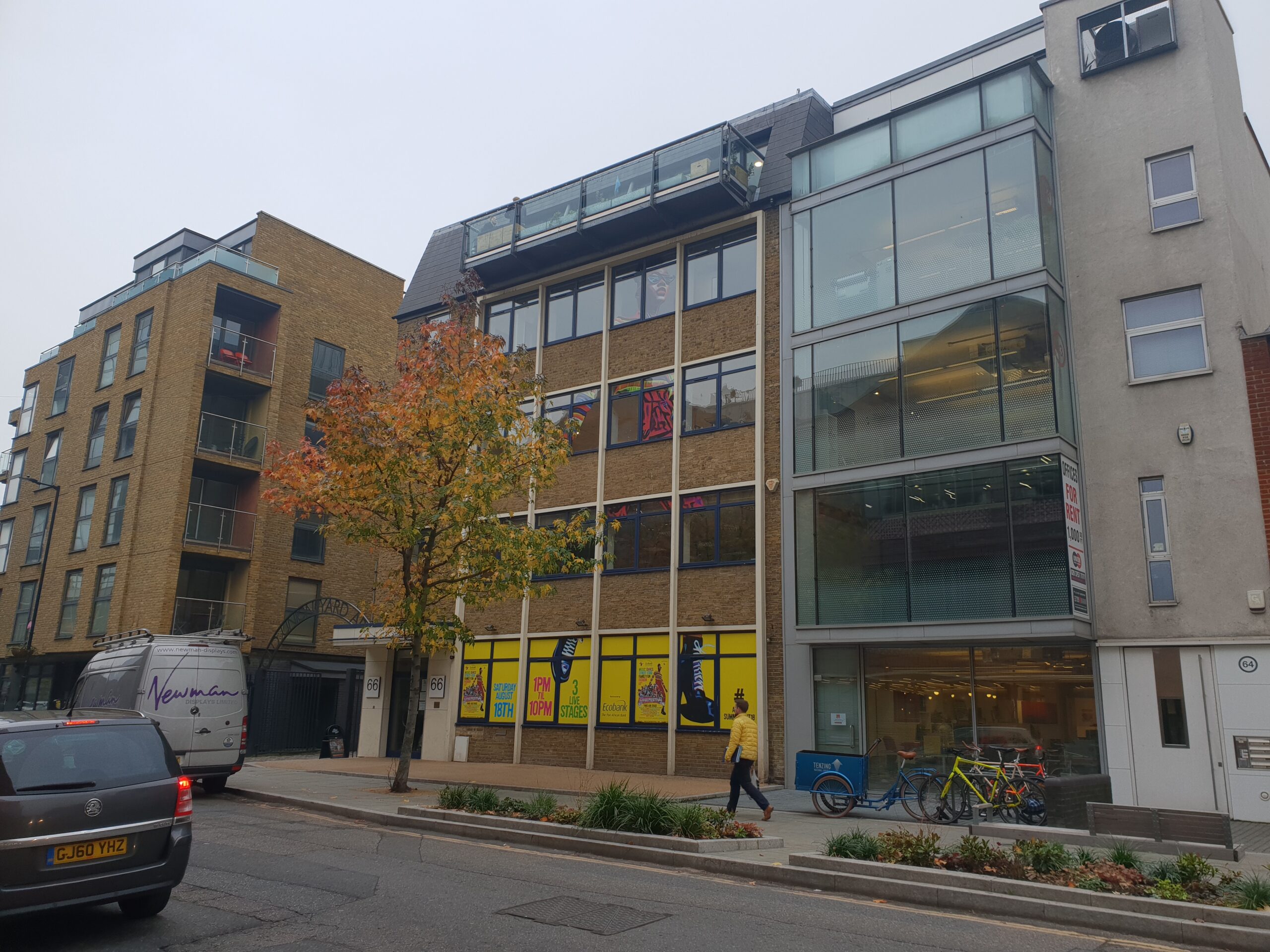
The Africa Centre belongs to several histories at once. It is part of the story of African independence, of Black cultural life in London and of the institutions through which people make a city their own. Its visitors have included writers, campaigners, artists and musicians. Yet its importance also rests with people who arrived to learn, eat, meet friends or find a connection with a continent that British public life too often discussed from a distance.1
An idea takes an address
Margaret Feeny helped turn the proposal for an African cultural centre into a charity, registered in 1961. A building at 38 King Street in Covent Garden was acquired with Catholic support in 1962. The centre opened to the public in November 1964, with Zambia’s first president, Kenneth Kaunda, participating in its inauguration. Its central location made it accessible to people moving between universities, public institutions and London’s cultural life.1
The London Archives records the range of learning that developed there: courses in African literature, Arabic and Swahili, discussions of the continent’s political and economic development, and dance and drama workshops. These activities offered several ways into African histories and contemporary experience. A person could begin with a language, a performance or a particular political question. The programme made room for sustained learning as well as occasional attendance, bringing education into an informal cultural setting.2
Everyday life and artistic opportunity
Artist and historian Eddie Chambers remembers a building that combined a gallery and performance space with shops and the Calabash Restaurant. Books by African and Caribbean authors could be found upstairs; food introduced visitors to dishes from different parts of the continent. These ordinary activities helped give the institution its social character. People did not have to approach it only as an audience sitting quietly before a stage or an artwork.3
Chambers’s own experience shows what access could mean. As a young art student, he approached the centre on behalf of a group of Black artists working in the Midlands. The result was The Pan-Afrikan Connection, which opened in May 1982 with work by Dominic Dawes, Claudette Johnson, Wenda Leslie, Keith Piper and Chambers. Their identification with Africa did not depend on having been born there. The exhibition gave that diasporic understanding a public setting and brought their work beyond the places where they were studying.3
The following year, Five Black Women brought together Lubaina Himid, Houria Niati, Sonia Boyce, Veronica Ryan and Claudette Johnson. The exhibition included drawing, painting and sculpture. Its surviving statement, reproduced on Himid’s website, emphasises that the artists chose to exhibit together while retaining individual artistic and political positions. That distinction is valuable: a shared platform did not require a single style or an identical experience. The Africa Centre gave these different practices a place to be encountered together, and the exhibition helped make Black women’s perspectives visible within the institution’s programme.16
A dance floor becomes a creative workshop
The Soul II Soul nights added another chapter. In an interview with DJ Mag, Jazzie B explained that the sprung dance floor, balcony and Covent Garden location helped attract him to the venue. Holding the parties on Sundays was a deliberate choice. He wanted a different atmosphere from the warehouse scene and an audience interested in the music the collective was developing. The room’s physical qualities and its place in the weekly calendar became part of that work.4
Jazzie B also described making and testing recordings within sound-system culture. Rose Windross sang over the groove that became Fairplay, connecting a record with the experience of the Sunday gatherings. An audience could therefore influence music before a record company became involved. The Africa Centre provided somewhere for that exchange to happen: dancers, selectors, vocalists and producers met through a recurring event, with ideas passing between the dance floor and the studio.4
Theatre and participation
The centre’s theatrical connections also reached into community organising. The George Padmore Institute records Ngũgĩ wa Thiong’o’s involvement with a 1984 production of The Trial of Dedan Kimathi. The work used open rehearsals in which audiences could engage with the company before the final production. An Africa Centre Company rehearsal took place in a north London community centre for members of the Black Parents Movement. This was a relationship between performance and political education: the theatre company carried its work into a community organisation, and those watching had a role beyond buying a ticket. The centre’s cultural life extended through relationships outside its own building.5
A mural carries memory
In 1987, the Mozambican artist Malangatana Valente Ngwenya painted an untitled mural on a curved staircase in the Covent Garden building. A regular visitor, he connected visual art with the political and social questions facing Mozambique and the wider continent. The mural later travelled with the institution: it was restored and installed in the Southwark headquarters that opened in 2022. Its survival made the relationship between the old and new buildings visible.6
A heritage programme announced in 2023, curated by Haja Fanta, proposed talks, workshops and events around Malangatana’s life and work. Activities for young people connected artistic practice with resistance, memory and social justice. The mural could serve as a starting point for new work and discussion, allowing a historical commission to remain part of an active educational relationship rather than becoming only a decoration.6
Leaving Covent Garden
The move was a difficult chapter. Contemporary And’s account of the centre’s return describes the sale of its Covent Garden building in 2013 despite a campaign to retain it. Supporters’ attachment involved decades of relationships and memories, as well as the value of a central London address. The later Southwark project therefore had to do more than provide replacement rooms. It inherited expectations about access, identity and the kind of welcome an African cultural institution should offer. Changing a building does not automatically transfer everything that people associate with it; a new home has to earn its place in their lives.7
Designing the Southwark home
Freehaus, appointed as architects in 2019, approached the new headquarters by asking how a building could acknowledge the diversity of Africa without reducing it to a set of familiar motifs. Their research considered light, surfaces, thresholds and practices of reuse. Staff, trustees, younger representatives and users contributed through a sounding board and public discussions. This process treated the design as a question to be worked through with people who would use the building. The result was intended to accommodate conversation, learning, food and performance within the same institution.8
Interior designer Tola Ojuolape brought that approach into materials and furnishings. Her studio describes indigo clay plaster referring to West African dyeing traditions, handmade screens, timber surfaces and furniture from contemporary designers and craftspeople. Tables by John Alfredo Harris and woven elements brought particular makers into the project. Such choices offered a more specific language than a general claim to an African appearance. They allowed materials, skills and contemporary design to contribute to the experience of entering and spending time in the building.9
The opening celebrations took place in June 2022. Sonia Boyce cut the ribbon alongside Lord Boateng, linking the occasion to an earlier artistic generation: Boyce had participated in the centre’s Five Black Women exhibition in 1983. In July, Akwasi Brenya-Mensa’s Tatale restaurant opened there. The combination of visual art, gathering and food recalled the centre’s earlier range of activities, while giving new practitioners responsibility for shaping its next phase.10
The new gallery also opened a relationship with another generation through Sungi Mlengeya’s (Un)choreographed. Developed with Afriart Gallery and curated by Tammi Bello and Jessica Lowe-Mbirimi, the Tanzanian artist’s London solo exhibition presented eight large paintings centred on Black women and dance. In her exhibition statement, Mlengeya connected the work to music and movement she had grown up with, including Lingala music and Nyisanzu dances. This was a specific account of cultural inheritance, expressed through a contemporary artistic practice. The programme connected the centre’s renewed physical space with the work and concerns of an artist making her own contribution to its history.17
Who gets to belong?
The sixtieth-anniversary programme announced in 2024 combined remembrance with contemporary interests. It proposed activities around South Africa’s freedom, African football, young people, art and business. The centre also invited people to contribute their memories to a living archive. An institutional anniversary can easily become a list of prominent guests. Collecting visitors’ experiences offers another account, attentive to the friendships, discoveries and repeated visits through which a cultural place becomes significant.11
The Chakula programme made a further contribution to that question of belonging. Led by Vee Belinga and supported by Propel, it brought Black and African LGBTQ+ voices into workshops, conversations and artistic activity. Its published programme included a writing club and collaboration with community organisations. Recognising those experiences made inclusion a matter of what the centre actually programmed and whom it supported. Shared African or diasporic connections could provide a starting point while leaving room for different lives and identities.12
In March 2026, the centre celebrated Margaret Busby as she launched Part of the Story and received its Icon of the Africa Centre award. Its account recalled that Busby and Wole Soyinka had first met there in the 1970s. That connection gives a human scale to the institution’s longevity: a place of introduction could become part of a relationship lasting decades, while continuing to bring readers and writers together around new work.13
A history still being made
The story also requires a clear account of the present. The Africa Centre announced that its building would close temporarily from 28 July 2026. By October, it was seeking partners to address its financial position and secure the future of its Southwark property. Its call for proposals, opened on 14 October, considered several arrangements, including purchase, leaseback and philanthropic support. These were proposals under consideration, rather than a completed rescue or a confirmed reopening.14, 15
That uncertainty does not erase the work already done. The records deposited at the London Archives in 2018 span 1956 to 2017 and include minutes, reports and material relating to artists, musicians and speakers. They allow researchers to follow both the public programme and the organisation behind it. The Africa Centre’s history is held in those documents, in surviving artworks and in people’s memories. Preserving all three makes it possible to understand how an institution brought people together, and what is at stake when its future becomes uncertain.2
Sources and further reading
1. The Africa Centre: Our Story.
2. The London Archives: The Africa Centre Project.
3. Eddie Chambers: Africa Centre: extracts from In the Centre.
4. DJ Mag; interview with Jazzie B: How Soul II Soul’s Fairplay carved a new path for Black British soundsystem culture.
5. George Padmore Institute: The George Padmore Institute’s tribute to Ngũgĩ wa Thiong’o.
6. The Africa Centre: Malangatana Heritage.
7. Contemporary And; Niellah Arboine: The Return of the Africa Centre in London.
8. Freehaus: The Africa Centre.
9. Tola Ojuolape Studio: The Africa Centre: interior design project.
10. The Africa Centre: Home Away From Home.
11. The Africa Centre: The Africa Centre announces programme for its 60th anniversary.
12. The Africa Centre: The Chakula Program.
13. The Africa Centre: A Tribute to Margaret Busby CBE: Icon of the Africa Centre.
14. The Africa Centre: Call for Proposals: Strategic Partnership for the Future Stewardship of The Africa Centre’s Southwark Property.
15. The Africa Centre: Notice of Closure.
16. Lubaina Himid: Five Black Women: exhibition record and statement, 1983.
17. Afriart Gallery: (Un)choreographed: Sungi Mlengeya, 20 June–24 July 2022.
Photograph
The Africa Centre in Southwark, London, photographed on 22 November 2018, before its 2022 reopening. Photo: Jwslubbock, Africa Centre, London, CC BY-SA 3.0. Original Commons image version; no further edits made.
