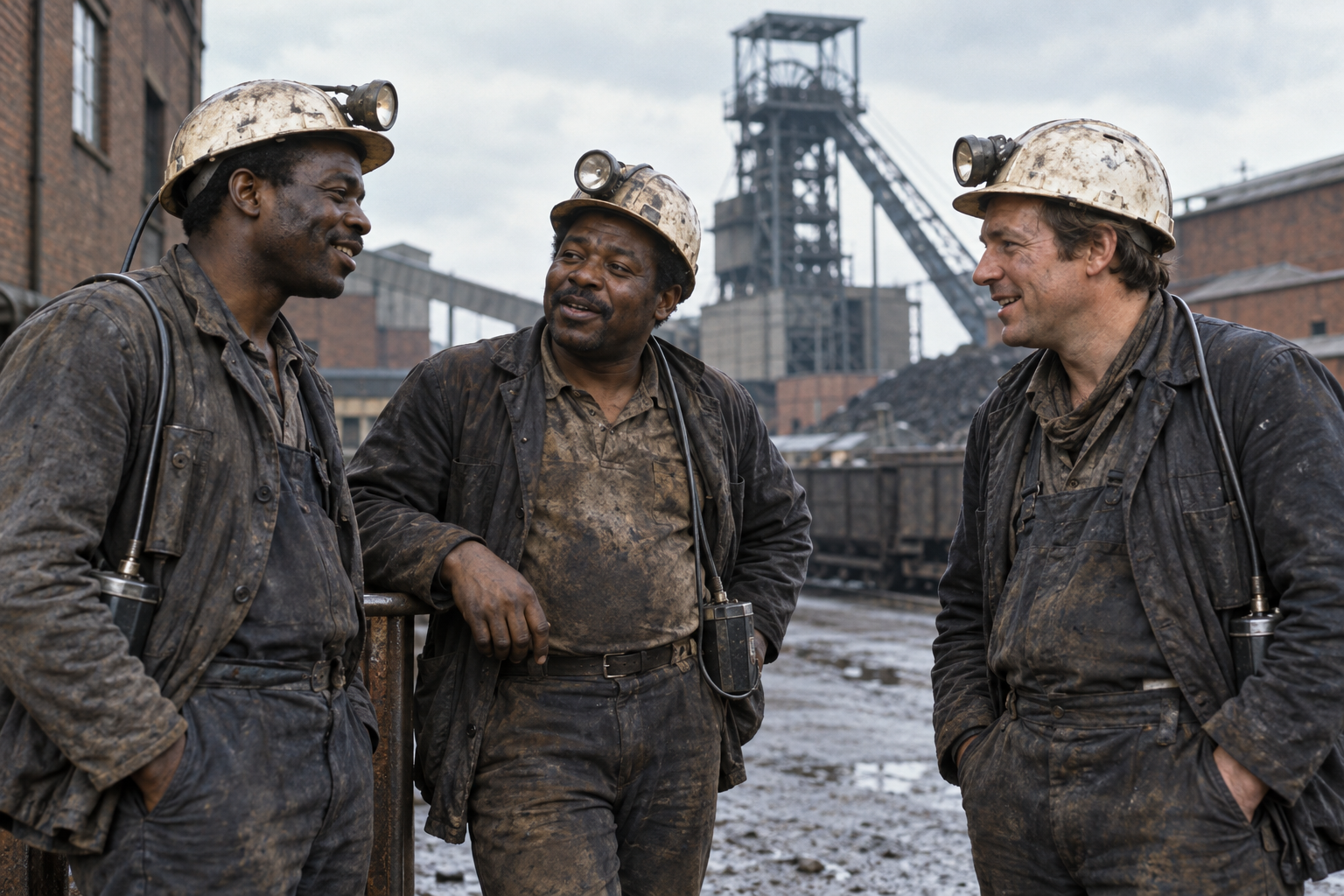
AI-created historical illustration of fictional miners at a British colliery in the 1970s.
Chester Thompson remembered catching a five o’clock bus to Gedling Colliery, descending underground around half past six, then travelling by train and on foot to the working area. His Black Miners Museum account records the long journey that preceded his work at the coalface.1
Accounts like Thompson’s give Britain’s industrial history names, voices and particular workplaces. The Black Miners Museum, led by Nottingham News Centre and historian Norma Gregory, preserves photographs, objects and oral histories of workers of African and Caribbean heritage. These materials open a history of earning a living, learning a trade and sustaining relationships, told by people whose work took place largely beyond public view.2
Writing for the Runnymede Trust, Gregory identified Black miners in coalfields including Nottinghamshire, Yorkshire, Lancashire, Kent, Durham and South Wales. Their occupations extended from work at the coalface to supervisory duties and union representation. This geographical spread matters: a history built around one particularly diverse colliery cannot capture every experience. Local recruitment practices, the work available and relationships within individual pits all deserve attention when reading the miners’ accounts.11
Before the postwar migrations
The story reaches back before the arrival of the Empire Windrush in 1948. Research by the Historic Dock Project places Black miners across the South Wales coalfield in the later nineteenth century. Its investigation began with Caribbean family histories and widened to include African American workers. Shipping and mining belonged to connected labour markets: some merchant seamen moved into employment ashore, bringing experience of tools, machinery and physically demanding work into industrial communities.3
The project identifies Claudius A. Cummings, from Sierra Leone, as a stoker at Marine Pit, and John Florence, from Bermuda, as a hewer at Bargoed. Its family material also expands the picture beyond an occupational list. A photograph from Gelligaer includes the Langford family; the accompanying research records Lydia making tea for workers while living at a colliery. Such evidence places women, children and domestic work within the history of communities usually represented through men underground.3
Finding work and building a household
For later arrivals, mining could offer an alternative to insecure employment. In interviews published in 1986, Garry Morris recorded Mike Ainsley’s route to Bentley Colliery near Doncaster in 1957. Ainsley had experienced the uncertainty of agricultural work and had initially looked for a job at a glassworks. Stopping at a National Coal Board office brought an opening at Bentley. His account describes a decision shaped by available work, rather than a childhood ambition to become a miner.4
Johnson-John Baptiste arrived from Dominica in 1961. His brother introduced him to Ollerton Colliery in Nottinghamshire, and he later worked at Gedling. In a National Lottery Heritage Fund interview, he remembered the practical attraction of the coal allowance: a miner’s household could keep warm through winter. Baptiste spent twenty-six years in mining. Work, housing and family security were connected, and a relative already established in a pit could provide the introduction that turned migration into a working life.5
Other Black miners were born into Welsh communities. Idris James Phillips grew up in Senghenydd, the son of a sailor from St Lucia and a woman from Merthyr. Interviewed by journalist Marcus Hughes, he recalled leaving school at fourteen and entering colliery work. His experience complicates any assumption that a Black face in a pit necessarily belonged to someone who had recently arrived in Britain.6
Learning the work, facing the barriers
Phillips also remembered being excluded from a working face at Windsor Colliery because, his manager told him, other men would strike if he joined them. He received different work and later took a deputy’s course, becoming a junior manager. He distinguished hostile colleagues from the many men he considered decent. His recollections show both occupational progression and the obstacles around it. Qualification did not erase the experience of being treated as someone whose presence required other workers’ permission.6
A different technical career unfolded at Dawdon Colliery in County Durham. Abiodun MacDonald Williams, known as Mac, worked as an assistant ventilation officer in 1961. He attended Durham Technical College and qualified for the work, becoming Dawdon’s colliery ventilation officer in 1968. In an ITV interview recorded in 2020, he described a job that involved testing for gas and moving through the mine’s airways. His role makes visible the knowledge and responsibility involved in keeping an underground workplace operating.7
Williams recalled travelling considerable distances underground alone, depending on his lamp as he moved between working areas. He remembered heat, damp and the strength of companionship among colleagues. These were his memories of a particular working environment, expressed with affection, alongside an insistence on equality. His career also widens the familiar visual image of a miner: the industry required technical judgement and formal study as well as the strength needed to handle materials and extract coal.7
Learning could mean watching before being trusted. Welsh miner Clyde Forde recalled picks, shovels and seams that left men crouching. In testimony reproduced by the British Safety Council, he explained that experienced workers initially made him observe. Participation followed when he understood the job. In his account, the delay helped people learn to work safely together.8
Danger on the journey and at the face
Lloyd Brown, a Bentley miner, recorded his survival of the mine’s 1978 train disaster for the Black Miners Museum. His recollection connects that accident directly with the history of Black working lives.1
On 21 November 1978, energy minister Alex Eadie told the House of Commons that three carriages of a diesel-hauled train carrying miners had derailed underground at Bentley at 5.40 a.m. Seven men had died; the initial statement reported seventeen injured. Eadie announced an investigation. The parliamentary record fixes the date and immediate official account, while the survivor’s testimony conveys what an industrial accident meant within a working life. These are different, complementary forms of evidence.9
The Commons discussion also exposed disagreement about how danger should be understood. MPs asked about transport training, inspection, maintenance and whether pressure for production affected safety. Those questions were raised before the inquiry had established its findings; they should not be mistaken for proven causes of the crash. They nevertheless show that concern for miners involved arguments over how work was organised, as well as expressions of sympathy after men were injured or killed.9
In her 2021 British Safety Council interview, Gregory described former miners living with lung problems, hearing loss and injuries to their limbs. She also recalled interviewees becoming distressed as they revisited accidents and the deaths of colleagues. Her observations concern the people she interviewed, rather than a measured rate of illness among all Black miners. They explain why preserving working memories can involve painful testimony, and why affection for former colleagues can coexist with lasting physical damage.8
Solidarity was practical and sometimes incomplete
Gedling miner David Henry remembered comradeship alongside racial discomfort. His recorded account described racist jokes at the miners’ welfare club and assurances that he personally was accepted. Men could rely on colleagues underground and still find that friendship on the surface carried conditions they had not chosen.1
Baptiste’s union work offers another view of relationships inside the pit. He helped colleagues who faced money difficulties, disputes with management or injuries. He remembered supporting a family after a worker was fatally hurt by a coal-cutting machine. Representation here meant practical obligations extending beyond the shift: dealing with a problem, helping someone obtain support and remaining involved when a household’s income or security was threatened.5
Different choices during the miners’ strike
The 1984–85 strike brought further divisions. Morris’s interviews recorded Black miners who feared standing apart from colleagues who continued working, alongside others who supported the stoppage. John Robinson, a former NUM committee member at Gedling, explained that he struck on principle and remained loyal to the union. Other interviewees worried that being visibly identifiable as Black men would expose them to police hostility or management retaliation. Their positions emerged from experiences of race, workplace authority and union representation; Black miners did not constitute a single political bloc.4
Support also came from outside the coalfields. The People’s History Museum preserves badges expressing Black support for miners and examines collaboration between Black, Asian and LGBTQ+ solidarity organisations during the strike. Its account draws on the museum’s collection and the records of Lesbians and Gays Support the Miners. These objects document people choosing to connect struggles across communities, even when reciprocal support could not be assumed. Solidarity involved organising, fundraising and persuasion, and sometimes challenging prejudice among the people being supported.10
Closures, reunions and the work of remembering
The coalfield’s working institutions were gradually dismantled as pits closed. A contemporary record by the Nottinghamshire NUM’s former and retired miners’ association documents Thoresby’s final day on 10 July 2015, with photographs of departing workers and a union protest. The last Nottinghamshire pit was closing. Its record brings an industrial transition down to the scale of a shift ending, colleagues leaving and people gathering to mark the loss of a workplace.12
After Gedling closed in 1991, Baptiste lost contact with former colleagues. Taking part in Digging Deep helped him meet them again. Recording the past therefore had an immediate social purpose: it rebuilt connections between people whose shared workplace had disappeared.5
Gregory’s research depended on people recognising names and introducing her to someone else. In a 2019 LeftLion interview, she described a growing network built through word of mouth, supported by radio and television appeals. Former miners and their families contributed letters, photographs and objects. She had interviewed two Black miners for her book on Jamaicans in Nottingham in 2012; the subsequent project expanded through contacts that conventional searches through published mining histories had not supplied.13
She also warned in that interview against allowing the strike to dominate the whole story. The disagreements remained painful, but a single year could not encompass decades of work. The records gathered around Digging Deep make room for learning a job, raising children, moving between pits and growing older with former workmates. Paying attention to those everyday histories gives the political confrontations their fuller human setting.13
The Black Miners Museum’s photographs and recorded voices offer material for a fuller account of Britain’s industrial communities. Preserving these workers’ names also preserves differences between them: their occupations, choices and memories. Their history belongs wherever the country asks who produced its coal, how that work was organised and what working people carried into retirement.2
Sources and further reading
1. Black Miners Museum / Nottingham News Centre CIC: Oral History Archives: Coal Miners of African Caribbean Heritage.
2. Black Miners Museum / Nottingham News Centre CIC: Black Miners Museum: creating and sharing diverse industrial heritage.
3. Historic Dock Project; Rebecca Eversley: Calypso & Coal.
4. Garry Morris, New Beacon Review, numbers 2/3, November 1986; scan hosted by Academia.edu: Black Miners and the Miners Strike in Britain.
5. The National Lottery Heritage Fund: Changing lives: Johnson digs deep and reunites with mining colleagues.
6. Marcus Hughes, WalesOnline; syndicated by inkl: Mixed race and working the mines: Suspicion, fear and racism in the Welsh pits.
7. Kris Jepson, ITV News Tyne Tees: New exhibition celebrates Black and African Carribean miners at Northumberland Museum.
8. British Safety Council: The lost story of Britain’s Black miners.
9. UK Parliament, Hansard, volume 958, columns 1104–1107: Bentley Colliery (Accident), House of Commons, 21 November 1978.
10. Jaime Starr, People’s History Museum: 1984 Miners’ Strike: solidarity from marginalised communities.
11. Norma Gregory, The Runnymede Trust: Black British Coal Miners: Significance and Sacrifice.
12. Ann Donlan, NUM Coal Mining Memories in Nottinghamshire: Thoresby Colliery closes – the last pit in Nottinghamshire closes down.
13. Alex Kuster, LeftLion: Norma Gregory on the Hidden History of Black Miners and Her New Exhibiton.