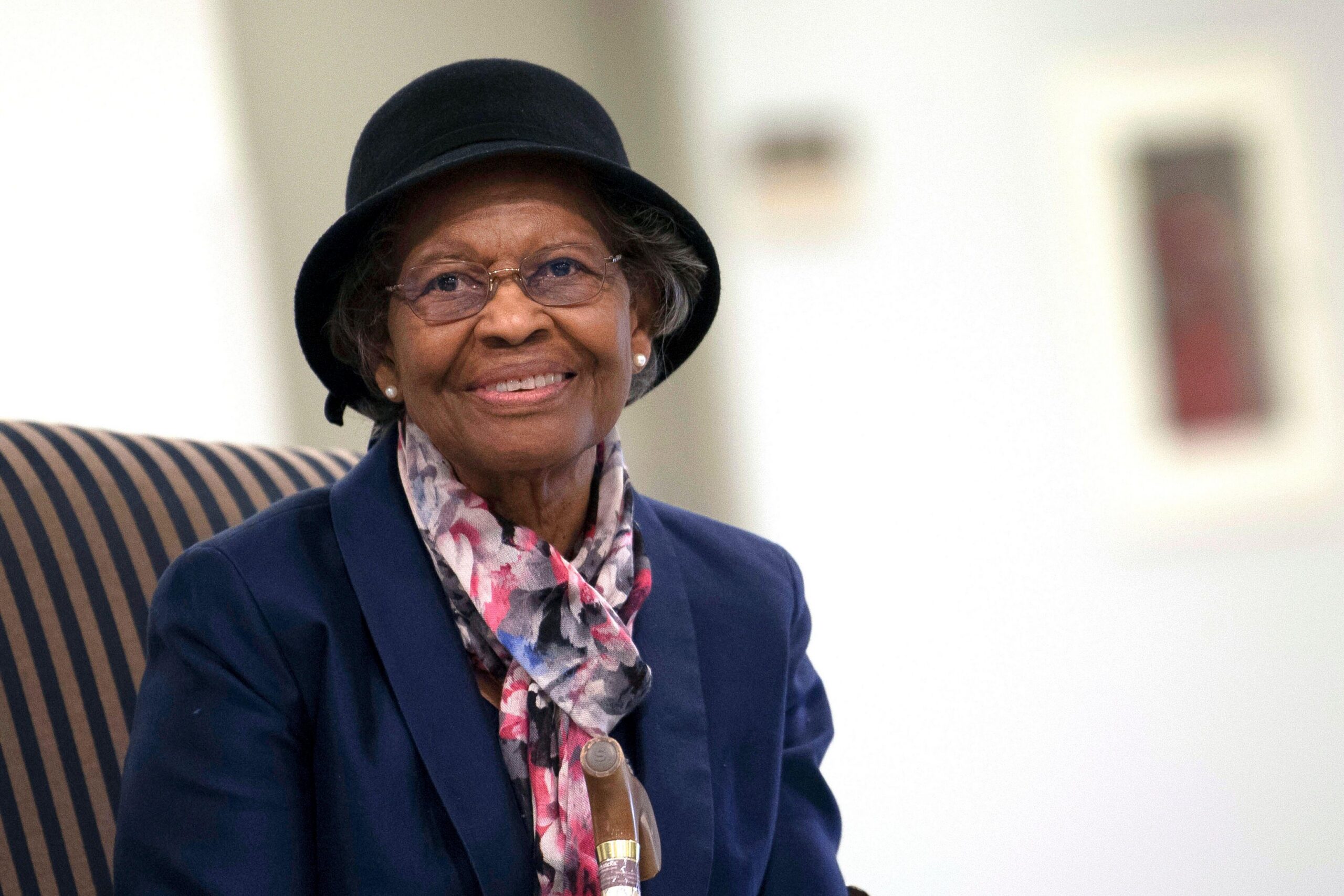
Gladys West’s place in the history of satellite navigation rests on decades of mathematical work. At the naval research establishment in Dahlgren, Virginia, she helped turn satellite measurements into a more accurate understanding of the Earth. Her career connects rural schooling and a historically Black college with early computing, naval research and the scientific foundations of modern navigation.1
An education beyond the farm
She was born Gladys Mae Brown on 27 October 1930 in Sutherland, in Virginia’s Dinwiddie County. Her early life was rooted in a farming family, and she grew up with limited financial resources. The distance between that childhood and her later professional life involved several changes of setting: from rural schooling to college, from a teaching job to a government laboratory, and eventually from specialist research to international public recognition.2
In an interview with the Queen Elizabeth Prize for Engineering, West explained that teachers helped direct her towards mathematics. They saw her strength in the subject and encouraged her to consider the opportunities it offered. Her mother’s experience also mattered. She had been unable to continue her own schooling and wanted her daughter to have the chances denied to her. West’s account places encouragement alongside ambition: adults around her helped turn academic ability into a possible route towards financial independence.3
Finishing at the top of her high-school class brought a scholarship covering tuition at Virginia State College, now Virginia State University. Other costs remained, and she earned money through babysitting to help pay for accommodation and meals. After her first degree she taught in Waverly, Virginia, spending two years in the classroom before returning to study. A teaching post gave her paid employment while she considered how to develop her mathematical training further.4
Virginia State records her bachelor’s degree in mathematics in 1952 and her master’s degree in 1955. The historically Black institution was central to both stages of her preparation. Its place in her story helps explain how Black scientific expertise developed through educational communities that provided teaching, qualifications and opportunities. West carried that preparation into a career whose everyday demands would soon include technologies she had never encountered as a student.5
Learning the language of computers
In 1956 she joined the naval laboratory at Dahlgren, becoming one of a very small number of Black women in its scientific workforce. Her early career included an astronomical study of the regularity of Pluto’s motion relative to Neptune. That project illustrates the range of mathematical work undertaken within a defence research institution. Understanding motion, handling large calculations and checking results were skills that could be applied across different scientific problems.6
West later described programming as a sequence of tasks: understanding the theory and equations, organising the steps towards an answer, and expressing those steps in a language a computer could follow. She had not used a computer at college. Learning to work with these machines therefore formed part of her professional education. Mathematical knowledge remained essential because the machine needed carefully prepared instructions. Her recollections convey the excitement of acquiring a new capability, alongside the sustained effort required to use it well.3
Technical progress took place within a workplace where race and gender affected opportunity. In a 2025 interview with Seth S. Leopold, West recalled losing chances to work on projects because she was a Black woman. She also described support among seven Black professionals hired around the same period. Weekly dinners gave them somewhere to discuss difficulties with people who understood their experience. Conversations with her husband helped too. These recollections add a collective dimension to her perseverance: maintaining a scientific career involved relationships of trust as well as individual study and determination.7
What does it mean to measure the Earth?
The Earth cannot be represented perfectly by a smooth sphere. Its overall shape is flattened at the poles, while variations in the distribution of mass affect gravity. Scientists use a model called the geoid to describe the level that the ocean would settle towards under gravity if tides and currents were removed, extended beneath the continents. This gives a reference for measuring heights. It is different from a map of mountains, buildings and valleys. Understanding that distinction helps make sense of work that uses observations of the sea to investigate the planet’s shape and gravitational field.8
Satellites made it possible to collect measurements across large areas of ocean. NASA’s Seasat mission, launched on 26 June 1978, carried several instruments, including a radar altimeter. Its observations concerned features such as wave height, winds, temperature and ocean topography. An electrical fault ended the mission after 105 days, but its records remained available for analysis. Seasat’s short operating life is a reminder that collecting observations and extracting scientific knowledge from them are different stages of a research programme.9
West became project manager for the Seasat radar altimetry work at Dahlgren. According to the Royal Academy of Engineering’s account, improvements she introduced cut her team’s processing time in half, leading to a recommendation for a commendation in 1979. This was a practical achievement in computing as well as mathematics. A large collection of observations becomes useful only when researchers can process it accurately and efficiently, and West held responsibility for improving that part of the work.10
Inside the work: the GEOSAT report
A technical report published under her name in June 1986 provides a particularly direct record of her contribution. Data Processing System Specifications for the GEOSAT Satellite Radar Altimeter described the Naval Surface Weapons Center’s system for turning radar measurements into estimates of geoid height and other geodetic information. It set out the movement of data between organisations, including Johns Hopkins University’s Applied Physics Laboratory and naval research bodies. The document places West’s work within a larger collaboration, with different teams responsible for the spacecraft, observations and processing.11
The report also shows why this was more demanding than simply collecting numbers. Processing required information about the satellite’s orbit and corrections for influences such as atmospheric conditions and tides. The system checked and filtered observations, calculated results and included indicators of data quality in its outputs. These details reveal a form of scientific responsibility that can disappear from brief accounts of invention. West documented how measurements should become usable evidence, including the checks that helped later users judge the information they received.11
GPS itself combines several kinds of expertise. Satellites broadcast information about their positions and precise time. A receiver uses signal travel times to calculate distances; observations from at least four satellites allow it to determine a three-dimensional position. A network on the ground monitors the satellites and updates their information. Accurate positioning therefore depends on a connected system of clocks, communications, orbital knowledge and calculation. This wider picture gives context to the work of researchers who improved the mathematical description of the Earth.12
Continuing to learn
West continued to seek qualifications after establishing herself as a mathematician. When she felt that career advancement was moving too slowly, she considered what additional study would offer. She already possessed the mathematical training her technical work required. A master’s degree in public administration, completed through the University of Oklahoma in 1973, developed a different set of skills. Her account to IEEE Spectrum connects that decision with her wish to become a stronger manager. Education remained something she could use to respond to changing responsibilities and ambitions.4
Retirement became another planned transition. West told Leopold that she completed the coursework for her doctorate before leaving employment so she could concentrate on the dissertation afterwards. Her advice was practical: make a plan for the next stage and remain active. That account helps explain an achievement sometimes presented simply as an extraordinary late-life event. The degree emerged from preparation carried out over time, followed by a deliberate decision to continue learning.7
Virginia Tech awarded her a doctorate in public administration and public affairs in 2000. Her education had therefore moved from mathematics into the study of organisations and public work. The university later recognised her with its 2024 University Distinguished Achievement Award. Its formal resolution brought together her computational research, professional service and wider influence, placing the degree within the full span of her career rather than treating it as a separate footnote.13
Recognition and the next generation
In 2018 West was inducted into the US Air Force Space and Missile Pioneers Hall of Fame. The official account of the honour described her earlier astronomical research and her later programming of models used in geodesy. Recognition came from a different branch of the armed services from the Navy establishment where she had worked, reflecting the wider relevance of research carried out at Dahlgren.6
In 2021 the Royal Academy of Engineering awarded her the Prince Philip Medal, making her the first woman to receive it. The presentation took place through a virtual audience with the Princess Royal, with West accompanied by her husband, Ira, who had also worked as a mathematician at Dahlgren. The award highlighted her use of mathematics and programming to process early satellite observations. It offered a public description of work whose significance had long been much more familiar within specialist communities.10
Virginia State also awarded West an honorary doctorate in 2021. The connection brought her story back to the institution where she had earned her first two degrees. When the university later remembered her life, it placed her among the alumni whose careers demonstrated the reach of its educational work. Her achievements belonged within the history of that community as well as the histories of computing and navigation.5
Education remained part of her life outside formal qualifications. The Community Foundation of the Rappahannock River Region records the mentoring, literacy support and encouragement that Gladys and Ira West offered to students, particularly in King George County. These activities connected their scientific careers with local relationships. Young people could encounter them through practical help and conversation, gaining access to adults who understood both the demands of study and the possibilities it might create.14
The Ira and Gladys West Scholarship Fund carries that connection forward. Stewarded by the Community Foundation in partnership with the Dahlgren Heritage Museum, it supports graduating students from King George County pursuing mathematics or other STEM degrees. Financial need forms part of its priorities. The fund gives their names a practical role in widening access to education: assisting with the costs that can stand between a young person’s academic ability and the opportunity to develop it.14
Remembering a working life
West retired from Dahlgren in 1998 after forty-two years and died on 17 January 2026, aged ninety-five. Her family obituary remembered a mathematician, a mother and grandmother, and a woman active in community and religious life. She had also helped tell her own story through It Began with a Dream, published in 2020 with M. H. Jackson. That personal record sits alongside the technical papers and institutional accounts through which her career can be explored.2
Her life connects Black education in Virginia, women’s scientific work, computing and satellite research. Following those connections gives substance to the recognition she received. West’s contribution can be understood through the work she performed and the opportunities she helped others imagine, with attention to the long career behind her public reputation.1