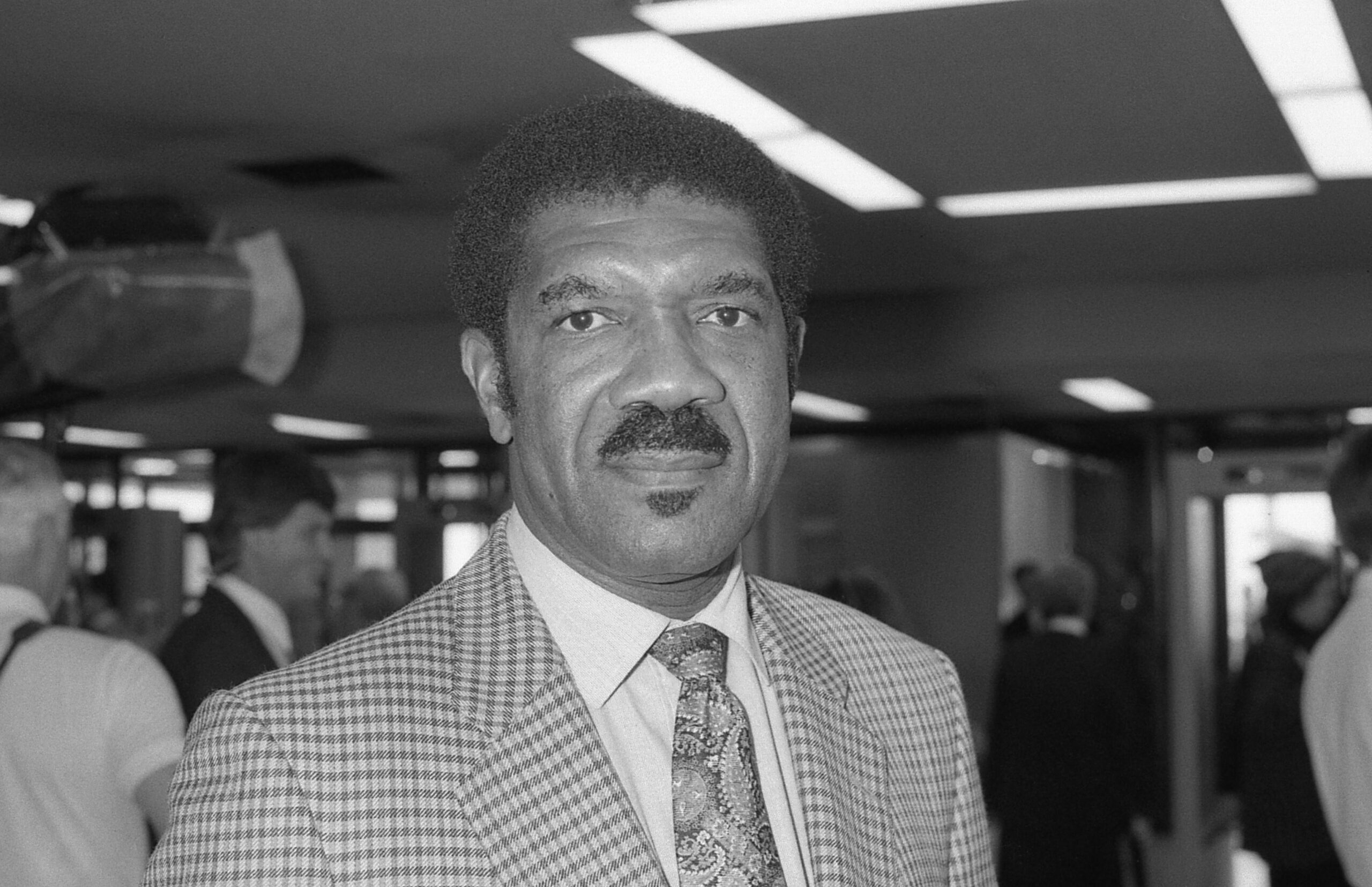
On 25 October 1999, Bill Morris joined other British union leaders in talks with the president of Ford. The meeting followed a racial harassment case involving Sukhjit Parmar, an Asian worker at the company’s Dagenham engine plant, and further allegations that had prompted walkouts. Morris had sought the meeting. The resulting agreement proposed an equality review, a national committee bringing management and unions together, and committees in individual plants. It addressed recruitment, promotion and the treatment of employees, alongside the company’s public image. The dispute brought a question familiar to workplace representatives into discussions with the company’s most senior leadership: how would an employer make its promises of fair treatment work in practice?1
Morris became the first Black leader of a major British trade union. That distinction belongs within a much larger working life. His campaigning encompassed low pay, racial discrimination, education, and the opportunities available to women and young members. Understanding his contribution means looking at the practical business of representation: who gets heard, who negotiates, and whose circumstances shape the decisions an institution makes.2
Growing up in Jamaica
Bill Morris was born in 1938 in Bombay, in the Jamaican parish of Manchester. He grew up in Cheapside and attended school at the Moravian Church in Mizpah. In his account of those years, he emphasised a community in which adults shared responsibility for children. His grandmother was a particularly important influence, encouraging the expectation that difficulties could be overcome.3
His mother taught domestic science and his stepfather worked as a part-time police officer. The family kept animals and grew crops, selling produce they did not need to buy household essentials. Church, school and cricket occupied an important place in village life. Morris later remembered improvising cricket equipment from an unripe orange and a piece of coconut tree, while imagining himself playing for the West Indies. These are his recollections of childhood, grounded in family work and shared activity.4
Birmingham and the factory floor
Morris arrived in Britain in 1954 to join his widowed mother in Birmingham. Handsworth became his home. His personal account recalls the shock of the weather and streets, but also notices excluding Black people. Racial barriers extended into the movement in which he would build his career. He recalled applying for a union job in 1964 and being told that the organisation was not ready to appoint a Black official. The later achievement of leadership followed an experience of exclusion within the institution itself.4
After two short periods in other jobs, he joined the engineering company Hardy Spicer and attended technical college on day release. He became a member of the Transport and General Workers’ Union, usually known as the T&G or TGWU, in 1958, and a shop steward in the early 1960s. His route into union leadership began through a workplace position elected by colleagues. The factory supplied both his employment and the setting in which he began representing other workers.5
He went on to serve on the union’s General Executive Council before becoming a full-time district officer in 1973. In 1979, he moved to London as national secretary of the Passenger Service Trade Group. He became deputy general secretary in 1986, was elected general secretary in 1991 and won re-election in 1995. He retired from the union in October 2003. The progression involved years of responsibility at different levels, from the workplace to regional organisation and national office.5
Leading a changing movement
In a 1991 interview, Morris set out the priorities he wanted to pursue as general secretary. He spoke about rebuilding unity after the election, managing the union within its income, and strengthening membership through organising and recruitment. He wanted the organisation to adapt while retaining the role of ordinary members in its decisions. This was a programme for running an institution as well as leading campaigns. Bringing different sections together and maintaining the union’s ability to support members were part of the same responsibility.6
He also argued for a national minimum wage. In the same interview, he connected low wages with the cost carried by the wider public when employers failed to pay enough. A wage floor, in his view, belonged within a broader argument about how economic power was distributed. He also defended bargaining close to the workplace, where employees and their representatives knew the work, rather than a single national arrangement determining everyone’s pay. A basic wage floor and local bargaining served different purposes.6
By 1998, Morris chaired the TUC’s Representation at Work Task Group. He introduced its General Council’s assessment of the government’s Fairness at Work proposals to a conference attended by almost 500 people from 50 affiliated unions. The discussion concerned rights to collective bargaining, protection against victimisation and representation during disciplinary or grievance procedures. These apparently technical questions determined whether employees could negotiate together and obtain support when something went wrong. The unions welcomed parts of the proposals while continuing to press for changes, including stronger protection for people working in small firms.7
Addressing the TUC in September 2002, Morris reported that the new recognition system had helped unions enter workplaces where employers had previously resisted them. He also described growth in voluntary agreements. He treated the 1999 Employment Relations Act as the beginning of further work, arguing for stronger protection and better opportunities to combine employment with family life. His speech drew attention to casual and seasonal workers whose employment status could leave them without adequate rights. For Morris, organising and legislation had to develop together: a legal entitlement mattered, but workers also needed a union able to make use of it.8
Campaigning beyond the membership
Morris’s campaigning also reached people seeking asylum. After a voucher system was introduced in 2000, the TGWU worked with Oxfam and the Refugee Council to seek its abolition. Campaign organiser Jonathan Ellis’s later account describes an alliance combining the union’s political connections, refugee organisations’ knowledge of people’s experiences, and Oxfam’s campaigning resources. Its methods included public campaigning, lobbying and gathering evidence of hardship. The campaign contributed to the scheme being scrapped. It provides a concrete example of a trade union joining organisations outside the labour movement around a shared concern for dignity.9
His public responsibilities developed alongside this campaigning. He served as a commissioner at the Commission for Racial Equality from 1977 to 1987 and as a member of the Employment Appeal Tribunal from 1988 to 2008. He also served with Acas, the body concerned with workplace relations and the resolution of disputes. These positions placed him within institutions handling questions that also arose in union work: discrimination, employment relationships and the procedures through which disagreements could be examined.10
Responsibility in national institutions
From 1998 to 2005, Morris served as a non-executive director of the Bank of England. The Bank’s own history identifies him as the first person from an ethnic minority to sit on its Court of Directors. Court is the Bank’s governing board. Under the arrangements introduced in 1998, its work included organisational strategy, resources and oversight, while the formulation of monetary policy belonged elsewhere. Morris’s appointment therefore brought experience of working life into the Bank’s governance. Interest-rate decisions were the responsibility of the separate Monetary Policy Committee.11
In 2004, he chaired an independent inquiry into professional standards and employment matters in the Metropolitan Police. Its remit included the handling of complaints, grievances, employment tribunal claims and workplace conflict. These were questions about how the police treated their own people, with implications for the standards expected of a public institution.12, 18
The inquiry’s findings remained relevant to subsequent reviews. The government-commissioned Chapman review of police discipline, published in 2014, returned to Morris’s concern that Black and minority ethnic officers were being managed differently. It described the earlier inquiry’s findings that managers could avoid dealing informally with minor problems, then rely disproportionately on formal procedures. Fair treatment required attention to everyday supervision and support, as well as disciplinary rules. This aspect of Morris’s work examined how inequality could be produced through ordinary organisational decisions.13
Public service in Parliament
Morris entered the House of Lords in 2006 as Lord Morris of Handsworth. His maiden speech that October supported protection for emergency workers against obstruction. He cited attacks recorded by the West Midlands fire service and asked for reliable national information about their scale. He also questioned why existing laws were not being enforced effectively. Returning to his childhood, he recalled the shared responsibilities of his Jamaican village. He linked respect for those serving the public with the safety of the people who depended on their help.14
Housing was another area in which he connected policy with daily life. Speaking in the Lords in July 2010 as chair of Midland Heart housing association, he argued that homes should be understood alongside the support people needed to live independently. He described accommodation linked to training for young residents. He also warned that reducing housebuilding would affect both people needing homes and those employed in construction. His contribution brought the perspective of a housing provider into parliamentary debate, while keeping the relationship between secure living conditions, skills and employment in view.15
Jamaican connections and a continuing argument
His connections with Jamaica continued through educational and community work. He served for ten years as Chancellor of the University of Technology. His account of projects there includes helping to secure British Airways funding, matched by the Jamaican government, for a health centre in Bombay, which he opened in 2002. He also helped obtain equipment for a farmers’ cooperative and transport for young disabled people. These activities linked relationships built during his British career with practical projects in Jamaica.3
Morris retired from the House of Lords on 21 July 2020. During his parliamentary service he had worked on committees covering human rights, adoption legislation, home affairs and statutory instruments. His record therefore extends beyond speeches to the less visible work of examining legislation and policy in detail.16
At his final TUC Congress as a serving general secretary in 2003, Morris had already set out a challenge that gives his career a wider meaning. He recalled the movement’s larger membership when he first attended Congress and urged it to rebuild. He argued that unions should speak for all workers, including those outside their existing membership. He also credited fellow union members with making his own career possible. His account placed collective effort at the centre: the future of the movement depended on whether it could reach people who still needed representation.17
Sources and further reading
1. Eurofound: Racist incidents lead to new equality initiative at Ford.
2. National Portrait Gallery: Bill Morris: biographical record.
3. Bill Morris’s official website: Bill Morris: Jamaica.
4. Bill Morris’s official website: Bill Morris: personal recollections.
5. Bill Morris’s official website: Bill Morris: trade unions.
6. Labour & Trade Union Review, reproduced by Labour Affairs: Rights and Responsibilities, Challenges and Opportunities: 1991 interview with Bill Morris.
7. Trades Union Congress: General Council report 1998, Chapter 1: employment rights.
8. Trades Union Congress: Congress 2002: verbatim report, Monday 9 September, Rights at Work.
9. Development in Practice / Oxfam Policy & Practice: Jonathan Ellis, More than a token gesture: NGOs and trade unions campaigning for a common cause.
10. UK Parliament: Experience for Lord Morris of Handsworth.
11. Bank of England: The Court of directors of the Bank of England.
12. UK Parliament, Hansard: Metropolitan Police (Racism): written answer, 3 November 2004.
13. Home Office; review by Chip Chapman: An Independent Review of the Police Disciplinary System, 2014, especially paragraphs 2.22–2.24.
14. UK Parliament, Hansard: Emergency Workers (Obstruction) Bill: Lord Morris’s maiden speech, 13 October 2006.
15. UK Parliament, Hansard: Housing: Lord Morris’s contribution, 8 July 2010.
16. UK Parliament: Parliamentary career for Lord Morris of Handsworth.
17. Trades Union Congress: Congress 2003: Thursday verbatim report, Bill Morris’s farewell address.
18. Inner Temple Library, Access to Law: Morris Inquiry: independent inquiry and report details.