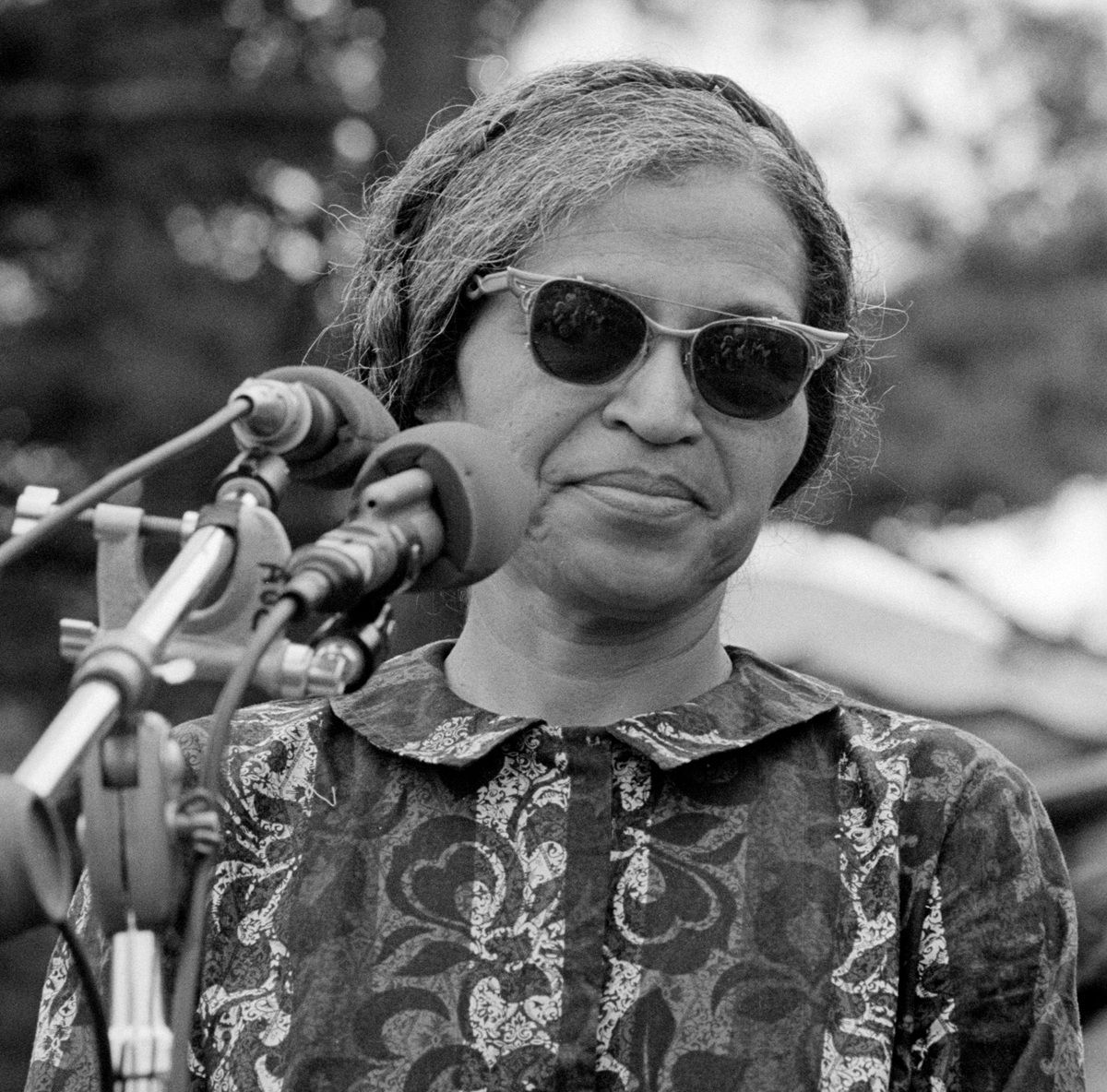
On 1 December 1955, Rosa Parks was travelling home after work at the Montgomery Fair department store in Alabama. She was forty-two and earned her living sewing and altering clothes. When the driver ordered her to surrender her seat so that a white passenger could sit down, she refused. Her arrest became the focus of a campaign that changed the city’s buses and drew international attention to racial segregation.1
Growing up in Alabama
Parks was born Rosa Louise McCauley in Tuskegee on 4 February 1913. She grew up in Pine Level, where her early schooling took place, before her mother enrolled her at the Montgomery Industrial School for Girls. Education gave her opportunities to learn beyond the limits imposed on Black children in Alabama, but family responsibilities repeatedly interrupted her studies. She left school to care for her grandmother and later her mother when they became ill.2
In 1932 she married Raymond Parks, a barber already involved in the campaign supporting the Scottsboro Boys. Raymond encouraged her to finish her education, and she subsequently gained her high-school diploma. Their marriage also brought a shared interest in public affairs into everyday family life. Both took part in the work of the National Association for the Advancement of Colored People, usually known as the NAACP.2
In 1943 Parks became secretary of its Montgomery branch. The work meant listening carefully to people whose experiences might otherwise go unrecorded. She gathered accounts of police violence, sexual assaults and killings, helping turn individual reports into material that could support wider campaigns. The secretary’s role involved much more than maintaining a list of members: it connected the organisation to the people seeking its help.3
The work before the boycott
Parks’s own attempts to vote revealed another part of the system she was challenging. She had to make repeated attempts to pass the tests imposed on Black applicants, and after she succeeded she was required to pay poll taxes for previous years. Records preserved in her papers show how money, official discretion and registration procedures could obstruct a right that existed on paper. Her interest in voting grew from direct experience of those barriers.4
In 1944 the Montgomery NAACP sent her to investigate the abduction and rape of Recy Taylor, a Black woman in Abbeville, Alabama. Parks listened to Taylor’s account and helped establish the Alabama Committee for Equal Justice for Mrs. Recy Taylor. Taylor herself continued to seek justice despite intimidation. Her testimony was central to a campaign that brought public attention to violence against Black women.5
Two grand juries refused to indict Taylor’s attackers. The absence of a prosecution did not make the organising insignificant. It brought people together around the demand that Black women receive protection and a hearing in the justice system. Parks’s involvement also helps explain the skills she carried into later campaigns: gathering testimony, connecting supporters and staying with a case when the authorities failed to act.5
During the summer of 1955, Parks attended a desegregation workshop at the Highlander Folk School in Tennessee. The school brought labour and civil rights organisers together across racial lines. Septima Clark, whose educational work linked literacy with citizenship, led the session Parks attended. Living and learning in an interracial setting gave Parks an experience of equality in daily practice, alongside conversations about how people could organise for change in their own communities.3
A refusal becomes a citywide campaign
On the bus that December evening, Parks occupied a row behind the seats permanently reserved for white passengers. As the bus filled, driver James Blake ordered the four Black passengers in her row to move. Three did; Parks remained seated. The distinction matters because she had not entered the bus by choosing a seat reserved for white people. It was the driver’s demand to give up the place where she was already sitting that she rejected.1
Local women had been challenging the bus system for years. After Parks’s arrest, Jo Ann Robinson and the Women’s Political Council prepared leaflets calling for a boycott on 5 December, the day of her trial. Churches and other networks carried the message. The response encouraged organisers to continue, and the Montgomery Improvement Association coordinated the campaign, with the young minister Martin Luther King Jr. as its president.6
Keeping the boycott going required a replacement transport system. Residents walked, shared journeys and volunteered their cars; the association organised an extensive carpool. Women maintained committees and networks that helped sustain participation. Every journey to work or an appointment became part of the practical challenge. A protest could attract attention through one arrest, but its continuation depended on thousands of people repeatedly choosing to support it.6
The legal challenge developed alongside the boycott. Claudette Colvin, who had refused to surrender her seat earlier in 1955, joined Aurelia Browder, Susie McDonald and Mary Louise Smith as plaintiffs in Browder v. Gayle. The federal case established that compulsory racial segregation on the buses was unconstitutional, and the Supreme Court upheld that decision. The boycott ended on 20 December 1956. Remembering the plaintiffs places Parks’s action within the wider effort that secured the change.7
Starting again in Detroit
The campaign brought serious personal costs. Parks lost her department-store job, and Raymond also lost work. Letters and financial records reveal the pressure this placed on their household. During the boycott, she travelled to speak at rallies and seek support, while the family’s finances remained precarious. Public recognition did not provide an immediate income or remove the difficulties of finding employment.4
In 1957 Parks moved to Detroit with her husband and mother. It became her home for the rest of her life. Her work for civil rights continued there, extending the story beyond Alabama and beyond the end of segregated seating on Montgomery’s buses.8
Detroit presented its own forms of racial inequality, including barriers to employment and housing. In 1965 Parks began working for Congressman John Conyers. Her duties included answering correspondence and telephone calls, but also visiting constituents, collecting information and representing him at meetings. The office received complaints about discrimination, giving her another way to connect people’s experiences with political action. She remained on his staff until 1988.9
She also stayed involved in community organising outside the office. Parks attended political meetings and supported causes that included the Black Power movement and opposition to apartheid. Discussions in the Parks home and nearby Black community spaces connected her with younger organisers. Her reputation from Montgomery brought attention, while her continued attendance and participation kept her connected to the work happening around her.9
History as something young people could use
In 1987 Parks and Elaine Eason Steele established the Rosa and Raymond Parks Institute for Self Development. Steele had first met her while working in a sewing factory in the early 1960s, beginning a friendship that developed into shared work. The institute honoured Raymond and gave an organisational home to their commitment to young people, education and community participation. It made teaching and personal development a continuing part of Parks’s public contribution.10
Its Pathways to Freedom programme linked journeys to historical places with research and practical learning. Young participants explored the Underground Railroad and the civil rights movement, then shared what they had learnt in their communities. Another initiative brought generations together through computer training: young people helped older learners, while the older participants shared their experiences. The institute records that Parks herself completed its first computer class in 1997. Learning could move in both directions.11
Parks died in Detroit on 24 October 2005, aged ninety-two. Her life had connected the struggle over segregation with the continuing needs of residents seeking housing, employment and opportunities for their children.8
Her papers at the Library of Congress preserve that range of activity through letters, notes, photographs and records of organisational work. They also preserve a private life of family responsibilities and everyday decisions. Reading them alongside the record of her arrest makes it possible to follow the years of work surrounding that famous bus journey. The archive gives future readers evidence with which to understand how one organiser stayed involved across changing times and places.12
Sources and further reading
1. An Act of Courage, The Arrest Records of Rosa Parks — National Archives.
2. Rosa Louise Parks Biography — Rosa and Raymond Parks Institute for Self Development.
3. Places of Rosa Parks — National Park Service.
4. Inside the Rosa Parks Collection — Library of Congress.
5. Mrs. Recy Taylor (1919–2017) — National Park Service.
6. Montgomery Bus Boycott — The Martin Luther King, Jr. Research and Education Institute, Stanford University.
7. 60th Anniversary of the Montgomery Bus Boycott — National Archives.
8. Rosa Parks — National Park Service.
9. Rosa and Raymond Parks Flat — National Park Service.
10. About Us — Rosa and Raymond Parks Institute for Self Development.
11. Programs — Rosa and Raymond Parks Institute for Self Development.
12. About this Collection: Rosa Parks Papers — Library of Congress.