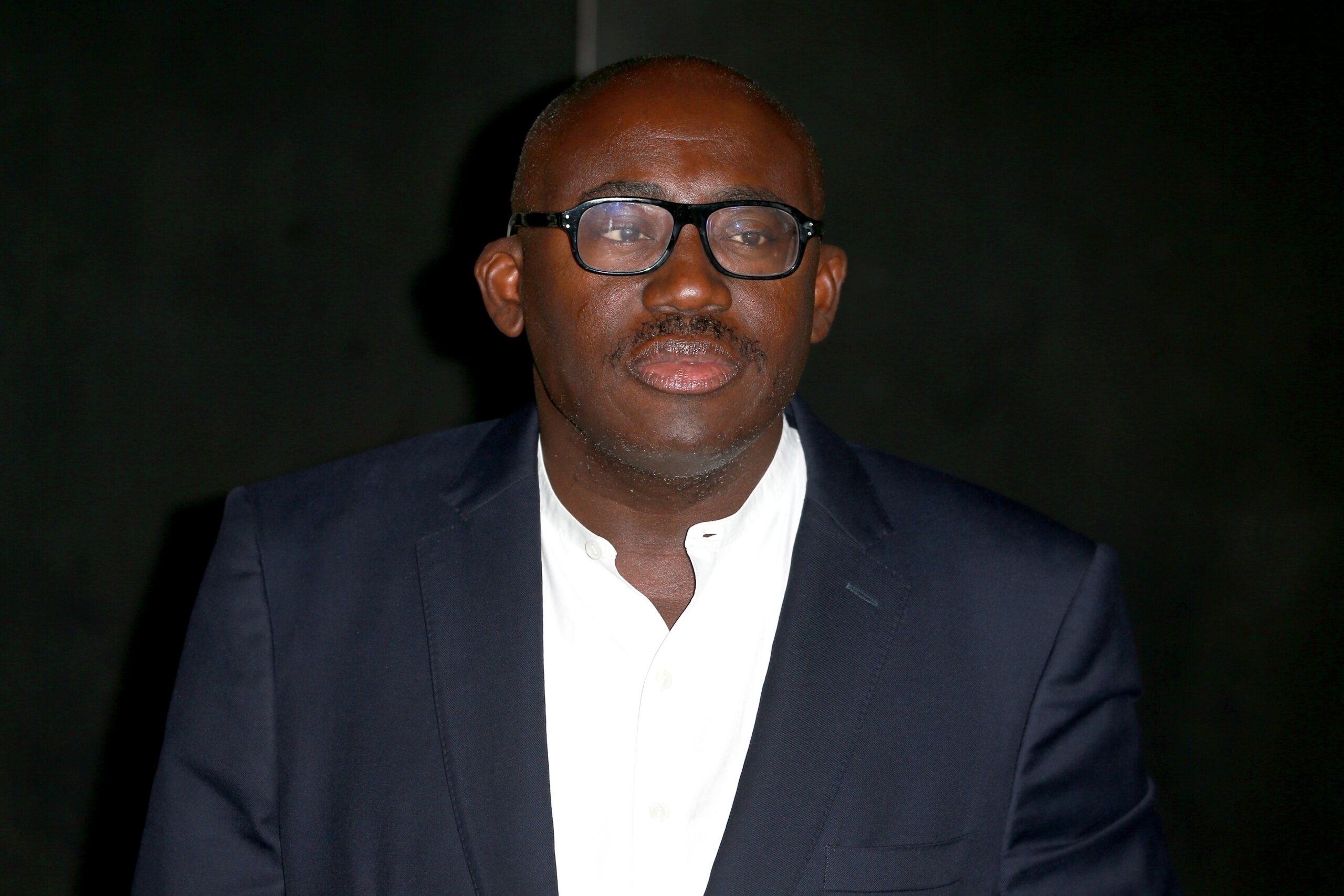
A magazine cover makes an argument before a reader turns a page. It decides whose face deserves attention and what beauty, influence or success might look like. During his time leading British Vogue, from 2017 to his final issue in March 2024, Edward Enninful used that authority to widen the range of people placed at the centre of fashion. His career also shows how the choices behind an image matter: who styles it, who commissions it and who has enough editorial power to keep making different choices.7, 14
An education in clothes, colour and people
Enninful’s first understanding of fashion came from his mother’s dressmaking business in Ghana. In an interview with Fresh Air, he recalled helping in her studio, sketching and assisting women into clothes. Her customers varied in age, complexion and body shape. Dressing them was ordinary professional practice, and he absorbed that breadth before encountering the narrower conventions of the international fashion industry. His account locates an important source of his visual imagination in African women’s expertise. Fashion was a skilled activity, carried out around people with individual needs, personalities and expectations about how they wanted to appear.1
His family moved to London in 1985, when he was 13. His father had served in Ghana’s military, and Enninful has described the family’s departure and their much reduced circumstances in Britain. School brought unfamiliar expectations and racist abuse. At 16, a journey on the Underground changed his prospects when stylist Simon Foxton approached him about modelling. Enninful’s interest soon extended beyond being photographed. As he modelled, studied and assisted, he began to discover the work through which a photograph was made: the selection, preparation and relationships that shape what eventually appears effortless on a page.2
Learning to construct an image
At i-D, Enninful moved from modelling to assisting fashion editor Beth Summers and then, at 18, into the fashion editor’s role himself. Founder Terry Jones later recalled consulting Foxton about the appointment and receiving an emphatic recommendation. Jones’s account of the office emphasised the people and ideas drawn towards Enninful’s desk. That environment helps explain the character of his early career. Styling developed through exchange with photographers, designers and make-up artists; the magazine was a place where a young creative community could encounter itself. Authority came with responsibility for the work, even before he possessed the status that would later surround his name.3
Different publications taught him different aspects of the profession. Enninful has described i-D as his education in street fashion and Vogue Italia, under Franca Sozzani, as a school for extended visual storytelling. At American Vogue, he learned to concentrate a reader’s attention on an individual garment and to consider fashion’s commercial purpose. These were compatible skills: making an imaginative world around clothes, while understanding how a reader might connect with them. The distinction helps explain why his later editorial work could combine ambitious statements about culture with the detailed presentation of fashion that a luxury magazine requires.4
One significant collaboration was Vogue Italia’s Black Issue in July 2008. The magazine’s archive identifies Naomi Campbell, Liya Kebede, Sessilee Lopez and Jourdan Dunn as its four cover subjects, photographed by Steven Meisel. It credits Enninful and Lori Goldstein as fashion editors. The issue placed Black models across an extensive editorial project, making their presence the basis of its visual world. Its significance lay partly in that scale: readers encountered a range of women, rather than being asked to treat one model as representative of everyone. The credits also make clear that such an undertaking was collective creative work.5
In 2011 he joined W as fashion and style director, adding another major publication to a career already spanning London, Milan and New York. The move to British Vogue in 2017 therefore followed decades of professional experience. He became its first Black editor-in-chief, bringing the knowledge of a working stylist into a position that involved choosing collaborators, shaping coverage and directing the identity of the whole magazine.6
A new picture of British Vogue
His first issue, dated December 2017, put Adwoa Aboah on the cover in a photograph by Meisel, styled by Enninful himself. The choice connected his new leadership to the craft through which he had made his reputation. It also established Aboah as the face through which readers first encountered his Vogue. An editor can set out intentions in interviews, but the opening issue has to embody them through actual decisions: a model, a photographer, clothes, an expression, and the relation between the cover and the publication behind it.8
Enninful’s inaugural editor’s letter treated fashion as an ongoing conversation with art, politics and society. He also described a magazine whose presence would extend into films, interviews and digital platforms. This understanding gave editorial permission to address subjects that might once have seemed peripheral to a fashion title. The magazine’s audience was made up of people living through political and social change; their interest in clothes did not cancel those other concerns. For Enninful, fashion could sit within that wider life while retaining its pleasure, sophistication and visual intensity.7
Expanding the meaning of a cover star
The July 2020 issue offered a particularly clear example. Its covers featured London Overground train driver Narguis Horsford, community midwife Rachel Millar and supermarket worker Anisa Omar. Photographer Jamie Hawkesworth travelled around London to make portraits of people working through the pandemic. The magazine applied the attention associated with a cover photograph to labour on which everyday life depended. Naming the women and their occupations mattered. They were recognisable individuals, with work and experiences of their own, within an issue that acknowledged a much larger population of essential workers.9
The May 2023 issue developed another strand of that enquiry through a portfolio of 19 disabled people. Enninful worked with Sinéad Burke, whose accessibility consultancy Tilting the Lens helped guide the project. Covers featured Burke, models Ellie Goldstein and Aaron Rose Philip, actor Selma Blair and American Sign Language performer Justina Miles. In his editor’s letter, Enninful connected the subject with his own experience of a chronic blood disorder and difficulties with sight and hearing. The editorial focus recognised disabled people as participants in fashion, sport, performance and public life, with style and professional identities to be represented on their own terms.10
Burke’s account of making the issue described the changes needed behind the photographs: quiet rooms, adjustable make-up seating and moveable clothing rails, alongside attention to access through the studio. Audio and braille versions extended the project to readers. These details are central to understanding the work. Representation concerns what an audience sees, but participation also depends on whether someone can use a space, communicate comfortably and take part in its working day. A photograph can announce an ambition; the conditions under which it is produced reveal how seriously that ambition has been taken.11, 12
Making his own experience visible
Enninful’s memoir, A Visible Man, published in September 2022, placed his own life within the story. Its subjects included family, migration, sexuality, illness and addiction, alongside his professional development. For someone whose work often involved deciding how other people would be seen, autobiography introduced a different kind of exposure. The book’s scope also resisted the assumption that access to famous people and prestigious appointments made a life straightforward. Success, vulnerability and the negotiation of identity could occupy the same account. The title carries that relationship between being publicly recognisable and being more fully understood.13
From editing an institution to building a company
Enninful’s final British Vogue issue, dated March 2024, assembled 40 women for a cover photographed by Meisel. In his farewell letter, he described the editor’s responsibility towards an institution with a long history and the need to change it. The scale of the photograph made the ending unmistakably his: a large collaborative production, built around people and the force of their combined presence. It closed his period as editor-in-chief, a useful distinction when considering a career that has continued into other forms of creative leadership.14
In 2025, Enninful and his sister Akua founded EE72, a media and entertainment company with a quarterly print magazine, 72, and a digital platform. His role as co-founder and chief creative officer places him within the structure of the organisation as well as its output. That changes the kind of responsibility attached to his editorial judgement. The question extends from what should appear in an established magazine to how a new publication and company should work, which creative relationships they should support and how their different activities can sustain one another.15, 16
His curatorial work provided a further development in October 2026, with The 90s: Art and Fashion at Tate Britain. The exhibition brought together photography, art and clothes, including work by Steve McQueen, Sarah Lucas, Yinka Shonibare, Corinne Day and Juergen Teller, alongside designers such as Vivienne Westwood and Alexander McQueen. Enninful’s accompanying reflections returned to the exchanges between creative disciplines that had shaped his youth. Those relationships now became material for a public museum: a period he had helped make could be examined as cultural history, with fashion included in the account of how Britain had changed.17, 18, 19
At every stage, the work has required other people: a photographer making an image, an editor accepting a proposal, a colleague identifying a barrier on set. Enninful’s career makes those relationships visible. Its achievement can be examined through the decisions they made possible and the people able to participate as a result. Editorial power becomes consequential when it changes the ordinary working assumptions behind the next picture, as well as the exceptional picture everyone remembers.3, 11
Sources and further reading
1. ‘British Vogue’ editor-in-chief wants his magazine to reflect the world he sees — Fresh Air / WHYY.
2. What’s It Like To Style A More Inclusive Fashion World? with Edward Enninful, OBE — Getting Curious / Earwolf.
3. Terry Jones, Naomi Campbell, Alexander McQueen and more on Edward Enninful — i-D.
4. Edward Enninful On How His Career Has Shaped New Vogue — British Vogue.
5. Fab Four: Vogue Italia’s July 2008 Black Issue — Vogue Italia.
6. Edward Enninful OBE to be honoured with the Trailblazer Award — British Fashion Council.
7. Edward Enninful Introduces The December 2017 Issue — British Vogue.
8. December Vogue 2017: Everything You Need To Know — British Vogue.
9. 3 Key Workers Cover The July Issue Of British Vogue — British Vogue.
10. A New Vanguard Of Disabled Talent Covers British Vogue’s May 2023 Issue — British Vogue.
11. Sinéad Burke Introduces British Vogue’s May 2023 Cover Stars — British Vogue.
12. Audio and Braille Editions of British Vogue’s May 2023 Issue — British Vogue.
13. A Visible Man — Bloomsbury Publishing.
14. 40 Iconic Women Cover The March 2024 Issue Of British Vogue, Edward Enninful’s Last As Editor-In-Chief — British Vogue.
15. About EE72 — EE72.
16. 72 Magazine, Issue 2, Winter 2025 — EE72.
17. The 90s: Art and Fashion — Tate Britain.
18. Edward Enninful on the enduring impact of the 90s — EE72.
19. Edward Enninful explores creativity and culture in Tate Britain’s The 90s — EE72.