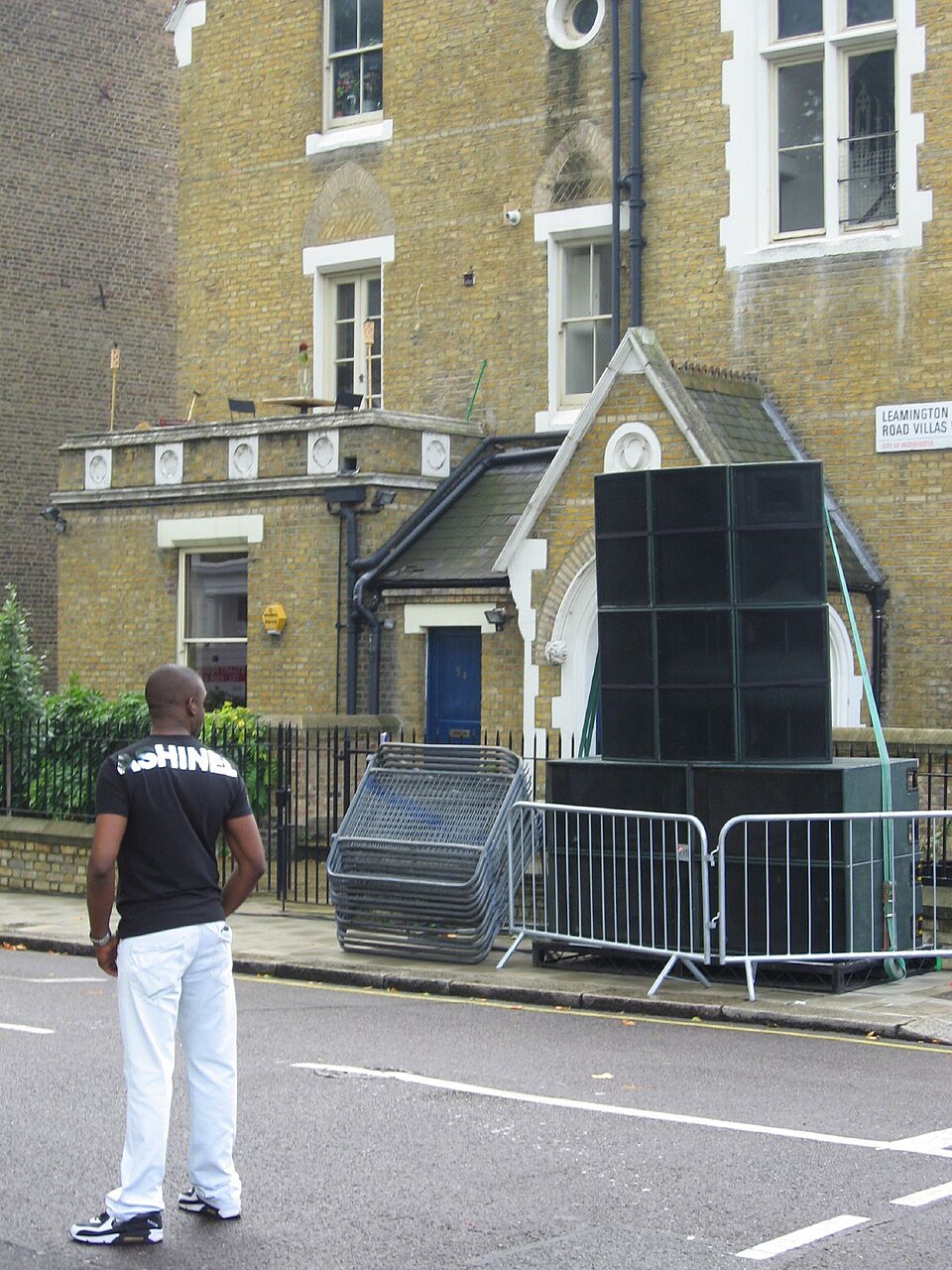
A sound system is both a set of equipment and the people who make a musical occasion with it. Handmade speaker arrangements, records and the judgement of the operator developed into a mobile form of entertainment in Jamaica, then travelled with Caribbean migration. London Museum dates Duke Vin’s pioneering British operation to 1955. House parties, clubs and, later, carnival streets became places where audiences could hear music that had little presence on British radio. 1
A place to gather and listen
For Caribbean communities facing exclusion from commercial clubs, an independently organised dance offered somewhere to meet on different terms. By the 1970s, roots reggae and Rastafari also gave many younger listeners a language for interpreting their experiences. In researcher Becca Leathlean’s interviews, Man fi Bill described the formation of Moa Anbessa International in 1977 after its members had worked with Lord David Hi-Fi. They painted their speakers in Ethiopian colours and selected music concerned with Black history and liberation. Dancer Lady Issachar recalled relief from hostility at school and work when she attended reggae sessions. These recollections locate the music within ordinary lives. A dance could offer pleasure, discussion and spiritual identification without every person in the room understanding it in exactly the same way. 2
Building a distinctive sound
Creating that experience required technical work, and expertise developed far beyond London. In their Huddersfield research, Mandeep Samra and Gopal Dutta investigated the reputation of Earth Rocker in the 1980s. Interviewees identified its three-way crossover, built by Pete Wood, as a crucial innovation. A crossover divides an audio signal into frequency ranges; this arrangement separated high, middle and low sounds so that a strong bassline could accompany a clearer vocal. The researchers also traced links with amplifier maker Matamp and local people who understood valves and other equipment. Expensive components might be obtained second-hand. At the Venn Street club, Caribbean organisers rented premises owned by an Indian family. The sound depended on relationships among musicians, builders, shopkeepers and venue owners as well as on the boxes facing the audience. 3
The records themselves became increasingly open to manipulation. Dub producers used the recording studio creatively, emphasising drums and bass while adding echo and reverberation. Instrumental versions on reggae singles gave MCs room to speak rhythmically over a track, a practice known as toasting. London developed its own dub production during the 1970s. The relationship between studio and sound system allowed a recording to acquire different lives: as a manufactured record, an altered mix and the foundation of a live performance. 1
The microphone and the clash
Competition encouraged performers to distinguish themselves. Recalling Saxon Studio International in a 2016 interview, Tippa Irie described a combination of exclusive recordings, strong MCs and individual vocal styles. Peter King’s double-time delivery became one element of its fast-chat approach, with other performers developing their own variations. Practice was collaborative and competitive: people rehearsed together while trying to produce something recognisably theirs. Tippa’s sister Miss Irie rehearsed with him and performed combinations at dances. Clashes with other systems tested music and microphone technique before an audience. Cassette recordings extended that audience beyond the venue. Tippa remembered hearing Jamaican performers use phrases from Saxon tapes circulating there in the early 1980s. British-based crews were contributing ideas to an international exchange. 4
The dance floor helped determine the character of a session. Artist Denzil Forrester’s recollections of Jah Shaka describe a performer on the same level as the audience, dancing and working among the people around him. Forrester repeatedly drew the crew near Shaka, learning their gestures through years of attendance. He also remembered how a venue could change within one night: gentler music upstairs or earlier in the evening gave way to heavier dub and a different physical energy. His drawings, later developed into paintings, preserved the movement and feeling he experienced there. This testimony makes the audience visible as participants. The meaning of the session arose through bodies responding to sound, the activities surrounding the operator and the changing pace of the night. 5
Different records, different listeners
Sound-system audiences helped shape the music being made in Britain. Lovers’ rock, which developed during the 1970s, brought romantic lyrics and soulful melodies into reggae. Young Black women participated as singers, buyers and dancers. In an interview about his lovers’ rock exhibition, curator Colin Brown emphasised the importance of teenage consumers, whose purchases helped make space for the music within sound-system programmes. Louisa Mark’s 1975 recording of Caught You in a Lie belonged to that early development; Janet Kay’s Silly Games later reached television audiences in 1979. Brown assembled records, magazines and images to recover this economy of production and listening. Romantic music and roots music could occupy the same social spaces, with selection responding to the people who attended them. 6
Regional histories reveal further changes in taste and opportunity. Interviewed by the Bristol Cable, Apollo recalled beginning with an amplifier bought by his father and speaker boxes made by an uncle. Family parties developed into wider community gatherings around the Jah Lokko crew. Younger operator Kai Dub described a different route: accompanying his parents to dances, then learning through involvement with Bristol’s Maasai Warrior before helping establish Concrete Lion. He also identified tensions around the increasingly electronic, driving rhythms of steppas and their appeal to different generations. His account resists a simple story of uninterrupted growth. New audiences might arrive while older listeners felt less at home, and younger Black people could prefer other genres. Keeping a sound active required choices about music, collaborators and listeners. 7
Who controls the equipment?
Women’s participation extended well beyond singing or buying records. June Reid, known as Junie Rankin, and Lynda Rosenior-Patten, DJ Ade, worked together as Nzinga Soundz. Their practice also joined performance with research and organising. In tributes after Reid’s death in September 2025, colleagues at Goldsmiths recalled her role in Sound System Outernational, including planning gatherings, choosing participants and chairing discussion. She investigated the experiences of Black women DJs and helped place those experiences within written scholarship. Reid and Rosenior-Patten’s recorded conversation also appeared in the 2021 Turner Prize exhibition through Black Obsidian Sound System. Such work changed who was treated as an authority on the culture. Operators could interpret their own history as well as supply music for somebody else’s account of it. 8
Black Obsidian Sound System, established in 2018, developed another model of collective ownership. The Black-led London group brought together queer, trans and non-binary Black people and people of colour working in sound, art and activism. Its work included workshops, performances and access to equipment at reduced rates or without charge. The 2019 film Collective Hum incorporated interviews, meetings and events into an account of collective practice. A 2021 collaboration with Coventry’s Hillz FM left the community station with the livestreaming equipment bought for the event. When the group received a Paul Hamlyn Foundation award in 2023, members described the relief of being able to develop projects without constantly covering basic costs. Shared infrastructure was part of the creative work. 9
Technology and the places to use it
The equipment has continued to change. Designer Tom Hagan’s research into Paraflex speaker enclosures examined systems moving towards the power and accuracy associated with professional public-address equipment. His conversations with builder Calum Young considered manufacturing, versatility and the costs of materials. Greater standardisation raised questions about the individual character of a sound. Hagan contrasted technical accuracy with qualities listeners might value in older equipment or records, including their imperfections. The debate concerns what a system is meant to do. An operator may seek maximum clarity, a particular warmth or a recognisable combination of frequencies. Engineering decisions therefore remain cultural decisions, influenced by budget, musical preference and the intended setting. 10
Even a carefully built system needs somewhere to play. At a Goldsmiths discussion in November 2022, Papa Face recalled a progression from classrooms and house parties to church halls, alongside difficulty gaining access to commercial clubs. Other participants raised the loss of venues and the limits of a culture whose practitioners might own equipment without owning a suitable meeting place. Researchers Julian Henriques and Brian D’Aquino subsequently argued that universities and cultural institutions could provide practical support by making space available. Their account records the gap between recognising a musical tradition and accommodating it. Storage, transport and access to a room suitable for amplified music form part of sound-system history, as much as the records and celebrated names associated with it. 11
Learning the records, preserving the experience
Knowledge also passes through smaller spaces. Lion Vibes record shop’s Selector Thursday, begun in 2019, offered an opportunity for people to play their own vinyl on shared equipment. Reporting in 2024, Becca Leathlean interviewed younger selectors who learned through family collections, conversations and listening beside more experienced participants. Vince Blais of Connected Youth described how selectors’ comments about producers, labels and alternative versions encouraged him to investigate further. Sugar recalled playing records on his grandfather’s system at family occasions before finding peers at the shop. The open decks brought these different forms of learning together. A newcomer could progress from buying records to presenting them, learning when and how to play them through attention to others. 12
Archives have begun preserving more of that surrounding activity. For its Dub London project, London Museum worked with paid community consultants and recorded oral histories with shopkeepers, musicians, Rastafari participants, broadcasters and listeners. It recorded a Channel One set at Notting Hill Carnival, commissioned photographs and filmed Mad Professor demonstrating mixing at Ariwa Sounds. The resulting 2020–21 display addressed gaps in the museum’s collections through personal testimony and the material of music-making. These methods preserved several kinds of evidence together: what equipment looked like, how it sounded, how it was operated and what participants remembered. They also retained the connections among workshops, shops, studios and gathering places that can disappear when a sound system is represented only by a speaker stack or a famous recording. 13
Sources and further reading
1. Dub in London: Shops, sound systems & legends. London Museum.
2. Musical Youth Pt. 2: A Struggles Music. Sonic Street Technologies, Goldsmiths.
3. Huddersfield: The Making of the SST Case Study. Sonic Street Technologies, Goldsmiths.
4. Interview with Tippa Irie, Part 2. Reggaeville.
5. Sketching and Skanking. Sonic Street Technologies, Goldsmiths.
6. Elevating the Culture of Lover’s Rock. Sonic Street Technologies, Goldsmiths.
7. Blazing the fire: Sound system culture through the generations. The Bristol Cable.
8. Remembering June Reid. Sonic Street Technologies, Goldsmiths.
9. Black Obsidian Sound System (B.O.S.S.). Paul Hamlyn Foundation.
10. Sonic Standardisation. Sonic Street Technologies, Goldsmiths.
11. The struggle for spaces to play. Sonic Street Technologies, Goldsmiths.
12. Musical Youth Pt. 3: Young Selectors at Lion Vibes. Sonic Street Technologies, Goldsmiths.
13. Dub London. London Museum.
Featured image. A sound system at Notting Hill Carnival, London, photographed on 23 August 2008. Photograph: Jay Bergesen, 23 August 2008, Flickr, via Wikimedia Commons. Image record · CC BY 2.0
