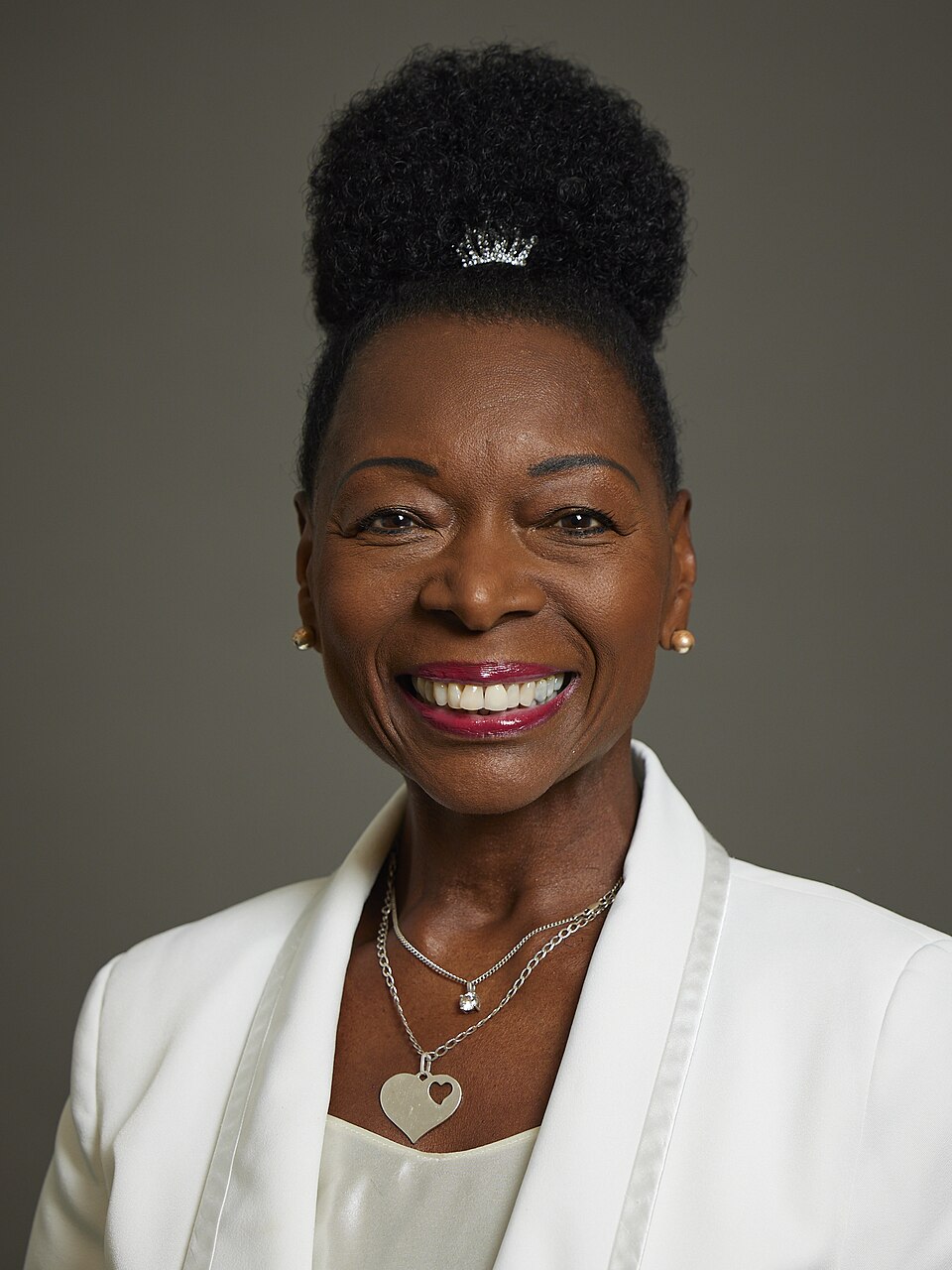
When Floella Benjamin made her first speech in the House of Lords in October 2010, she spoke about children and the organisations supporting them. Television had made her familiar to generations of viewers, but her parliamentary argument concerned public responsibility: children’s wellbeing needed to be considered across the decisions that shaped their lives. 4
From Trinidad to British television
Benjamin was born in Trinidad in 1949 and came to England in 1960, aged ten. She left school at sixteen, initially hoping for a career in banking, before entering the performing arts. Her career developed across theatre, television, writing and production. Programmes including Play School and Play Away made her a familiar presence in children’s broadcasting. 1
She also used books to address younger audiences. Coming to England described her childhood journey, and its twentieth-anniversary edition appeared in 2016. The book became part of teaching about Caribbean migration to Britain, giving children an account centred on the experiences of another child. Storytelling remained an important part of her public work as her responsibilities expanded. 1
Giving children a place in policy
In a 2023 interview with the Lord Speaker, Benjamin traced her campaign for a minister for children to her work on Play School. She recalled beginning it in 1983, arguing that policies made across government affected children even when children were not their stated subject. She wanted someone at Cabinet level to ask what those decisions would mean for young people. 2
She also recalled challenging the lack of Black and Asian children in illustrations used on the programme. In her account, producers had failed to notice the omission. Her intervention concerned the routine choices through which television presented society to its audience: who appeared in stories and which children could recognise themselves in them. 2
Charities and parliamentary work
Her maiden speech drew on work with the NSPCC, the medical research charity Sparks and Barnardo’s. She described these organisations as providers of services and as sources of knowledge that government could use. She had also run ten consecutive London Marathons to raise money for Barnardo’s. Fundraising, work with charities and arguments about public policy were already connected before she became a legislator. 4
Benjamin joined the Lords as a Liberal Democrat life peer in June 2010. Her committee service later included the Communications and Digital Committee from 2015 to 2019 and the COVID-19 Committee from 2020 to 2022. By October 2026, she remained a Liberal Democrat member of the House, with a parliamentary career extending well beyond her initial appointment. 3
Education and public ceremony
Another part of her public life developed at the University of Exeter, where she became Chancellor in 2006. This was the university’s ceremonial headship, involving occasions such as graduations. In July 2009, the university recorded her participation in ten ceremonies involving more than 3,000 students. She also performed with a band at the graduation ball, bringing her experience as an entertainer into a different institutional setting. 7
Children and the online world
During the Online Safety Bill’s passage through the Lords in April 2023, Benjamin argued that protecting children required attention to different kinds of internet services. She supported amendments intended to prevent gaps between rules for platforms where users shared content and other websites or applications. Her argument was that parents expected protection wherever children encountered harmful material. 5
She also supported age verification for pornography and age assurance for other forms of harmful content. Other peers raised concerns about privacy, anonymity and adults’ access to information. These exchanges show the legislative work behind a broad commitment to child protection: debating which services should be covered, how safeguards would operate and how they would affect different users. 5
Commemorating the Windrush generation
Benjamin chaired the Windrush Commemoration Committee, commissioned in 2018 to develop a lasting tribute to the Windrush generation and their descendants. The process included public engagement on shortlisted artists in 2021. Basil Watson was chosen to create the National Windrush Monument, which was unveiled at London’s Waterloo station on 22 June 2022. 6
Watson’s sculpture depicts a man, woman and child with suitcases. The committee worked with government and public-art specialists to bring the project to completion. Benjamin described the monument as a place for Caribbean communities and the wider public, especially children, to encounter a shared history. Here, her work with younger audiences met the practical tasks of commissioning, consultation and making space for history in a major railway station. 6
Sources and further reading
1. Baroness Floella Benjamin. UK Government.
2. Lord Speaker’s Corner: Baroness Benjamin. UK Parliament.
3. Baroness Benjamin: Parliamentary Career. UK Parliament.
4. Charitable Sector, 5 October 2010. House of Lords Hansard.
5. Online Safety Bill, 25 April 2023. House of Lords Hansard.
6. National Windrush Monument Unveiled at London Waterloo Station. UK Government.
7. Exeter’s Chancellor and Chanteuse. University of Exeter.
Featured image. Floella Benjamin, Baroness Benjamin, in her official parliamentary portrait from June 2023. © House of Lords / photography by Roger Harris, 27 June 2023, via Wikimedia Commons; source-provided crop. Image record · CC BY 3.0
