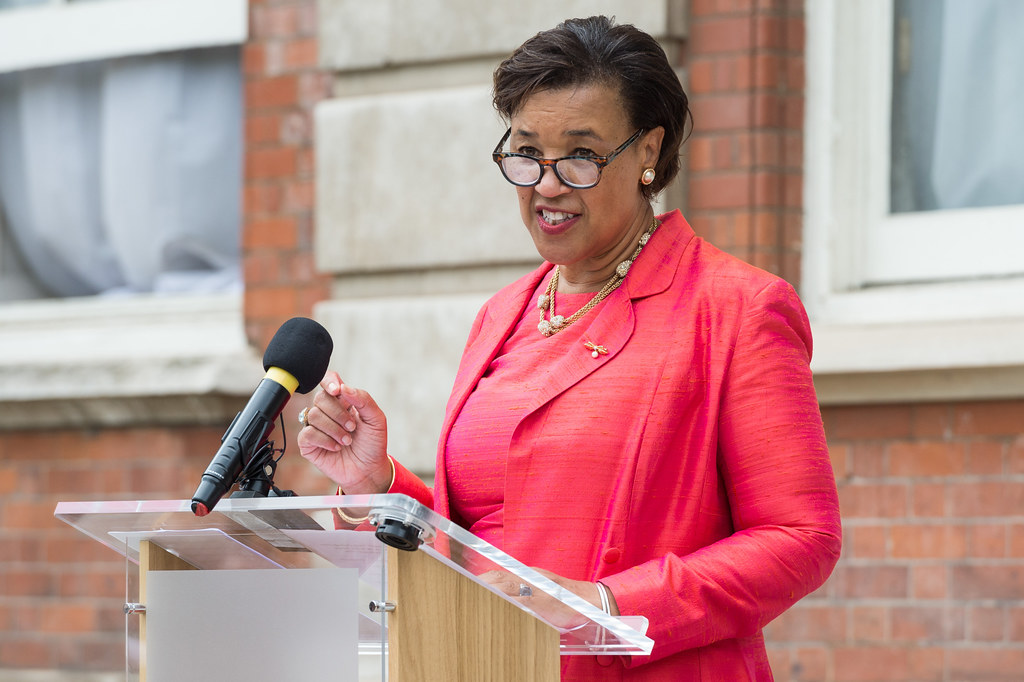
Patricia Scotland’s public career connected family law, criminal justice and international diplomacy. She became the first Black woman appointed Queen’s Counsel and the first woman to serve as Attorney General for England and Wales. Later, Commonwealth governments chose her to lead their Secretariat, taking her work from British legal institutions into a wider association of countries. 3
An external student enters the Bar
Born in Dominica, Scotland moved to Britain with her family when she was two. She attended Walthamstow School for Girls and studied at Mid Essex Technical College in Chelmsford, taking a University of London law degree as an external student. Middle Temple called her to the Bar on 28 July 1977. Family law became her specialism, and she was subsequently called to the Bars of Dominica and Antigua and Barbuda. In 1991 she became a Queen’s Counsel, joining the senior ranks of the profession. She later founded chambers at 1 Gray’s Inn Square and became a Middle Temple bencher in 1997. 1
Ministerial work in the Lords
Scotland entered the House of Lords as a Labour peer on 30 October 1997. Her responsibilities included service as Parliamentary Secretary in the Lord Chancellor’s Department from June 2001 to June 2003. She then moved to the Home Office, working on criminal justice and offender management before briefly holding the crime-reduction brief. On 28 June 2007 she became Attorney General, an appointment that lasted until 6 May 2010. Her ministerial career therefore developed in the upper chamber, where she presented government measures and answered for responsibilities spanning courts, criminal justice and legal administration. 2
Protection from domestic violence
On 15 December 2003, Scotland moved the second reading of the Domestic Violence, Crime and Victims Bill. It proposed making breach of a non-molestation order a criminal offence, extending protection to more relationships and establishing reviews after domestic homicides. Those reviews were intended to identify failures across services that might already have encountered a victim. The bill also proposed a code describing the support and information victims should receive. Scotland acknowledged the work of charities, victims and the Law Commission. Baroness Anelay of St Johns supported the broad aims while questioning drafting and safeguards. Both speakers stressed that new powers required effective use, training and changes in attitudes towards abuse. 4
The Attorney General and prosecution decisions
As Attorney General, Scotland faced a continuing question about the office: how could a government’s legal adviser oversee prosecutors while protecting their independence? In a statement on 21 July 2009, she announced that ministers had decided to retain its combined responsibilities, including protection of the public interest. A new protocol with the principal prosecuting authorities set out their relationship with the Attorney General and arrangements for accountability. A strategic board brought those departments together, and had agreed that the Crown Prosecution Service and Revenue and Customs Prosecutions Office should merge. Scotland also reported a change in Cabinet attendance: the Attorney General would attend when matters affecting her responsibilities were discussed. 5
Representing the Commonwealth
Dominica nominated Scotland for Commonwealth Secretary-General, and leaders elected her at their 2015 meeting in Malta. She was the first woman to hold the position and the second Secretary-General from the Caribbean. The office combined public representation, protection of Commonwealth values and management of the Secretariat. It brought together diplomatic advocacy and responsibility for the organisation carrying out the Commonwealth’s practical programmes. 3
Climate finance became one focus of that advocacy. At an event before the 2024 Commonwealth Heads of Government Meeting, Scotland argued that disasters placed small and vulnerable countries under pressures compounded by debt and restrictions on affordable development finance. The gathering included representatives from Tonga, Tuvalu, the Maldives, Fiji and Mauritius. Scotland highlighted the Climate Finance Access Hub, which supported countries seeking funding and helped officials develop policy and expertise. The Secretariat reported that the programme had helped unlock more than US$366 million, against an initial investment of US$8.5 million. Canada announced additional support at the meeting. The discussion connected demands for international finance with the practical capacity of governments to obtain it. 6
A completed international tenure
Scotland’s period as Secretary-General ran from 2016 to 2025. Shirley Ayorkor Botchwey succeeded her on 1 April 2025, following selection by Commonwealth leaders at their 2024 meeting in Samoa. The handover closed Scotland’s tenure at the head of the Secretariat. 7
Sources and further reading
1. The Rt Hon the Baroness Scotland of Asthal KC. Middle Temple.
2. Parliamentary career for Baroness Scotland of Asthal. UK Parliament.
3. Former Secretary-General Patricia Scotland. Commonwealth Secretariat.
4. Domestic Violence, Crime and Victims Bill, 15 December 2003. House of Lords Hansard.
5. Attorney-General: Reform, 21 July 2009. House of Lords Hansard.
6. Commonwealth leaders and climate experts call for additional climate finance. Commonwealth Secretariat.
7. Secretary-General, Shirley Botchwey. Commonwealth Secretariat.
Featured image. Patricia Scotland speaking at the 16th Raúl Prebisch Lecture in Geneva on 10 September 2019. Photograph: Timothy Sullivan / UNCTAD, 10 September 2019, via Wikimedia Commons. Image record · CC BY-SA 2.0
