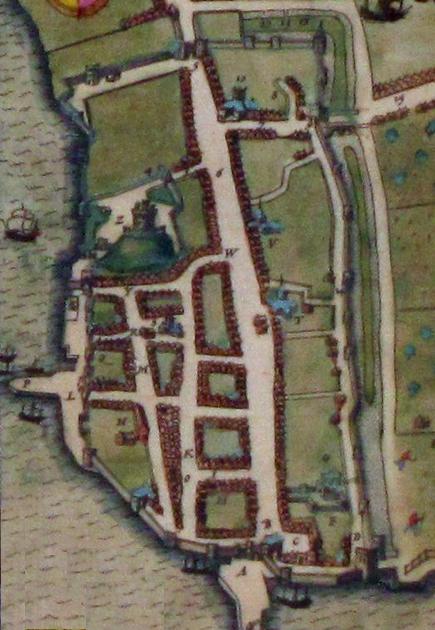
In February 1548, the knowledge Jacques Francis had acquired underwater became evidence in an English courtroom. The African salvage diver was working from Southampton when a dispute over a sunken merchant ship brought him before the High Court of Admiralty. He is the first Black person currently known to have given evidence in an English court.1
A diver working from Southampton
Francis can be traced in Southampton around 1546–1548, leading specialist recovery work along the south coast. His employer was the Venetian salvage operator Piero Paolo Corsi. Their work included both a royal warship and a merchant vessel, placing Francis in a maritime world where the Crown, overseas merchants and skilled workers all had interests in what could be brought back to the surface.1
The craft depended on much more than being able to swim. A salvage diver had to work underwater and help recover objects from a wreck. Royal Museums Greenwich suggests that Francis may have come from a West African community with experience of pearl diving, while stressing that this is uncertain. His training and early life remain obscure. The surviving evidence identifies an accomplished worker; it does not explain exactly where he acquired his abilities.5
Recovering the Mary Rose
The Mary Rose sank during the Battle of the Solent on 19 July 1545. Attempts to recover the ship began that summer, before Francis’s documented involvement. One scheme used two large vessels with cables passed beneath the wreck, hoping to lift it and move it into shallower water. The work failed. By the following stages of recovery, attention had turned towards guns and other valuable contents that might be saved even if the hull could not be raised. Corsi and his divers belonged to this continuing effort to recover material from the seabed. Payments continued in 1547 for the removal of anchors and weapons; Corsi received £50 for work to recover the ship’s guns.2
The scale of that material is apparent in the ship’s entry in the Anthony Roll, a naval inventory compiled in 1546. It lists large cannon, culverins and smaller guns, alongside shot, gunpowder, bows and other stores. The different kinds of artillery required different ammunition; a warship carried a whole system of weapons and supplies. These lists help explain the persistence of salvage efforts after the loss of the vessel. They describe equipment associated with the ship, rather than an inventory of objects personally recovered by Francis.4
Francis is the earliest diver named in the surviving evidence about the Mary Rose, appearing in connection with the work in 1546. Earlier recovery attempts make it impossible to call him the first person ever to dive on the wreck. That distinction leaves his contribution clear: he was a named specialist in an operation that continued after the initial attempt to save the ship had failed.3
Another wreck and a dispute over tin
The court case arose from the Sancta Maria and Sanctus Edwardus, a single merchant vessel with a double name, also rendered as St Mary and St Edward. It burned and sank near Southampton in late 1546. Corsi’s team was engaged to recover its cargo, but the work led to accusations of theft. The merchants alleged that Corsi had taken tin. Francis appeared as a witness supporting his employer; he was not the person being tried for stealing it.7
His evidence concerned goods that he had seen and handled underwater. He maintained that the recovered material would have been returned if Corsi had not been arrested. Timing also mattered: the evidence described May as a particularly suitable period for diving. The dispute therefore involved the practical conditions of recovery as well as ownership of the cargo. Francis could speak about work the merchants themselves had not performed beneath the water.6
Whose evidence would count?
Francis testified on 8 February 1548 with the assistance of an interpreter, John Tyrart. Some Italian witnesses tried to discredit him by calling him a slave and questioning his Christian status. Their objections sought to make his identity a reason to discount what he knew. These were hostile claims made within a commercial dispute, and should be read as such.7
The Latin record describes Francis as a famulus, a word used for a servant or attendant. The court took his evidence despite the objections. This establishes that his testimony was heard; it does not settle every question about his earlier circumstances or the position of all Africans in Tudor England. His later life has not been securely traced. In the surviving case, his underwater work and his capacity to explain it were both consequential.6
Sources and further reading
1. The Tudor diver: Jacques Francis — Southampton City Council, Southampton Stories.
2. Recovery attempts, 1545–1552 — The Mary Rose Trust.
3. The first men who dived on the Mary Rose — Simon Clabby, The Mary Rose Trust.
4. Anthony Roll, first roll: Mary Rose inventory, 1546 — Anthony Anthony; original naval inventory, transcription at Wikisource.
5. Black Tudors and the sea: teacher resource — Royal Museums Greenwich.
6. History Below the Waterline: Enslaved Salvage Divers Harvesting Seaports’ Hinter-Seas in the Early Modern Atlantic — Kevin Dawson, University of California, Merced; International Review of Social History 64 (2019), pp. 43–70.
7. Black Tudors: Three Untold Stories, lecture of 17 October 2019 — Dr Miranda Kaufmann, Gresham College.
Featured image. Southampton in a town plan by John Speed, published in the early seventeenth century. This later map shows the port where Jacques Francis worked in the 1540s. John Speed (1551/52–1629); map detail via Wikimedia Commons. Public domain. Image record · Public domain
